
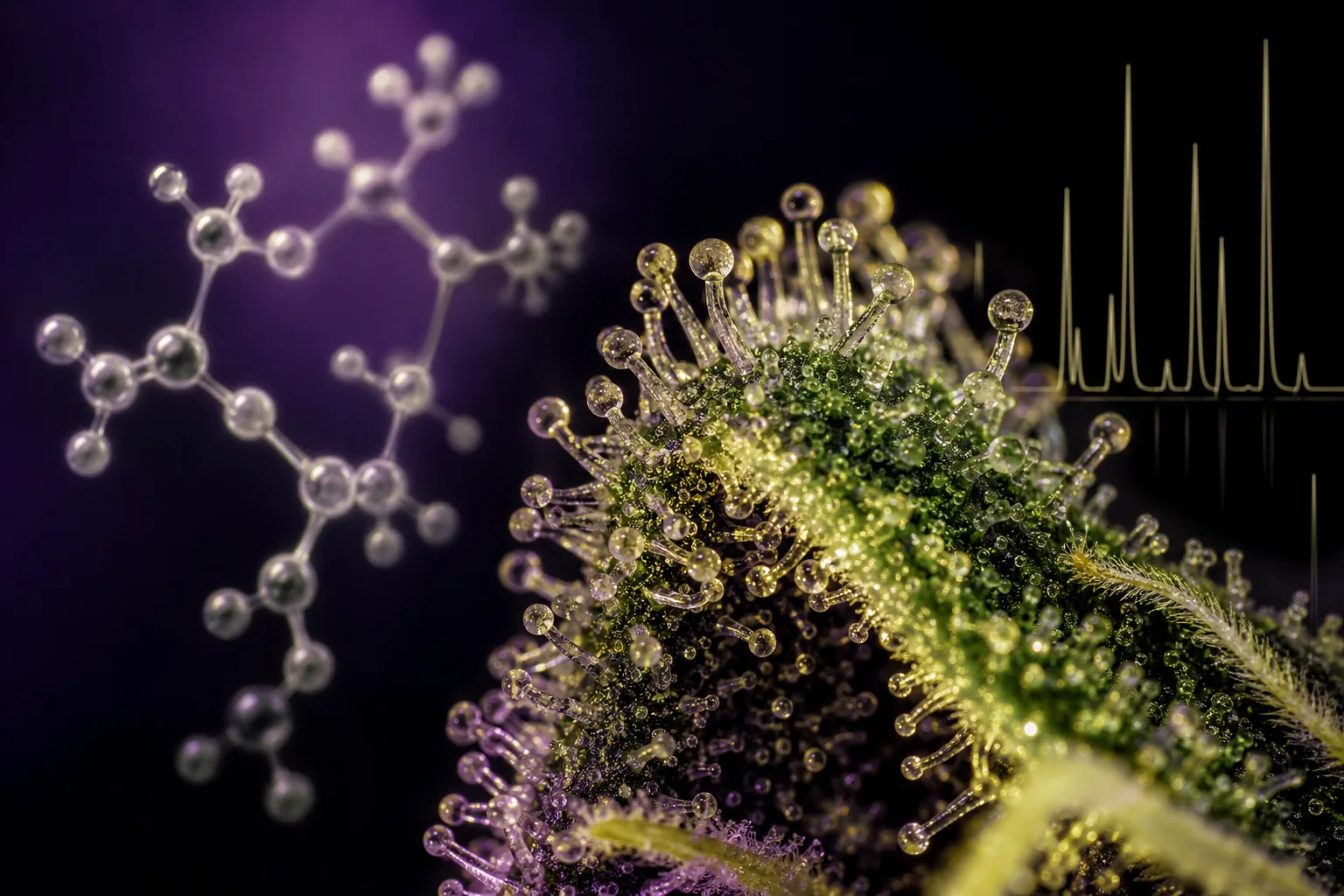
Glandular trichomes store the volatile terpenes—like β‑myrcene—that shape cannabis aroma; precise quantitation requires laboratory chromatography and standardized sampling.
Mainezilla original editorial visual · AI-assisted art directionWhat β‑myrcene is — chemistry and botanical occurrence
β‑Myrcene (commonly shortened to myrcene) is a small acyclic monoterpene (C10H16) produced by many plants. In cannabis it is one of the more abundant volatile molecules in many chemotypes and often sits among a dozen terpenes that together shape a cultivar’s aroma fingerprint. Chemically, myrcene is lipophilic and volatile at room temperature, so it concentrates in glandular trichome secretions and evaporates readily from cured flower.
Botanically, myrcene is not exclusive to cannabis: it is abundant in hops, lemongrass, bay, and several citrus chemotypes, which helps explain why smell-based descriptions ("musky," "herbal," "clove-like") are common across different plant materials. Because myrcene is so widespread, detecting it in a sample doesn't indicate a single botanical origin, nor does its presence by itself predict a particular physiological effect.
For readers who follow regulatory or toxicology literature, myrcene is the same chemical repeatedly examined across food, fragrance, and industrial contexts. That cross‑sector presence is one reason myrcene appears in both pharmacology reviews and regulatory monographs: plant science and public‑health arenas have studied the same molecule from different angles.
- Small, volatile monoterpene (C10H16) concentrated in glandular trichomes.
- Common in cannabis but also in hops, lemongrass, and many aromatic plants.
- Widely studied across pharmacology, toxicology, and analytical chemistry literatures.
Evidence trail: [2]
Aroma and sensory role: what smell tells you (and what it doesn’t)
In blends of cannabis volatiles, myrcene contributes to the low‑note, herbal or clove-like character many people associate with "indica" descriptors. Sensory perception of cannabis aroma is emergent: myrcene interacts with other terpenes and trace sulfur compounds to form the plant’s full olfactory signature, so its contribution is context dependent.
Because human smell perception is non‑linear and influenced by small co‑occurring volatiles, two samples with similar myrcene concentrations can smell and be perceived very differently. Likewise, a cultivar’s marketed aroma claim—"earthy," "mango," or "herbal"—is rarely a reliable proxy for myrcene content without lab confirmation.
A practical implication: aroma-driven shorthand used in retail or pop culture can be a useful orientation for growers and consumers, but it is not a robust indicator of chemistry or of likely effects. The evidence-based route to knowing what’s in a sample is analytical measurement, not smell alone.
- Myrcene shapes herbal/earthy notes but is only one player in aroma blends.
- Perceived aroma depends on terpene ratios and minor volatiles, not just myrcene.
- Smell-based claims are useful but insufficient for scientific classification of samples.
Measurement: how laboratories detect and quantify myrcene
Laboratories commonly quantify myrcene by gas chromatography coupled with mass spectrometry (GC–MS) or flame ionization detection (GC–FID) after solvent extraction or headspace sampling. Method detail matters: sampling approach (solid phase microextraction, solvent extraction, thermal desorption), calibration standards, and chromatographic conditions change sensitivity and the ability to resolve myrcene from neighboring peaks.
Institutions such as NIST have developed and evaluated protocols for volatile collection and lab workflows—including breath and filter‑based methods used in cannabis research—that show how sample collection and instrument settings alter results. In short: two labs analyzing the same product can report different absolute numbers unless methods are harmonized.
Beyond instrument choice, sample history matters: drying, curing, and storage volatilize and oxidize terpenes. Batch sampling, replicate measurements, and transparent reporting of limits of detection are the responsible practices that allow comparisons across studies and vendors.
- GC–MS and GC–FID are standard; headspace and thermal desorption approaches affect result comparability.
- Method harmonization and use of standards are essential for reliable terpene reporting.
- Post-harvest handling (drying, curing, storage) strongly alters measured terpene levels.
Evidence trail: [7]
Cultivar variation and the genetics of myrcene production
Myrcene concentration varies widely between cultivars and even between batches of the same cultivar. Modern metabolomic surveys and chemotyping efforts show that some cannabis chemotypes consistently have higher myrcene while others favor limonene, linalool, caryophyllene, or humulene. Those chemotypes are the product of both breeding choices and environmental conditions.
Genetic work links variation in terpene profiles to terpene synthase gene differences. Genome‑wide association studies (GWAS) and terpene synthase mapping have identified loci associated with myrcene and other terpenes, meaning breeders can select for myrcene‑rich lines — but the genetic effect is modulated by environment (soil, light, nutrient regimes) and plant development stage.
For practical readers: cultivar names and strain labels are imperfect; a genetics‑aware chemotype classification is more informative than retail naming. Laboratories that report full terpene profiles and batch numbers provide more actionable records than single-terpene claims.
- Variation arises from both heritable terpene synthase alleles and growing environment.
- GWAS links specific chromosomal regions with myrcene abundance.
- Batch-level testing and full-profile reports beat strain names for chemical information.
Preclinical picture: mechanisms that have experimental support
Preclinical work in rodents and cellular systems shows myrcene can modulate nociception (pain‑related endpoints), motor activity, and sleep‑related behaviors under certain conditions. These effects are dose‑ and route‑dependent and often studied using purified myrcene or essential oils where myrcene is a major component. Mechanistic hypotheses include modulation of GABAergic and serotonergic pathways, and interactions with cannabinoid signaling, particularly in some pain models.
The preclinical literature is heterogeneous: some studies report sedative‑like or motor‑relaxant effects at high experimental doses, while others find little evidence for benzodiazepine‑like anxiolysis. Sex, exposure method (inhalation vs. injection vs. oral), and co‑constituents strongly influence outcomes in these models.
Because animal models use much higher relative doses than typical human exposure from inhaling or smelling cannabis, translating those findings to human expectations is not straightforward. Preclinical data identify plausible biological interactions that warrant human testing, not definitive clinical claims.
- Rodent studies support analgesic and motor‑relaxant effects in some paradigms.
- Mechanistic candidates include GABAergic, serotonergic, and cannabinoid pathways.
- Animal doses and exposure routes limit direct extrapolation to typical human cannabis use.
Human evidence, exposure questions, and regulatory context
Evidence from controlled human trials isolating myrcene is scarce. Some human studies have measured monoterpene absorption after ingestion of myrcene‑containing products, and a few clinical trials have tested multi‑terpene formulations (myrcene included) alongside cannabinoids, but they do not isolate myrcene’s independent acute effects. As a result, most human claims that 'myrcene causes sedation' are extrapolations from animal data or from observational associations with particular cultivar profiles.
On exposure and safety: authoritative evaluations have examined myrcene across food, fragrance, and toxicology literatures. The U.S. National Toxicology Program conducted long‑term animal bioassays; the International Agency for Research on Cancer (IARC) has reviewed rodent tumor data and classified β‑myrcene as 'possibly carcinogenic to humans' (Group 2B) based on experimental animal studies. Other risk assessments have debated relevance of those animal mechanisms to humans. The U.S. Food and Drug Administration has removed certain synthetic myrcene uses from the list of authorized synthetic flavoring substances, reflecting regulatory application of precautionary statutes in additive law.
At the state level in Maine, the Office of Cannabis Policy (OCP) governs licensing, reporting, and public information. OCP materials and guidance documents provide the programmatic context for testing, labeling, and consumer information in Maine, but they do not treat plant volatiles as separately regulated molecular entities: regulatory activity focuses on establishment licensing, safety, and product standards rather than regulating myrcene itself. For consumers and professionals, the combined landscape of laboratory science, preclinical toxicology, and regulatory decisions argues for transparency in reports, careful reading of exposure levels, and an acknowledgement of uncertainty where human data are missing.
- Few or no controlled human trials isolate myrcene’s acute psychoactive effects.
- IARC reviewed animal tumor data and classified β‑myrcene as Group 2B; regulatory decisions have followed different precautionary logics.
- Maine’s Office of Cannabis Policy provides program-level guidance on testing and consumer information but does not regulate molecules separately.
Reading claims, records, and what remains uncertain
When you read a product label or a lab certificate, look for batch‑level terpene profiles, clear method descriptions (GC–MS vs. headspace), replicate measurements, and a mention of sample age or storage. Broad claims—"deeply sedating" or "mango indica—myrcene high"—are marketing signals unless supported by within‑lab replication or human data linking that batch to a controlled outcome.
Important open questions remain: what concentrations of inhaled myrcene (as part of smoke or vapor) are required to produce consistent sedative effects in humans? Does typical cannabis inhalation deliver myrcene at levels comparable to the doses that produced effects in rodents? How do co‑constituents and cannabinoids change the pharmacology of inhaled myrcene? Answering these requires controlled human pharmacokinetic and pharmacodynamic studies using standardized sampling and reporting.
In the meantime, treat anecdote and strain lore as hypothesis‑sparking, not conclusive. Growers and labs can help close knowledge gaps by sharing full terpene profiles, documenting sampling methods, and supporting carefully designed human laboratory studies rather than relying on single‑compound assertions.
- Prefer batch-level lab reports with method details over simple single-terpene claims.
- Key uncertainties involve human exposure levels, inhalation pharmacokinetics, and terpene–cannabinoid interactions.
- Harmonized lab methods and transparent reporting are practical steps that reduce uncertainty.
Questions this guide answers
Does myrcene make cannabis sedating?
Short answer: the evidence does not establish myrcene alone as a reliable sedating agent in humans. Animal studies show sedative-like and motor‑relaxant effects at experimental doses and in some exposure paradigms, but controlled human trials isolating myrcene are lacking. Some human studies test multi‑terpene formulations or measure myrcene absorption, but they do not prove that inhaled myrcene at levels found in typical cannabis use reliably causes sedation. See the preclinical and human evidence sections for details and context.
Can lab reports or labels be trusted to tell me how much myrcene is in a sample?
Lab reports are useful if they include method details (instrument type, sampling approach), batch identifiers, and replicate or uncertainty measures. Differences in extraction, headspace sampling, and chromatographic parameters produce variability across labs. Look for reports that list full terpene panels, method descriptions (e.g., GC–MS with internal standard), and sample collection dates; those are more informative than single-number labels.
Is myrcene a safety concern?
Regulatory and toxicology bodies have examined myrcene. Long‑term animal studies led to regulatory actions and an IARC classification as 'possibly carcinogenic to humans' (Group 2B) based on rodent tumor data; other assessments emphasize differences between rodent mechanisms and human risk at typical dietary or inhalation exposure levels. The FDA has removed certain synthetic myrcene uses from authorized synthetic flavoring substances. These findings underscore the value of exposure‑level context and the need for more human data rather than implying direct consumer-level hazard without context.
How can researchers and producers reduce ambiguity around myrcene claims?
Use harmonized and well‑documented analytical methods, provide batch‑level full‑profile terpene certificates, retain sample aliquots for retesting, and support controlled human pharmacokinetic/pharmacodynamic studies. Transparent reporting of growth conditions, harvest and curing dates, and storage is also helpful because terpenes change quickly post‑harvest.
Where can I find Maine program guidance about testing and labeling?
The Maine Office of Cannabis Policy (OCP) publishes guidance documents, FAQs, and resources on licensing, testing requirements, and consumer information. Those materials set program‑level expectations for reporting and public information but do not regulate individual plant molecules separately.
Educational information only. This guide is not medical or legal advice and does not recommend a product, dose, treatment, or outcome.