
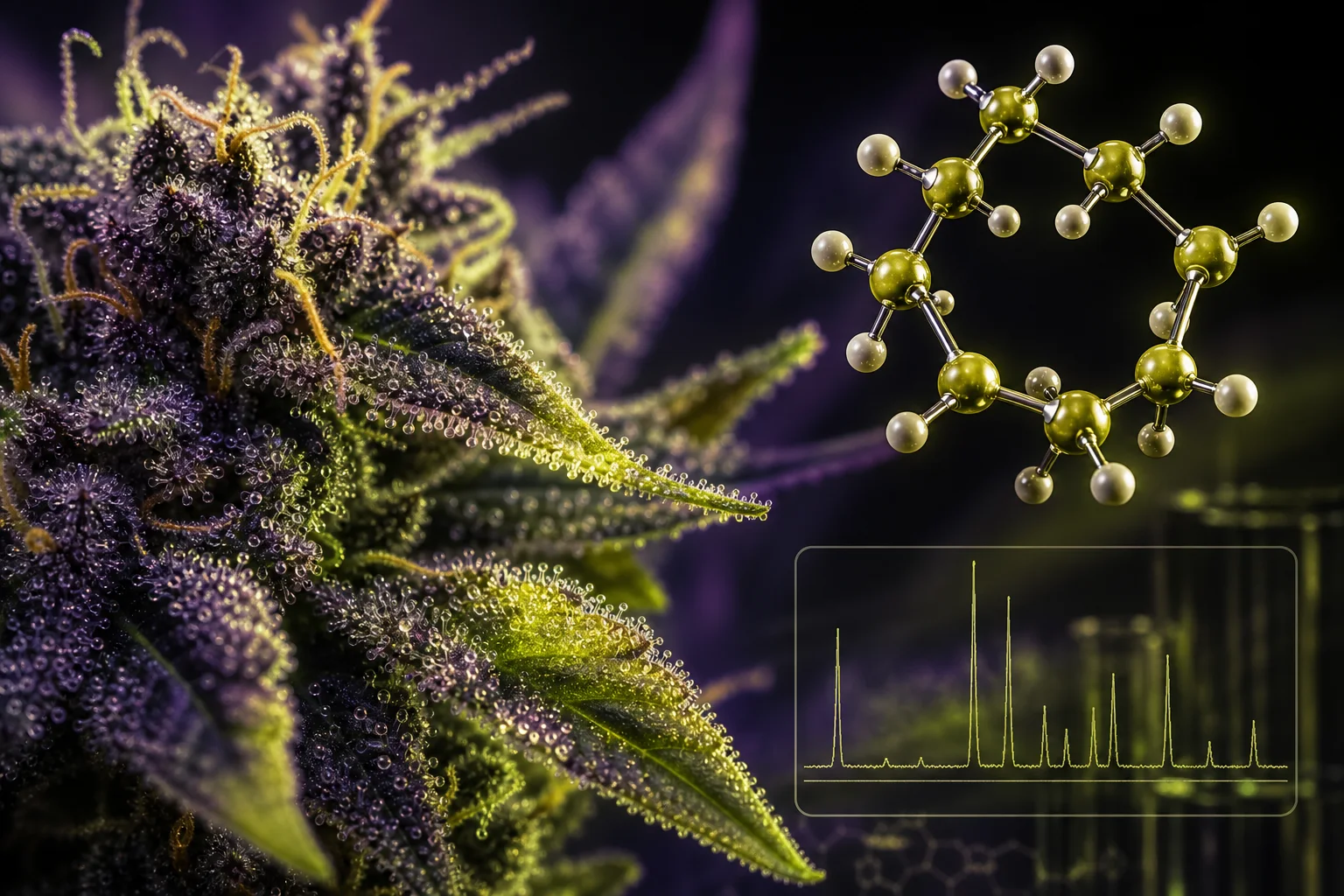
Resin glands and chemistry: β‑caryophyllene is visually abundant in plant aroma profiles and chemically identifiable by modern chromatographic methods.
Mainezilla original editorial visual · AI-assisted art directionSesquiterpene identity: what β‑caryophyllene is (and isn’t)
β‑Caryophyllene (often written β‑caryophyllene or BCP) is an abundant sesquiterpene — a 15‑carbon volatile organic compound produced by many plants. In chemical terms it is C15H24 and exists in the (E)‑configuration in most botanical sources commonly discussed in cannabis literature. As a sesquiterpene it is larger, less volatile, and more lipophilic than typical monoterpenes such as myrcene or limonene, which affects its behavior during extraction, analysis, and inhalation.
BCP’s presence in cannabis is one notable context, but it is not unique to the plant: it is a major aroma component in black pepper, cloves, rosemary, and many culinary herbs. Because it is a plant‑made volatile, its abundance in a given sample depends on genetics, growing conditions, harvest timing, and post‑harvest processing such as drying, curing, and storage.
Importantly, BCP is not a classical cannabinoid (it does not share cannabinoid chemical scaffolds with THC or CBD). It is a terpene: the plant’s volatile aroma chemistry. That distinction — terpene versus cannabinoid — matters for chemistry, measurement, and pharmacology.
- BCP is a sesquiterpene (C15H24), larger and less volatile than many monoterpenes.
- It is common across plants — so dietary exposure is routine and separate from cannabis exposure.
- Chemically distinct from cannabinoid scaffolds (THC, CBD); often discussed for receptor activity rather than cannabinoid structure.
Evidence trail: [4]
How labs measure β‑caryophyllene and why numbers vary
Analytical laboratories most commonly detect BCP with gas chromatography coupled to mass spectrometry (GC‑MS) or flame ionization detection (GC‑FID). The compound’s lower volatility relative to monoterpenes means sampling, column choice, and thermal desorption conditions materially influence the reported concentration. Reproducible measurement therefore requires validated methods and appropriate reference standards.
National metrology work and reference materials help with that reproducibility. NIST publishes thermochemical and spectral data for caryophyllene and runs interlaboratory efforts and reference materials for cannabis/hemp analytes. Those efforts are intended to reduce inter‑lab variance and to give regulators, researchers, and labs a common yardstick when terpene numbers are reported.
Because labs use different extraction procedures (headspace, solvent extraction, direct injection of concentrates) and because plant material changes with drying and storage, reported BCP levels can differ by orders of magnitude between cultivars and between batches of the same cultivar. That variability is a crucial context when someone points to a single mg/g figure and implies a predictable human exposure.
- GC‑MS/FID is the standard for volatile terpene quantitation, but method differences matter.
- Reference materials and interlaboratory studies (e.g., NIST programs) are central to harmonizing results.
- Sample processing (drying, grinding, solvent use) typically shifts terpene profiles more than small genetic differences.
Receptor pharmacology: why CB2 keeps showing up in the literature
A foundational, highly cited finding is that (E)‑β‑caryophyllene binds selectively to the cannabinoid receptor type 2 (CB2) and acts as a functional agonist at nanomolar–subnanomolar ranges in the assays reported. This observation established BCP as a plant metabolite that can directly engage a canonical receptor in the endocannabinoid system without having the THC scaffold that activates CB1.
CB2 is primarily expressed in peripheral immune cells and some glial populations; it is not the CB1 receptor responsible for the psychoactive effects of THC. Because BCP’s activity maps to CB2 in preclinical systems, the compound became of interest for inflammation and pain biology rather than for intoxication.
Those receptor‑binding data come from controlled in‑vitro binding and signaling assays. They demonstrate a biochemical interaction and receptor activation but do not by themselves prove a therapeutic benefit in humans; translating receptor engagement to clinical outcomes requires careful pharmacokinetics, dosing, and controlled human studies.
- BCP selectively binds and activates CB2 receptor in preclinical assays.
- CB2 is associated with immune and inflammatory signaling, distinct from CB1‑mediated psychoactivity.
- Receptor binding ≠ proven clinical efficacy; it’s a mechanistic starting point.
Evidence trail: [1]
Preclinical evidence: consistent mechanisms, varied models
Since the initial receptor discovery, numerous animal and cellular studies have investigated BCP in models of inflammation, neuropathic pain, and skin disorders. Broadly, those studies find anti‑inflammatory or analgesic‑like signals that are often CB2‑dependent (i.e., blocked by CB2 antagonists or absent in CB2 knockout models). These results form a coherent preclinical literature that supports mechanism‑based hypotheses.
A recent focused review on topical BCP summarizes the skin‑directed evidence: murine dermatitis and wound models often show reduced inflammatory markers and improved histology with BCP treatment, and mechanistic work implicates CB2 signaling and downstream modulation of cytokines and keratinocyte responses. Similar trends appear in inflammatory pain models where BCP reduces behavioral hypersensitivity.
Preclinical datasets are valuable for hypothesis generation and for clarifying mechanism. But they also carry systematic limitations: dosing regimens in rodents, the route of administration (systemic versus topical), metabolic differences between species, and the tendency for publication bias toward positive findings all mean that preclinical effects are necessary but insufficient evidence for human benefit.
- Animal and cellular studies repeatedly implicate CB2 as the mediator of BCP’s anti‑inflammatory actions.
- Topical models and systemic rodent models both show activity, but with different exposures and endpoints.
- Translational gaps (dose, metabolism, route) remain large — human trials are required to confirm applicability.
Human data: sparse, often confounded, and usually mixed formulations
Controlled clinical evidence testing isolated β‑caryophyllene in humans is limited. Where BCP appears in human studies, it is often part of multi‑compound preparations (for example, formulations that include cannabinoids like CBD/CBG and other actives), which complicates attribution of any observed effect to BCP alone.
One randomized, double‑blind pilot study tested a beverage powder containing CBD, CBG, BCP, branched‑chain amino acids, and magnesium for recovery from delayed‑onset muscle soreness. Because BCP was one component among several, the trial cannot isolate BCP’s contribution; it does, however, illustrate that BCP is being included in mixed formulations that advance to early human testing.
Separately, topical formulations with BCP have entered early human observational or small controlled studies in dermatology contexts, but systematic reviews note heterogeneity in formulations, variable quantitation of BCP content, and general scarcity of large, well‑powered trials. In short: human‑specific, BCP‑only efficacy claims are not yet supported by robust, replicated clinical trials.
- Most human studies include BCP as part of a multi‑ingredient product; BCP‑only randomized trials are rare or absent.
- Small pilot trials and topical studies exist but do not provide definitive, generalizable evidence.
- Clinical claims for isolated BCP should be weighed against the reality of limited, confounded human data.
Exposure routes: food, cannabis inhalation, ingestion, and topical use — separate the contexts
Dietary exposure to BCP is ordinary: people encounter meaningful amounts in common foods (black pepper, clove, some herbs). Those dietary exposures complicate any observational attribution of an effect to cannabis‑derived BCP unless a study controls for food intake or quantifies BCP systemically.
Cannabis‑derived exposure is typically via inhalation (smoking/vaping), ingestion (edible), or topical application. Inhalation delivers volatiles to the lung with rapid absorption, but the fraction of BCP that survives pyrolysis or vaping temperatures, and the bioavailable dose, depend on product type and device conditions. Edibles deliver a different pharmacokinetic profile because BCP is lipophilic and may be absorbed with dietary fats and metabolized during first pass.
Topical use concentrates exposure locally and can be appropriate when the desired target is the skin; preclinical skin models often use topical administration. The distinction among routes is pragmatically important: a terpene lab report showing high mg/g in a dried bud does not directly translate to the systemic mg dose a consumer actually receives by inhalation or eating.
- Dietary BCP exposure is common and must be considered separately from cannabis exposure.
- Inhalation, ingestion, and topical routes produce very different pharmacokinetic profiles and potential targets.
- Terpene concentration in plant material is not a direct proxy for human systemic exposure.
Practical guidance for reading terpene claims, lab reports, and product labels
Read terpene numbers as analytic results bound to the method and sample. A single lab report should be read with method notes in hand (GC column type, extraction/headspace method, calibration standards). Without method details or an accredited laboratory stamp, terpenes listed on a label are informative but not definitive.
Look for independent method validation or reference materials. Programs and reference materials from national laboratories (for example, NIST initiatives) are meant to improve confidence in terpene quantitation; products or labs that participate in recognized proficiency testing are more likely to yield reproducible results.
From a regulatory and consumer context in Maine, the Office of Cannabis Policy provides program guidance and resources for licensing, testing rules, and public information. Regulatory pages and guidance documents are useful for understanding what testing is required for sale and what limits or labeling rules apply in the jurisdiction — even though such rules do not change the underlying chemistry of BCP.
- Check methods: GC‑MS/FID and calibration standards should be stated.
- Prefer results from labs that use reference materials or participate in interlaboratory comparisons.
- Consult local regulatory guidance to understand testing requirements and reporting conventions.
What remains uncertain and where research should go next
Key translational gaps remain. The most important are: robust human pharmacokinetic data for BCP by route (inhaled, oral, topical); well‑powered randomized trials testing BCP alone against placebo with clearly quantified dosing; and standardized, widely available reference materials for terpene quantitation in complex matrices.
Another uncertainty is exposure comparators: how much BCP does a typical consumer actually absorb from a given cannabis product compared with a dietary meal that contains black pepper? Answering that requires paired analytical chemistry and human pharmacology studies that explicitly measure systemic levels after real‑world exposures.
Finally, research that clarifies the limits of CB2 engagement in humans — receptor occupancy studies, dose‑response biomarker work, and well‑controlled trials in target conditions — would move the field from plausible mechanism to testable, evidence‑based conclusions. Until then, mechanistic plausibility should not be read as a clinical endorsement.
- Needed: PK studies by route, BCP‑only randomized trials, and harmonized analytical standards.
- Needed: comparative exposure studies that quantify systemic BCP after dietary and cannabis exposures.
- Needed: receptor occupancy and biomarker studies to link CB2 activation to measurable human outcomes.
Questions this guide answers
Is β‑caryophyllene a cannabinoid?
No — chemically it is a sesquiterpene, not a cannabinoid scaffold like THC or CBD. Functionally, however, BCP can bind and activate the CB2 receptor in preclinical assays, which is why it is sometimes called a ‘dietary cannabinoid’ in mechanistic papers. That receptor activity does not make it a classical cannabinoid nor does it imply psychoactive effects.
Can β‑caryophyllene make someone high?
Current evidence does not indicate BCP causes the psychoactive ‘high’ associated with CB1 activation by THC. BCP’s primary receptor engagement, as shown in preclinical studies, is CB2 rather than CB1 — CB2 activation is not linked to intoxication in humans.
Does cannabis lab testing show BCP reliably?
Trusted labs using validated GC‑MS or GC‑FID methods can quantify BCP, but reported concentrations depend on sampling and method. Participation in reference‑material programs and transparency about methods improve reliability; NIST and national metrology programs exist to support that standardization.
Are there proven medical uses for β‑caryophyllene in people?
Not yet. Preclinical models suggest anti‑inflammatory and analgesic mechanisms mediated by CB2, but randomized, well‑controlled human trials of isolated BCP are lacking. Existing human studies often test BCP as part of multi‑ingredient formulations, which confounds attribution.
How should I read product claims that mention β‑caryophyllene?
Treat such claims with caution. Ask whether the claim refers to chemistry (e.g., lab‑measured mg/g), preclinical mechanism (CB2 binding), or demonstrated clinical effects. Prefer products and labs that provide method details, third‑party test results from accredited labs, and clarity about the exposure route relevant to the claim.
Educational information only. This guide is not medical or legal advice and does not recommend a product, dose, treatment, or outcome.