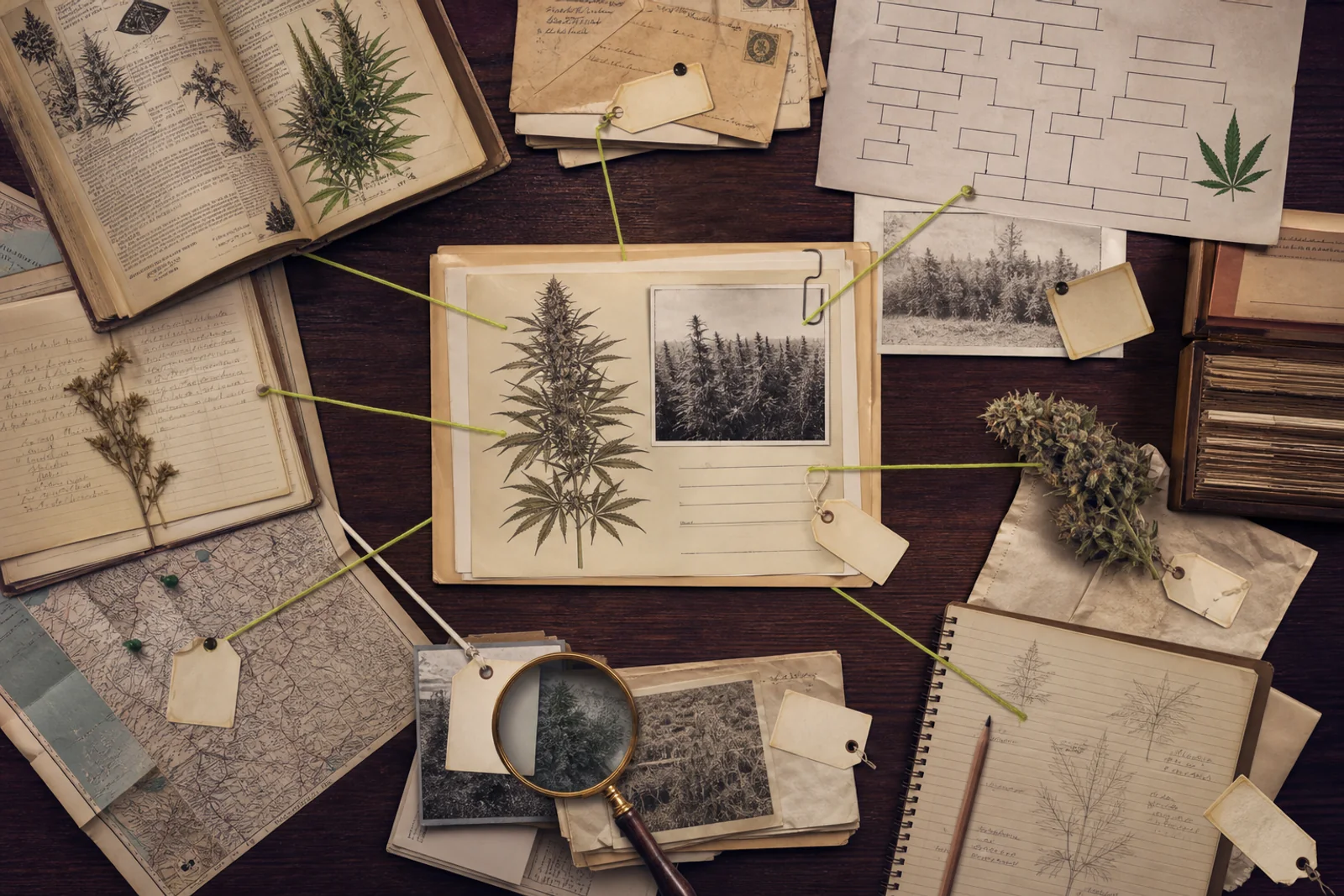
Historical records, provenance tags, maps, and lineage diagrams show strain history as careful archival work rather than copied folklore.
Mainezilla original editorial visual · AI-assisted art directionWhy bother tracing a strain’s history?
If you’ve ever held a jar of flower and wondered who actually bred the plant and why that matters, you’re not alone. A strain’s ‘history’ is a bundle of different things: the people who selected and stabilized traits, the markets that amplified certain names, and the chemistry produced by particular plants in particular places and times. For people who grow, breed, or recommend varieties, knowing the difference between origin story and contemporary chemistry helps avoid misattribution and keeps credit where it’s due.
This field guide treats the question like a piece of responsible craft work. We aim to help you identify early, attributable sources, document what kind of material (seed run, clone, stabilized cultivar, or phenotype) a source is describing, and preserve multiple accounts when they exist. It’s an evidence-first approach that leans on primary documents, contemporary reporting, and the scientific literature about how labels and chemistry map (or don’t) to genetics. See the Evidence section at the end for the sources that support the approach.
A practical reason to do this: labels travel faster than verification. Repeated catalog copy, social media claims, and market shorthand (like “Blue Dream from Breeder X”) can become accepted fact even when the original link is thin. That matters not just to historians and breeders, but to buyers and patients who expect consistent chemistry and to regulators who require accurate labeling. In Maine, the Office of Cannabis Policy (OCP) and statute set labeling and packaging standards that intersect with any strain-history work you do.
Work backward from the claim: find the earliest attributable source
When a catalog entry, dispensary menu, or forum post says “created by” a particular breeder, treat that as a claim, not a fact. The first step is to ask: where did that claim originate? Independent confirmation requires tracing to contemporaneous, primary evidence: breeder press releases, dated interviews, seed release paperwork, original seed-pack labels, or magazine/newspaper coverage published at the time of release.
Search strategy: start with the named breeder or seed company and filter for early, dated materials (press pages, archived news, and vendor seed releases). If the breeder is named, seek a dated announcement or a contemporaneous interview where the breeder explains parentage and selection process. If the earliest material is a retail catalog, note that catalog copy is often recycled across sites and years; it’s not independent confirmation. For projects in Maine, check whether the product had labeling that included cultivation or license information—OCP guidance and labeling rules are useful for modern products.
If you can’t find a dated breeder statement, preserve what you do find and mark its provenance: “first cited on Dispensary X menu, July 2016” is useful because it’s specific and falsifiable. Always record the kind of material the source is describing (e.g., “seed batch,” “named clone,” “single-plant selection”) and the date of publication or sale; that metadata is what makes later synthesis honest and traceable.
- Locate breeder press releases, seed-pack labels, or dated interviews.
- Record the material type (seed, clone, phenotype) and exact date of the claim.
- Treat repeated catalog copy as a secondary, not primary, source.
Use contemporary chemistry and genetics, but don't conflate them with origin
Modern genetic and chemotype studies give powerful tools for testing whether two samples are related, or whether a popular label reliably predicts chemistry. Work published in plant genetics and population studies shows that popular labels (like Sativa/Indica or many strain names) often do not map cleanly to genome-wide structure — instead, labeling sometimes tracks variation in a small set of terpene synthase loci or consistent chemotypes. That means chemical identity of a given harvest can be informative about that batch, but it’s not definitive proof of breeder origin.
When you cite genetic or chemotype evidence, be explicit about scale: are you comparing a single lab result from one batch, a multi-year vendor dataset, or a genotyping panel? Single-batch certificates of analysis tell you about that harvest, not about the ancestral seed lot. Larger-scale studies (multi-sample, multi-state collections) can show population patterns and help determine whether a label reliably corresponds to a chemotype across producers. Use those larger datasets as context, not as identity certificates.
Practical rule: keep lineage claims and contemporary chemistry in separate sections of your record. Say plainly: “Breeder claim: X × Y parents (source: breeder announcement, date). Chemistry observed: terpene profile dominated by myrcene and β-caryophyllene (source: lab result, date).” Don’t let the chemistry overshadow missing provenance; it can corroborate but rarely proves parentage by itself.
- Cite whether chemistry/genetics evidence is single-batch or population-level.
- Keep lineage claims and chemical data in separate, linked records.
- Use genetics to test hypotheses; do not treat it as sole proof of origin.
Track selections, phenotypes, and aliases systematically
A single seed line can contain substantial variation. Within a population run, a distinct phenotype or clone—sometimes a single mother plant—may become famous and take the name. That phenotype might behave differently in another grower’s environment. Conversely, a stable, propagated clone will more reliably reproduce traits but can still drift over years. When researching history, record whether sources describe a ‘population’, a named phenotype, or a clonal mother. That distinction matters for reproducibility and for assigning credit.
Names drift. Regional aliases, renames for marketing, and accidental re-labeling during distribution chains scramble identity. Document every alias you encounter, and record where you saw it and when. An alias list with timestamps is more valuable than insisting on a single canonical name when the public record is messy.
Make a simple provenance table for each claim: source (who), description (what material), place (where), date (when), and evidence type (photo, seed packet, lab result, interview). That table lets later readers see how tight or loose the chain of custody is, and where new sampling or interviews would be most informative.
- Distinguish population seed runs from named phenotypes and clones.
- Log each alias with date and provenance.
- Use a provenance table: who, what, where, when, evidence type.
Tell the story like a human: context, selection goals, and uncertainty
Histories are stories, but good ones are evidence-backed and transparent about uncertainty. When you write up a strain history, explain why the plant mattered to people: was it selected for yield, terpene aroma, mold resistance, or a particular effect reported by patients? Attribution to individuals should include their role (breeder, selector, distributor) and a citation to the earliest source for that role.
Include a short ‘selection goals’ paragraph: what traits were intentionally selected and how people reported using the plant. Then add a ‘what we don’t know’ note that lists gaps (no breeder statement found, conflicting parentage claims, no genotype data). Preserving conflicting accounts is an ethical practice: instead of forcing a winner, present both claims with dates and sources and let readers see the evidence.
Finally, keep reported effects and consumer reports in a separate section with caveats. Public reporting about effects is cultural and highly variable; it can inform use but must never be presented as medical fact. Remember the public-health context: state and federal agencies emphasize that labeling and reported effects are not guarantees of safety or therapeutic benefit.
- Write a selection-goals paragraph and list gaps explicitly.
- Preserve and cite conflicting origin accounts—don’t erase them.
- Keep effect reports separate and caveated with public-health sources.
A humane approach to breeder credit and lineage disputes
Breeders and selectors deserve clear credit when possible. If you find a named breeder statement or a seed release, credit the person and include a dated citation. If a name was appropriated later, document both the appropriation and the original claim. Humane research practice avoids public shaming; instead, present evidence and offer the chance for correction. That’s how archives improve over time.
When disputes involve living people, extend a basic professional courtesy: contact the named breeder or their estate with your findings and a clear list of the sources you used. A short exchange can often clarify dates or point you to primary documents (old seed packets, internal breeding notes) that are not online.
In public write-ups, be explicit about where the record is strong and where it is weak. Use phrases like “breeder claims” or “reported by” rather than asserting undocumented parentage. This protects both the researcher and the community from making authoritative claims unsupported by evidence.
- Credit breeders when you find dated, primary evidence.
- Contact living sources before public accusations; allow correction.
- Label assertions clearly: 'claimed', 'reported', 'documented'.
Practical checklist and record template you can use in the field
Here is a compact checklist to carry in your research notebook or digital form: 1) Claim text (verbatim), 2) Earliest dated source (URL/photo/scan), 3) Source type (breeder release, catalog, lab COA, interview), 4) Material described (seed, clone, phenotype), 5) Chemistry evidence (lab COA date and lab), 6) Genetic evidence (if any; panel and date), 7) Aliases and where encountered, 8) Conflicting claims and dates, 9) Contact attempts and responses.
Make the provenance fields mandatory in your template. If you use a spreadsheet or database, include columns for ‘evidence file’ (link to sample photo or PDF) and ‘confidence rating’ (low/medium/high) with criteria you define, e.g., high = contemporaneous breeder release + seed packet; medium = repeated catalog copy from different vendors; low = single social-media claim.
If you plan to publish histories, retain copies of original materials (screenshots, PDFs) and note the date you captured them. Web pages change and the Wayback Machine is helpful, but for Maine-specific regulatory context you should also capture any OCP labeling or guidance documents referenced, because state rules influence what appears on product labels.
- Required record fields: claim, earliest source, material type, chemistry/genetics, aliases, conflicts, confidence.
- Store screenshots/PDFs and note capture dates; label your confidence criteria.
- When in Maine, cross-check OCP labeling and guidance.
Regulatory and safety context in Maine and the U.S.
State rules matter because product labels are an important part of provenance. In Maine, the Office of Cannabis Policy maintains guidance documents and a voluntary packaging/labeling review program; adult-use statute and OCP rules set minimum labeling and packaging requirements that can help you confirm which licensee produced a product and when. Consult OCP resources and the labeling statute for firm, dated facts about a product’s legal identity.
From a safety standpoint, federal agencies emphasize caution about product claims and the limits of current evidence. The FDA explicitly warns that many unapproved cannabis products are sold without evaluation for safety or effectiveness; the CDC outlines known risks and uncertainties around use. When assembling histories that include reported effects, link to those public-health sources and avoid making medical claims.
Finally, state enforcement actions and OCP recall notices are primary evidence when they exist. If OCP has issued a recall or potency investigation related to a named product or batch, that record is directly relevant to any historical account you build about how that name moved through the market. Keep those records as part of your provenance folder.
- Cross-check product identity with OCP labels and guidance documents.
- Cite FDA/CDC for safety context; do not convert reports into medical claims.
- Include OCP enforcement or recall records when they pertain to the name.
Questions this guide answers
Can a lab certificate of analysis prove a strain’s parentage?
No. A COA documents the chemistry of a specific harvest or batch on a date. It can support a claim that one batch matched a chemotype, but it does not prove breeder parentage or that a name was the same across different suppliers.
If multiple sources claim different parents, how should I report that?
Preserve both claims with exact citations and dates. Describe the evidence for each, rate confidence, and identify what additional evidence would resolve the dispute (original seed packet, breeder statement, or genotyping panel).
Are strain names legally protected in Maine?
Maine law focuses on labeling, licensing, and safety rather than protecting strain names as trademarks. OCP guidance and statute require accurate labeling information but do not create a centralized public registry of breeder-owned names. Check OCP guidance for current labeling rules.
How much can genetics tell me about a strain’s identity?
Genetics can show relatedness and identify variation in key biosynthetic genes (like terpene synthases), but genome-wide similarity does not always map to common market labels. Use genetics as corroboration, not as sole proof of breeder origin.
Where should I keep my provenance records?
Keep both local backups and cloud-stored copies of scans/screenshots, and timestamp them. For public histories, attach source links or archived copies and be explicit about the date you captured each item.
Educational information only. This guide is not medical or legal advice and does not recommend a product, dose, treatment, or outcome.