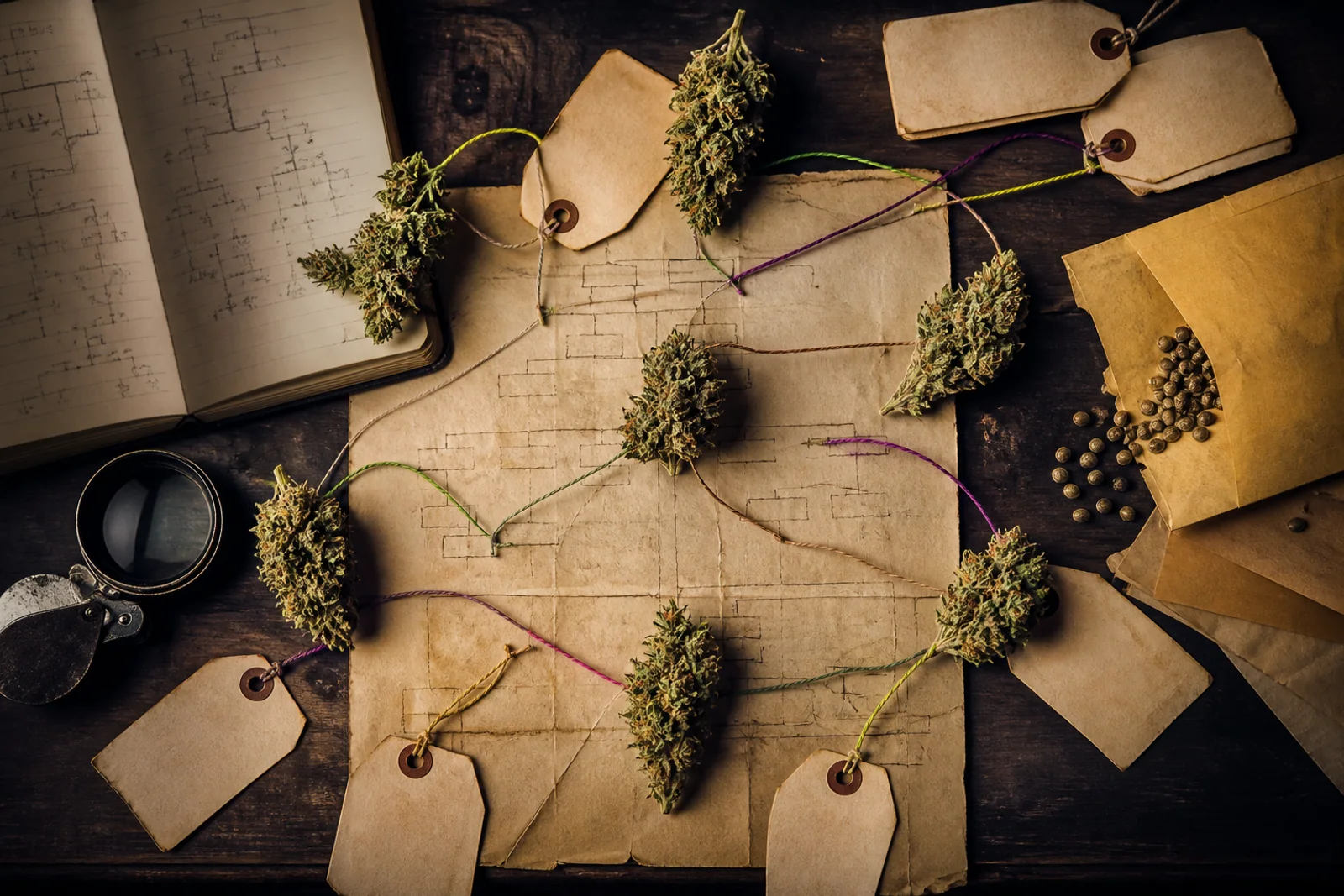
Changing labels, multiple samples, and an evidence trail illustrate how a cultivar name can drift across growers, markets, and time.
Mainezilla original editorial visual · AI-assisted art directionWhy this matters: names, not guarantees
If you’ve ever asked a budtender which strain will do a particular thing and got a long, apologetic shrug, you’ve bumped up against the core problem: names travel faster than chemistry. Growers, breeders, and retailers pass names, cuttings, and seed packets around—sometimes with careful notes, sometimes with nothing but gossip and a brand. Over time the name may be preserved while the plant behind it changes.
That doesn’t mean names are useless. They carry history, breeding decisions, and cultural signals. But the history encoded in a name is not the same as a certificate of analysis. Modern research shows that plants sold under the same name can vary substantially in terpenes and other chemistry. Treat the cultivar name as provenance shorthand rather than a chemical guarantee.
For growers and educators—our audience at Mainezilla—that distinction is practical, not pedantic. It changes what we record, what we test, and how we teach. The rest of this guide explains the biological and regulatory reasons names drift, the minimum provenance questions that restore useful context, and a practical filing approach you can use in a garden, catalog, or learning library.
Plants travel; labels travel faster
A named cultivar usually starts as a breeder’s cross, a deliberate pairing that produces seed or a discovery of an unusual phenotype. From there it may be multiplied as seed, selected as a stable line, or propagated as clones. Add distributors, regional markets, hobby breeders, and shadow renaming habits, and a single name can end up attached to genetically different populations in different places.
Seed batches are especially prone to drift. Seed-grown populations carry genetic segregation: siblings can vary, and naming a seed lot after a parent plant is convenient but imprecise. Clonal material reduces within-line genetic variation, but clones can be renamed, mislabeled, or accidentally mixed. In short: the mechanism of propagation (seed vs. clone) is a major axis of identity change.
From a regulatory angle, jurisdictions including Maine require clear labeling of license numbers and batch-level traceability—measures that help tie a product back to a production event even if the cultivar name is ambiguous. Those rules make provenance data useful even when names are not perfectly specific.
Why names split from chemistry
Genetics and chemistry are what the plant actually is; names are social constructs tied to origin stories. Several research studies have tested many samples sold under the same commercial name and found wide chemical and genetic variation. One study that combined genotyping and chemical profiling found that labelling correlated with variation in a small number of terpene synthase genes—but not with a single uniform chemical profile for each name. The upshot: a name may predict some tendencies, but it doesn’t promise a single chemotype.
A separate line of work on terpene synthases documents complex gene families and expression patterns that drive terpene diversity. Because terpene content is controlled by multiple gene copies and regulatory factors, even closely related plants can differ in aroma and terpene profile depending on which alleles are present and how they’re expressed. That biological complexity is why two plants both called by the same cultivar name can smell and test differently.
This scientific variability doesn’t erase the value of a name. Names point to breeding choices, horticultural techniques, and cultural lineage. But if you need chemical predictability—say, for research, product development, or a teaching garden—you should rely on batch testing and clear provenance instead of a name alone.
Four provenance questions that restore useful context
When you encounter a named cultivar, ask four simple questions. Who is credited with the original cross or discovery? Is the material seed-derived or clone-derived? Who selected the phenotype you’re looking at (the person or operation that chose that particular plant from a population)? And who produced this specific batch or harvest? Each answer narrows the possible genetic and chemical space behind the name.
Those questions put social claims into testable frames. A breeder claim should be accompanied by a source: a named breeder, a catalog entry, a dated announcement, or a breeder’s registry entry. Whether material is seed or clone matters for reproducibility. The selector’s name matters because selections within a seed lot are the moment where a population becomes a named line. And the grower/batch ties the plant to cultivation environment and postharvest handling—factors that strongly influence chemistry.
Record the source for every claim—link to a packet note, a license number, a submission to a voluntary labeling review, or a lab result. When credible sources conflict, keep both records and date them. Honest annotation such as “disputed origin; sources disagree” is more useful than forcing a single origin story.
- Who is the original breeder/discoverer? (Provide a dated source.)
- Is this seed-derived or clonal material? (Seed lots vs. clones matter.)
- Who made the phenotype selection? (Name and date the selector.)
- Who grew this batch? (Facility, license number, harvest date, batch ID.)
How Mainezilla files a strain (practical structure)
We separate two records: a public strain-history entry and a garden-grown selection record. The strain-history entry is a curated, sourced timeline of the name—claims about breeder, selection events, notable crosses, and common trade names. It’s broad and permissive: it collects claims, dates, and sources so learners can see the story and its disagreements.
The garden-grown selection record is specific. If we actually grow a selection that we call by that name, the selection page links to a product/gallery entry and includes harvest date, batch ID, cultivation notes, and the test results for that batch. That way the educational library remains comprehensive, while the garden record is strictly tied to what we actually grew and tested.
This two-library design mirrors how regulators approach traceability: Maine’s labeling and packaging rules require license numbers and provide a voluntary review mechanism for package and label designs. Batch testing and tracking guidance give regulators and growers the tools to tie a product back to its production history—critical when names alone are ambiguous. Use those regulatory hooks in your records: license numbers, Metrc or batch IDs, and lab reports reduce the guesswork.
How to research a strain’s history (sources and methods)
Start with primary, dated sources: breeder announcements, seed-pack labels, historical catalog pages, and registered trademarks or plant variety protections. For Maine growers, add OCP resources: voluntary packaging, labeling, and advertising (PLA) review submissions can contain provenance claims and are a public compliance touchpoint. Finding a PLA number tied to a product or label gives a documented filing to cite.
Next layer in lab data. Certificates of analysis and potency-verification guidance are not origin stories, but they are hard evidence about a specific batch’s chemistry. Maine’s guidance on verifying potency and mandatory analyte types shows what tests are required and how OCP treats potency claims; attach the lab report to any garden or product record. If a name is repeatedly associated with certain chemotypes in multiple independent, accredited reports, that association becomes stronger—still not absolute, but useful.
When possible, include genetic data. Publicly available genotyping projects and peer-reviewed studies can show whether samples labeled the same cluster genetically or not. Those datasets are technical, but they are the most direct way to test if a named population shares a common genetic signature. Remember that genetics explains potential; environment and postharvest processes shape what the consumer experiences.
- Primary documentation: breeder notes, seed packets, dated catalog entries.
- Regulatory filings: OCP PLA submissions and label approvals.
- Batch evidence: lab COAs, potency verification, and testing records.
- Genetics: published genotyping where available.
Teaching, recordkeeping, and living with uncertainty
A good garden and a good learning library preserve messy truth. That means documenting uncertainties as first-class data: conflicting origin stories, incomplete breeder attributions, or a seed lot that changed hands multiple times. Keep notes on who made each claim and when—annotations that read “claimed by X in year Y; contested by Z” are invaluable later.
For educators, translate those uncertainties into lessons. Use the split between a public strain history and a garden-grown selection record to show learners how names, genes, and tests interact. Show how a lab COA tied to a dated harvest provides stronger practical information than a legendary origin story. When addressing students or consumers, avoid stretching associative data (aroma, anecdotes) into guarantees about human effects.
Finally, use regulatory tools and testing wisely. Maine’s rules and guidance—labeling statute, the universal symbol standard, voluntary PLA reviews, and testing requirements—are there to keep provenance and safety traceable. Lean on batch IDs, license numbers, and lab reports when you need to make decisions or report results; keep narrative history alongside, not in place of, that objective evidence.
Questions this guide answers
If two products share a strain name, will they test the same?
Not necessarily. Research shows that plants sold under the same commercial name can vary in chemical profile. Use batch-level lab reports, not name alone, to compare chemistry.
What’s the single most useful piece of provenance to record?
A dated batch identifier tied to a lab certificate of analysis and the growing facility’s license number. That combination ties chemistry to a specific production event and is far more actionable than a name alone.
Does Maine require strain names on labels?
Maine’s statute and OCP rules require specific label elements—license numbers, identity statements, and warnings—and OCP offers a voluntary PLA review for label materials. Labels must not be false or misleading; for detailed guidance, consult OCP’s PLA resources.
Are terpene or genetic tests a sure way to identify a strain?
They are powerful tools but not absolute. Genetics and terpene synthase profiles reveal relationships and tendencies, but expression and environmental factors alter chemistry. Combine genetic data with repeated batch testing and provenance records for the best practical information.
How should teachers present conflicting origin stories?
Present both (or all) claims, date them, cite the sources, and label the status as disputed when appropriate. Transparency about disagreement is more informative than forcing a single narrative.
Educational information only. This guide is not medical or legal advice and does not recommend a product, dose, treatment, or outcome.