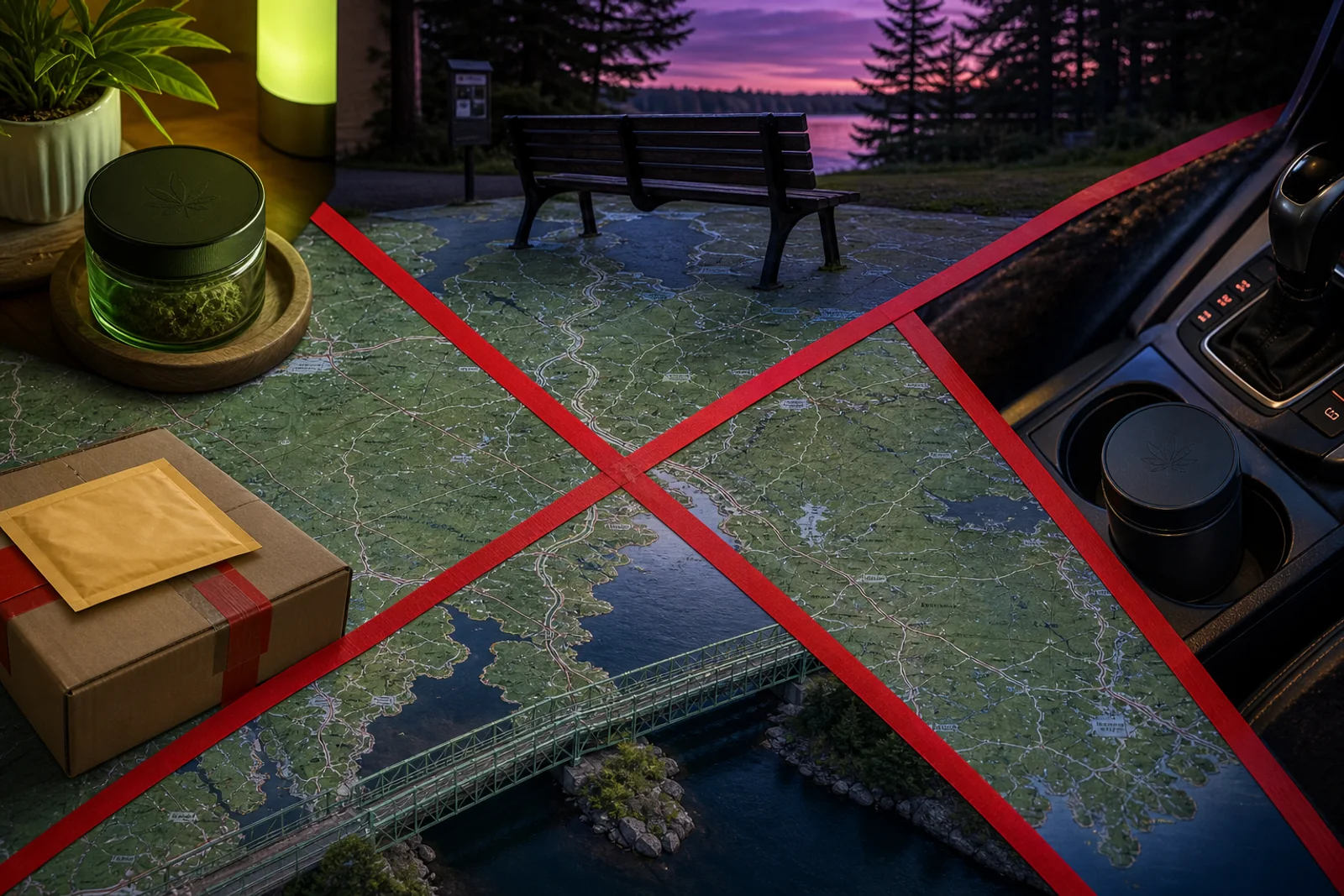
The Maine map and boundary markers organize the exact legal contexts discussed: public use, vehicles, property rules, and crossing state lines.
Mainezilla original editorial visual · AI-assisted art directionWhy a field guide for legal boundaries?
If you grow, buy, or use cannabis in Maine, it helps to think like someone who maps fences: state lines, property lines, and the boundaries between state and federal power. Maine’s laws allow possession and use in defined settings, but that permission is tightly circumscribed. This guide translates the primary, official sources into practical checkpoints you can use in the field — what the law says, what the Office of Cannabis Policy (OCP) emphasizes, and what to plan for before you light, vape, or consume an edible.
We’re not offering legal advice. This is an evidence-first field guide that points to the specific Maine statute and OCP materials you should check if a situation matters — for example, when you’re hosting, traveling, or transporting product. Because laws and rules change, especially in the months after rulemaking sessions, treat the citations here as the map legend: verify the text on OCP and the Maine statutes if the stakes are high.
Plain-language takeaway up front: what’s legal in Maine stays legal only within Maine’s rules, on private property where the owner allows it, and in ways the statutes and OCP rules permit. Consumption in public places and on federal land is off the table; transport across state lines or by mail is illegal. The rest of this guide explains the why and how, with practical checks for growers, hosts, and consumers.
Public consumption: what 'private' actually means
Maine law is explicit about where an adult may consume cannabis: generally, in a private residence (including curtilage) or on private property not generally accessible to the public and only when the property owner has explicitly permitted consumption. That restriction is statutory — written into Title 28‑B — and is the baseline for most subsequent rules and enforcement. Because the statute limits consumption to private places, public smoking, vaping, or eating in parks, sidewalks, or other places open to the public is prohibited.
OCP’s Frequently Asked Questions reinforce that position in plain language: cannabis use in any form — smoking, eating, vaping — is prohibited in public places. Property owners can go further and ban possession or use on their property even if it is private. That means a landlord, campground operator, employer, or event organizer can restrict or forbid on-site consumption; permission from a property owner is the practical condition that turns a private place into a lawful consumption site.
A common field question from growers and hosts is whether a private porch, a semi-private yard, or a building common room counts. The practical test used by statute and agency guidance is access: if the area is generally accessible by the public (even intermittently), it’s not automatically a lawful consumption area. Where visibility from a public way is an issue, the statute requires that plants and consumption be out of view without binoculars or other aids — a useful on-the-ground rule for growers who want to keep their garden private and permitted.
Vehicles: a hard boundary and planning ahead
Maine’s statute and OCP guidance treat vehicles as a special situation. The operator and passengers of a vehicle on a public way may not consume cannabis in the vehicle. Even if a vehicle is parked, consuming in a vehicle that is on a public way is treated like public consumption and is prohibited. The law is deliberately bright-line here because of road safety and enforcement clarity: consuming in a vehicle is not permitted for drivers or passengers while on public roads.
Beyond the consumption ban, the rules that govern licensed businesses (and OCP guidance for transport) require that product being transported by licensees be contained and tracked in specific ways. For consumers, storage and possession while traveling locally should be planned so that product is not being consumed in the vehicle; package product securely and separate it from the driver’s reach. In practice, the same planning you use for other legal but safety-sensitive items (locked container, out of passenger area) is a reasonable on-ramp to compliance.
Driving while impaired is itself illegal and separate from the consumption-in-vehicle rule. The State’s highway safety materials and OCP notices emphasize that impairment laws apply regardless of whether alcohol, cannabis, or another substance is involved; do not treat possession lawfulness as permission to drive. If you plan to use cannabis, plan your transportation first — designate a sober driver, use paid transport, or consume only when you are not going to operate a vehicle.
For licensed deliveries and transfers, additional OCP rules govern how businesses package, track, and transport product. Those requirements can affect what a retailer or delivery service may do. Adults using those services can verify the business and review current OCP guidance instead of relying on a general description of the service.
Property rules, employers, and federal land
Ownership matters. Even when state law permits possession or personal cultivation, property owners can set stricter rules. A private business, rental agreement, condominium association, or employer can prohibit possession or use on the premises. OCP repeatedly reminds consumers that permission from the property owner (explicit permission) is part of the statutory permission to consume outside a residence.
Employers remain able to set workplace policies that restrict use, possession, or impairment at work. Employment and lease agreements commonly include language that addresses controlled substances; don’t assume workplace rules will track state permissiveness. For people who grow cannabis for personal use, read lease and HOA rules carefully: the state’s permission to cultivate does not override a private contract that prohibits cultivation or smoking on site.
Federal property is a distinct and absolute boundary. The statutes and legislative drafting specifically note that state authorization is not a defense on federal land: a Maine statute may not be construed to allow possession or consumption on federal property. National parks, federal buildings, military bases, and other federally managed sites therefore remain off-limits for possession or use under federal law and federal rules. The practical effect is straightforward: keep your cannabis off federal land and out of federal buildings.
Mailing, interstate travel, and state lines
State legalization does not erase federal interstate rules. OCP’s FAQs state plainly: it is illegal to leave Maine with any cannabis products — medical or adult-use — and mailing cannabis from Maine is illegal. That includes trying to carry cannabis across state lines into a neighboring state or shipping it via postal or courier services. Because the U.S. postal system and federal law regulate interstate transport, moving cannabis across state lines remains a federal offense regardless of the destination state’s laws.
Practical takeaway: treat state lines as a final hard border for cannabis. Even if you are visiting a neighboring state where adult use is permitted, you cannot legally cross the border with product you purchased in Maine. OCP’s guidance also emphasizes that visiting patients from approved registries must follow both Maine’s rules and the laws of the patient’s home state — the permission to purchase in Maine does not translate into permission to export.
Why does OCP say this so plainly? Because possession and transfer across jurisdictional lines create potential federal trafficking issues and expose people to enforcement by federal or other states’ law enforcement. If you travel, plan to leave product behind or to acquire product only in the state where you will consume it, subject to that state’s rules. When in doubt, check both OCP guidance and the statutes for updates before traveling with cannabis.
Enforcement, penalties, and routine contacts with law enforcement
Most statutory prohibitions are framed as civil violations, quantity or context-based criminal offenses, or conduct that is specifically disallowed by chapter rules. For many day-to-day consumer infractions — for example, public smoking in a park — the statute contemplates civil penalties rather than felony prosecution in straightforward cases, but consequences can still include fines and confiscation. The exact penalty depends on the section of Title 28‑B and the circumstances.
Traffic stops and searches create particular risk points: if you are detained for a traffic violation and cannabis is visible or smelled in the vehicle, that encounter may expand to additional enforcement actions. The State’s highway safety materials treat cannabis-related driving violations as a public-safety priority: do not assume possession equals permission to use while driving, and do not assume a small quantity will prevent further investigation. If an enforcement interaction occurs, the same plain-language rule applies: be cooperative, know your rights, and be prepared to show that possession and transport comply with state limits and OCP guidance.
For licensed businesses, OCP’s rulebook supports active compliance programs: mandatory testing, packaging and labeling rules, and track-and-trace systems for product movement. Violations by businesses can result in license action beyond simple fines — for growers and retailers this is a second-level boundary that operates separately from a consumer’s conduct but likewise matters in the field because it determines which establishments you can safely work with or buy from.
Evidence trail: [5]
Field checklist: before you host, travel, or transport
An evidence-first checklist keeps you out of trouble more reliably than rules of thumb. Before hosting, confirm the property owner’s explicit consent to on-site consumption (get it in writing for events). If you grow for personal use, position plants and drying racks so they’re not visible from a public way without binoculars; that simple step aligns with statutory expectations for keeping plants out of public view.
Before traveling, ask three questions and answer them with sources: (1) Am I leaving Maine with product? (OCP: don’t.) (2) Am I crossing a state line or entering federal land? (don’t.) (3) Will I be in a vehicle on a public way while consuming? (don’t consume in vehicles). If the answer to any of those is yes, change the plan — leave product at home, use a licensed retailer in the destination state (if lawful there), or arrange transport that does not involve vehicle consumption.
For on-the-ground transport within Maine, separate storage from the driver’s area, lock containers during stops, and carry documentation of lawful purchase or ownership if available. If you use a delivery service, confirm the vendor is a licensed retailer and follows OCP delivery/packaging rules. Finally, if your situation is unusual (large quantities for shows, inter-party transfers, cross-border visitors), call OCP or consult the statute — official guidance is only a phone call or an OCP web page away.
- Get explicit, written permission before allowing consumption on private property you manage.
- Never consume in a vehicle on a public way; plan transport before use.
- Do not mail or cross state lines with cannabis — OCP says it is illegal.
Questions this guide answers
Can I consume on my front porch if it’s part of my private residence?
If the porch is part of your private residence (including curtilage), the statute permits consumption there — unless the property owner or another applicable contract (like an HOA) prohibits it. Avoid areas that are generally accessible to the public or visible from a public way without binoculars; when in doubt, confirm permission in writing. (See Title 28‑B §1501 and OCP FAQ.)
Can I drive with cannabis in the car if I’m not consuming?
You may possess lawful amounts in Maine, but you may not consume in a vehicle on a public way. Also, driving while impaired is illegal regardless of substance. Store product securely, separate from the driver’s area, and avoid any situation where impairment could be an issue. (See Title 28‑B §1501 and OCP guidance.)
Is it legal to mail cannabis or send it to another state?
No. OCP’s FAQs state clearly that mailing cannabis from Maine is illegal and that it is illegal to leave Maine with cannabis products. Interstate transport remains a federal matter and is prohibited. Don’t mail or cross state lines with product purchased in Maine.
What about federal land like Acadia National Park or federal buildings?
State authorization does not extend to federal property. Maine statutes and legislative language explicitly state the chapter may not be construed to allow possession or consumption on federal property. Keep cannabis off federal land and out of federal buildings.
If a licensed store delivers to my house, is that allowed?
OCP has specific rules for licensed delivery and packaging; licensed retailers and delivery services must follow OCP’s transport and tracking rules. Consumers should confirm the vendor is licensed and that its delivery procedures comply with OCP guidance before accepting a delivery.
Educational information only. This guide is not medical or legal advice and does not recommend a product, dose, treatment, or outcome.