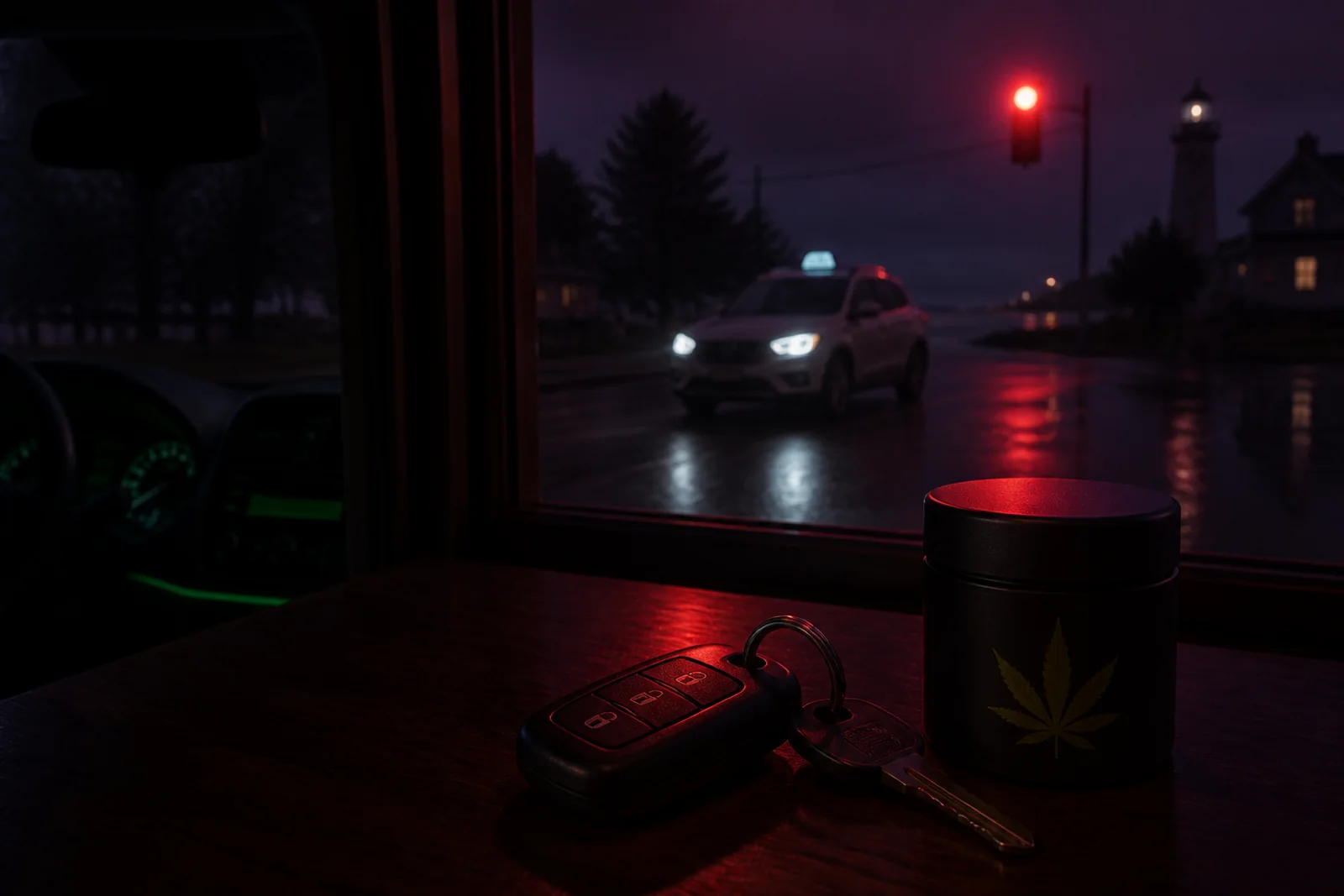
Keys physically separated from the cannabis container turn the article’s central decision into one unmistakable visual: do not drive impaired.
Mainezilla original editorial visual · AI-assisted art directionWhy a simple rule matters
Driving is a precision task built on reaction time, coordination, attention, perception, and split-second decision-making. Those are the exact cognitive and motor domains THC can change—sometimes subtly, sometimes enough to matter for crash risk. Clinical and population research consistently links recent cannabis use to modest but real increases in crash risk, even if the size of that increase varies between studies. ([cdc.gov](https://www.cdc.gov/cannabis/health-effects/driving.html))
That variability—different study designs, different populations, different ways of measuring recent use—creates a practical problem: there is no single test, single blood number, or universally safe waiting period that reliably tells you “I’m good to drive.” Reviews and meta-analyses repeatedly show the association, but also note heterogeneity and uncertainty about dose–response and timing for individuals. In other words: the evidence supports a simple boundary more than a precise stopwatch. ([pubmed.ncbi.nlm.nih.gov](https://pubmed.ncbi.nlm.nih.gov/40367728/))
For growers, patients, and people who share cars, the simplest working rule is also the safest: if cannabis is part of the plan, driving is not. This is easier to follow than trying to self‑test under a subjective “I feel fine” standard—and it fits both the science and Maine law. ([cdc.gov](https://www.cdc.gov/cannabis/health-effects/driving.html))
What the science actually shows (and what it does not)
Experimental driving studies—simulators, closed courses, and controlled on-road tests—show deficits after acute THC exposure in tasks like lane-keeping, reaction to hazards, and tracking. Those controlled studies give a clear signal that THC can change driving‑related skills, although the size of effect depends on dose, route (inhaled vs oral), and prior tolerance. ([pubmed.ncbi.nlm.nih.gov](https://pubmed.ncbi.nlm.nih.gov/35083810/))
Population-level studies and meta-analyses see the same story from a different angle: drivers identified as recently using cannabis have a higher odds of being in a crash compared with drivers who were unimpaired, but estimates vary and study types matter. Case–control and fatal‑crash studies often report higher relative risks; culpability studies and those that rely on different sampling methods may report smaller effects. Importantly, authors repeatedly caution against converting a positive drug test into a definitive statement that a person was impaired at the wheel. ([pubmed.ncbi.nlm.nih.gov](https://pubmed.ncbi.nlm.nih.gov/22323502/))
What the evidence does not give us is a reliable, universal blood or saliva cutoff that corresponds to impairment for every person. THC pharmacology is messy: heavy or chronic users can have detectable levels long after acute impairment has resolved, while occasional users can be impaired at lower concentrations. The research community and public‑health agencies therefore emphasize behavior and prevention over single-number thresholds. ([pubmed.ncbi.nlm.nih.gov](https://pubmed.ncbi.nlm.nih.gov/40172477/))
Why blood THC and ‘sobriety math’ fail as a field test
THC is fat‑soluble and redistributes into and out of body tissues over hours and days. That means laboratory detection of THC or its metabolites tells you someone used cannabis at some point recently (or earlier, in the case of metabolites), but it does not reliably tell you whether they are currently impaired. Toxicology is useful for understanding exposure, not, by itself, current fitness to drive. ([cdc.gov](https://www.cdc.gov/niosh/bulletin/2020/cannabis-and-work.html))
A tempting but dangerous practice is to invent a wait-time or math rule—“X hours per mg” or “Y hours after one puff.” Because individual responses vary by tolerance, route (edible vs smoking), dose, sleep, other drugs, and even metabolism, such a formula is likely to misclassify people and give false reassurance. Reviews explicitly warn against over‑interpreting the presence or concentration of THC in blood as proof of impairment. ([pubmed.ncbi.nlm.nih.gov](https://pubmed.ncbi.nlm.nih.gov/33497784/))
For the field guide user: replace the math with decisions. Plan sober transport before consuming. If you’re unsure, don’t drive. If you must travel with product, keep it sealed and stored per Maine rules and never consume in the vehicle. Those practical choices line up with the evidence and the law. ([maine.gov](https://www.maine.gov/dafs/ocp/resources/faq))
Maine law and practical boundaries you should know
Maine statute and the Office of Cannabis Policy (OCP) set clear behavioral boundaries: consuming cannabis in a vehicle and operating a vehicle while under the influence of cannabis are prohibited. The state’s medical‑use chapter and the adult‑use statutes both make this explicit—so from a legal perspective the safest course is to avoid driving after use. ([legislature.maine.gov](https://legislature.maine.gov/legis/statutes/22/title22sec2426.html))
Beyond the “don’t drive while impaired” rule, Maine also regulates how cannabis is stored and transported. The OCP FAQs and administrative rules require secure packaging and prohibit open containers in the passenger area; rules for licensees further specify documentation for transportation of adult‑use product. If you carry product in a vehicle, keep it closed, out of immediate reach of the driver, and follow OCP guidance. ([maine.gov](https://www.maine.gov/dafs/ocp/resources/faq))
Important practical note for people in medical and adult‑use systems: the existence of a medical authorization does not create a legal exception for driving while impaired. Clinical need and possession rights are separate from public‑safety rules about vehicle operation. When in doubt, treat the driving rule as absolute. ([legislature.maine.gov](https://legislature.maine.gov/legis/statutes/22/title22sec2426.html))
A step‑by‑step field checklist before you light, eat, or vape
Keep it simple: assign one of these before you use cannabis. (a) A sober driver or ride service to and from your destination. (b) A plan to stay put—use at home or at your lodging and don’t drive. (c) If you share a car, make the impaired person the passenger and insist on a sober driver. Planning beats improvising every time. ([cdc.gov](https://www.cdc.gov/cannabis/health-effects/driving.html))
If you’re traveling with product, follow Maine transport rules: keep it in sealed, labeled containers and out of the driver’s reach and passenger area. Public consumption and consumption inside vehicles are prohibited in Maine—so even if you’re parked, public‑use rules and open‑container concepts still apply. ([legislature.maine.gov](https://legislature.maine.gov/statutes/28-b/title28-Bsec505.html))
Watch for combinations. Alcohol plus cannabis produces more impairment than either alone in most experimental settings. Likewise, prescription medications that cause drowsiness, underlying fatigue, or medical conditions that affect concentration can multiply risk. The field rule: if any of those factors are present, treat driving as off the table. ([pubmed.ncbi.nlm.nih.gov](https://pubmed.ncbi.nlm.nih.gov/35083810/))
- Before use: book a ride home or plan to stay put.
- If carrying product, keep it sealed and stored per Maine rules.
- Never ride with an impaired driver; never consume inside a vehicle.
Building a reliable personal learning record (not a loophole)
We encourage growers and patients to keep simple observation logs: what you tried (product, route, dose form), where and when you used it, how you felt over time, and whether you later judged yourself fit to do tasks like cooking, biking, or driving. But record the safety rule—“no driving”—not a numerical countdown that you treat as authoritative. Practical logs reduce risk and build honest experience; they are not certifications of sobriety. ([pubmed.ncbi.nlm.nih.gov](https://pubmed.ncbi.nlm.nih.gov/33497784/))
A useful log entry includes: product name and lab‑tested THC/CBD if known, route (smoked, vaporized, edible), time started, subjective effects (onset, peak, fade), and any co‑use (alcohol, medicines). Over time you’ll learn patterns, but remember that tolerance and context change. Logs are tools for learning, not legal or medical proof. ([maine.gov](https://www.maine.gov/dafs/ocp/resources/faq))
If you use cannabis for medical reasons, share your learning record with your clinician when it matters—how use relates to symptom control, side effects, and activities of daily living. Clinicians can help interpret patterns but cannot translate your log into legal clearance to drive. Keep the no‑drive boundary in the record. ([maine.gov](https://www.maine.gov/dafs/ocp/resources/faq))
Special situations: riders, deliveries, and work drivers
Riding as a passenger with an impaired person is not safe. Passengers who accept rides from impaired drivers increase everyone’s risk. If you’re offered a ride and you suspect the driver has used cannabis recently, decline and arrange an alternate ride. This is true for friends, family, and rideshare situations. ([cdc.gov](https://www.cdc.gov/cannabis/health-effects/driving.html))
For people who drive for work—commercial drivers, delivery personnel, or caretakers—employers often have stricter rules. Testing policies, workplace impairment assessments, and safety standards exist because crashes have outsized consequences in occupational settings. If your job involves driving, follow your employer’s policy and treat cannabis use as an operational hazard. ([cdc.gov](https://www.cdc.gov/niosh/bulletin/2020/cannabis-and-work.html))
Delivery and transport of cannabis by licensed businesses are governed by Maine statute and OCP rules; those rules govern documentation, secure transport, and where licensed transport is permitted. Individuals should not assume that possession rights alone allow casual in-vehicle consumption. Follow the law and the field checklist above. ([legislature.maine.gov](https://legislature.maine.gov/statutes/28-b/title28-Bsec505.html))
Final checklist: the grower’s forehead test (simple and honest)
Before you consider driving, run through three questions out loud: (1) Did I consume cannabis within a timeframe where I would feel altered? (2) Did I take anything else (alcohol, sedating meds) that could increase impairment? (3) Do I have a sober ride or can I stay put? If the answer to any of these is yes or uncertain, don’t drive. Keep the line clear: use equals no driving. ([cdc.gov](https://www.cdc.gov/cannabis/health-effects/driving.html))
This field rule is intentionally conservative. It respects both the limits of current science—no universal blood cutoff—and the legal boundaries Maine sets around use in vehicles and operation while impaired. Practically speaking, a little planning (a $10 rideshare, an overnight stay, or asking a friend) prevents much greater risk and consequences. ([legislature.maine.gov](https://legislature.maine.gov/legis/statutes/22/title22sec2426.html))
If you want to get more precise about patterns for yourself, use a learning record, discuss it with a clinician if relevant, and never use a log as an excuse to drive. The safest, most evidence‑consistent rule for our community: plan transport before you use. It’s the small habit that removes a big risk. ([pubmed.ncbi.nlm.nih.gov](https://pubmed.ncbi.nlm.nih.gov/33497784/))
- Plan a sober ride before use.
- Keep product sealed and out of the driver’s reach.
- If unsure, don’t drive—and don’t ride with someone who is impaired.
Questions this guide answers
Is there a safe blood or saliva THC level for driving?
Short answer: no reliable universal number. THC detection reflects recent use or exposure, but because individuals differ in tolerance and metabolism, a single cutoff can’t guarantee safety. Public‑health reviews recommend behavioral rules (don’t drive if you used cannabis recently) rather than relying on one lab value. ([pubmed.ncbi.nlm.nih.gov](https://pubmed.ncbi.nlm.nih.gov/40172477/))
How long after using edibles is it safe to drive?
Edibles change the timing and duration of effects—onset is slower and the peak can be later than inhaled cannabis—so timing is unpredictable. Because there’s no universal wait time that covers every person and product, the safest choice is to plan transportation before consuming and avoid driving while you’re unsure. ([pubmed.ncbi.nlm.nih.gov](https://pubmed.ncbi.nlm.nih.gov/33497784/))
Does a medical cannabis card let me drive after using for symptoms?
No. Medical authorization in Maine permits legal medical use under state rules but does not create an exception to driving‑while‑impaired laws. Operating a vehicle while impaired remains prohibited. ([legislature.maine.gov](https://legislature.maine.gov/legis/statutes/22/title22sec2426.html))
What should I do if I’m a passenger and the driver seems impaired?
If you suspect impairment, do not get in the vehicle or ask the driver to stop. Arrange an alternate, sober ride (another passenger, a friend, rideshare, or calling for help). Your refusal to ride is a practical safety step with solid evidence behind it. ([cdc.gov](https://www.cdc.gov/cannabis/health-effects/driving.html))
Can combining alcohol and cannabis make driving riskier?
Yes. Experimental studies and public health reviews show that alcohol and cannabis together typically increase impairment beyond either substance alone. That combination is a clear reason to avoid driving. ([pubmed.ncbi.nlm.nih.gov](https://pubmed.ncbi.nlm.nih.gov/35083810/))
Educational information only. This guide is not medical or legal advice and does not recommend a product, dose, treatment, or outcome.