
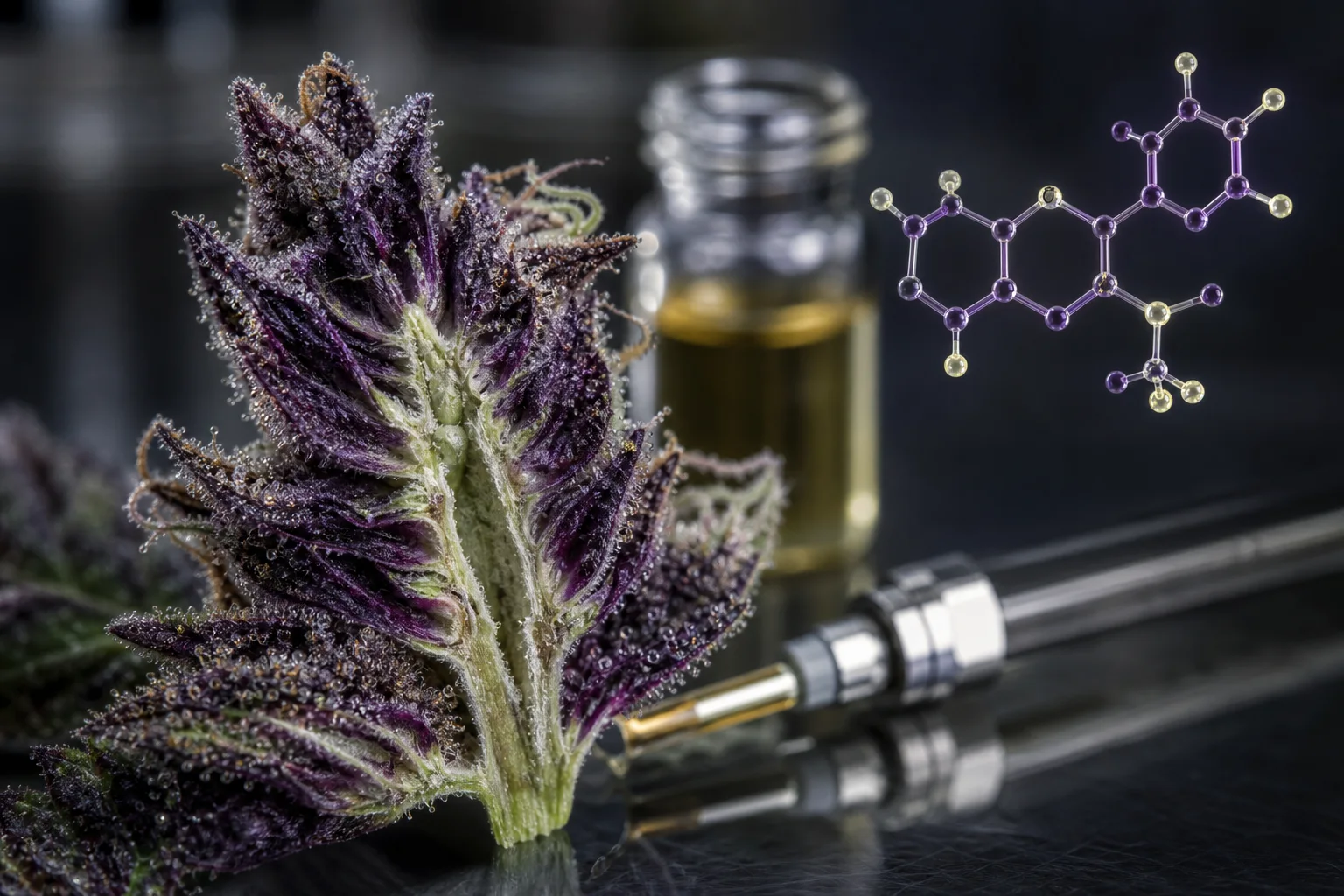
Purple hues in cannabis arise from anthocyanin pigments (example cyanidin derivatives); color depends on chemistry, cellular pH and handling, not cannabinoid content.
Mainezilla original editorial visual · AI-assisted art directionA quick primer: what anthocyanins are and why they look purple
Anthocyanins are water-soluble flavonoid pigments found across the plant kingdom; they produce red, purple and blue hues in flowers, fruits, leaves, and stems. Chemically they are glycosides of anthocyanidins (for example cyanidin, delphinidin, pelargonidin) and their optical properties depend on the aglycone structure and the substituents attached to the B- and A-rings. These structural differences change absorption maxima and therefore perceived color. ([pmc.ncbi.nlm.nih.gov](https://pmc.ncbi.nlm.nih.gov/articles/PMC8068391/))
Crucially, anthocyanins do not have a single fixed color. In solution and in the vacuolar environment of plant cells they exist in pH-sensitive equilibria among the flavylium cation (red), quinoidal bases (blue–purple), colorless hemiacetal forms, and chalcones. Small changes in pH, metal complexation, or molecular decoration (methylation, acylation, glycosylation) shift these equilibria and the resulting hue. This chemistry explains why the same basic anthocyanin can present as red in one tissue and purple or blue in another. ([pmc.ncbi.nlm.nih.gov](https://pmc.ncbi.nlm.nih.gov/articles/PMC13297885/))
Beyond simple pigment chemistry, anthocyanins are stabilized in planta by co-pigmentation (stacking interactions with other flavonoids or phenolics), vacuolar pH control, and metal chelation (e.g., Al3+, Fe3+ with certain anthocyanins) — mechanisms plants use to secure bright, persistent colors under physiological conditions. That constellation of factors is why visual color is a convenient but fundamentally complex trait. ([pmc.ncbi.nlm.nih.gov](https://pmc.ncbi.nlm.nih.gov/articles/PMC8750456/))
How cannabis makes (or doesn’t make) purple: genes, pathways, and tissue specificity
Anthocyanin biosynthesis sits inside the larger phenylpropanoid–flavonoid network. Core structural enzymes — CHS, CHI, F3H, F3'H/F3'5'H, DFR, ANS, and various transferases — build the chromophore, and transcription factor complexes (MYB–bHLH–WD40) control where and when those structural genes are expressed. Variants in these regulators and in enzyme isoforms explain why different cultivars, and different tissues within a plant, produce distinct anthocyanin profiles. ([pubmed.ncbi.nlm.nih.gov](https://pubmed.ncbi.nlm.nih.gov/34777426/))
Work focused specifically on Cannabis sativa shows the same basic toolkit at work: recent molecular characterization of pigmented cannabis varieties reports differential expression of many canonical flavonoid pathway genes (for example, DFR, ANS, and glycosyltransferases) that correlate with anthocyanin accumulation in leaves. That paper mapped both gene-expression differences and the actual anthocyanin molecules present in colored versus non-colored varieties. In short: cannabis has the genetic capacity, and cultivars differ in how those genes are regulated. ([pubmed.ncbi.nlm.nih.gov](https://pubmed.ncbi.nlm.nih.gov/39600728/))
Importantly, anthocyanin accumulation is tissue-specific and temporally regulated. In cannabis, like other plants, you can see anthocyanins in leaves, petioles, bracts, and sometimes in floral tissues; presence in one organ doesn’t guarantee presence in another. Genetic packages that favor leaf pigmentation may not produce deep flower pigmentation, and vice versa. That separation matters for anyone trying to draw conclusions about cannabinoid content from visual color. ([pubmed.ncbi.nlm.nih.gov](https://pubmed.ncbi.nlm.nih.gov/39600728/))
Environment, pH, and co‑pigmentation: the external levers that tune purple
Environmental conditions have large, rapid effects on anthocyanin accumulation. Light intensity, cool night temperatures, nutrient status, and certain stressors (low phosphorus, drought, ultraviolet exposure) commonly up-regulate anthocyanin biosynthesis in many species. Those stimuli act through signaling cascades that modulate the activity of the transcription factors controlling the pathway, so the same cultivar can look markedly different under different culture conditions. ([pubmed.ncbi.nlm.nih.gov](https://pubmed.ncbi.nlm.nih.gov/41436926/?fc=None&ff=20251224063036&v=2.18.0.post22+67771e2))
Within plant cells, vacuolar pH and co-pigment concentrations are the immediate determinants of the color that anthocyanins display. Anthocyanins accumulated in vacuoles around pH 5–6 are more likely to appear purple/blue when stabilized by acylation or co-pigmentation; at more acidic vacuolar pH the same compounds shift red, and at neutral-to-alkaline pH they can bleach to colorless forms. This is a chemical equilibrium, not a change in 'amount' of pigment per se. ([pmc.ncbi.nlm.nih.gov](https://pmc.ncbi.nlm.nih.gov/articles/PMC13297885/))
Practically, growers sometimes exploit environment (e.g., cooler nights) as a way to increase purple hues late in flower, but the effect is contingent on cultivar genetics and on the specific anthocyanins that cultivar produces. Not all varieties will respond, and environmental manipulation that stresses plants for color can also influence yield and cannabinoid profiles — outcomes that require separate measurement, not visual inference. ([pubmed.ncbi.nlm.nih.gov](https://pubmed.ncbi.nlm.nih.gov/41436926/?fc=None&ff=20251224063036&v=2.18.0.post22+67771e2))
Senescence and post‑harvest: how harvest timing, drying and storage change color
Anthocyanins are chemically labile. Temperature, light, oxygen exposure, pH changes and enzymatic degradation during senescence and processing will alter both the amount and the color properties of these pigments. Simple hydrolysis, oxidation, or formation of colorless hydration products decreases visible color even when other attributes of the plant remain. Thus, the shade you see in a pre-harvest flower can change substantially during drying and curing. ([pmc.ncbi.nlm.nih.gov](https://pmc.ncbi.nlm.nih.gov/articles/PMC8750456/))
Drying and curing affect vacuolar integrity and the microenvironment around pigments: moisture-driven pH shifts, microbial activity or oxidants, and interactions with other phenolics can convert anthocyanins into degraded or bound forms that lose chromatic intensity. Some stabilization is possible through rapid low‑temperature drying and exclusion of excessive oxygen and light, but long-term storage commonly reduces visible color. That is why post-harvest handling records are relevant for interpreting color on a certificate of analysis or a label. ([pmc.ncbi.nlm.nih.gov](https://pmc.ncbi.nlm.nih.gov/articles/PMC2783603/))
Because anthocyanin content and hue can decline after harvest while cannabinoid concentrations may be comparatively more stable under standard post‑harvest protocols, a purple sample at point of observation is a time‑specific snapshot — not a guarantee of persistent chemical status. In other words, color is dynamic; certificates and photographs document condition only at the moment of sampling. ([pmc.ncbi.nlm.nih.gov](https://pmc.ncbi.nlm.nih.gov/articles/PMC2783603/))
How labs (can) measure anthocyanins, and what results do — and do not — prove
Laboratories quantify anthocyanins by a variety of analytical methods. Spectrophotometric assays (for total anthocyanin equivalents) are rapid and useful for rough quantitation, but they conflate different anthocyanin species and cannot resolve structural isomers. High-performance liquid chromatography (HPLC) coupled to diode-array detection or mass spectrometry separates and identifies individual anthocyanins and their glycosides; these methods reveal the actual anthocyanidin backbones and their decorations that determine color stability. The choice of method matters for what a lab report can legitimately claim. ([pmc.ncbi.nlm.nih.gov](https://pmc.ncbi.nlm.nih.gov/articles/PMC2783603/))
Crucially, anthocyanin assays are analytically distinct from cannabinoid assays: they use different extraction chemistries, chromatographic conditions, and detection parameters. A lab certificate that reports 'purple' or an anthocyanin concentration does not measure THC, or CBD, or terpene activity unless those analytes are also assayed and reported under validated methods. Cross-talk between pigments and cannabinoids in measurement is minimal if proper methods are used, but report readers must check what was actually measured. ([pmc.ncbi.nlm.nih.gov](https://pmc.ncbi.nlm.nih.gov/articles/PMC2783603/))
Analytical nuance also introduces uncertainty: matrix effects, incomplete extraction, interconversion during sample prep, and lack of certified reference materials for some plant anthocyanins can complicate absolute quantitation. For that reason, high-quality claims about anthocyanin content should be accompanied by method descriptions, limits of detection, and, ideally, chromatograms or mass spectra that show compound-level identification. ([pmc.ncbi.nlm.nih.gov](https://pmc.ncbi.nlm.nih.gov/articles/PMC2783603/))
Why purple is not a certificate of potency, quality, identity, or effect
It is tempting to accept purple as a proxy for something desirable. But anthocyanins are biosynthetically separate from cannabinoids: flavonoid and cannabinoid pathways diverge early and are regulated by different genes and environmental signals. Correlations between color and cannabinoid concentration are inconsistent across cultivars and cultivation conditions; some purple plants are low in THC, and some high‑THC plants never develop visible anthocyanins. Thus, color alone cannot reliably predict potency. ([pubmed.ncbi.nlm.nih.gov](https://pubmed.ncbi.nlm.nih.gov/39600728/))
Quality is multifaceted — it includes cannabinoid potency, terpene profile, absence of contaminants (microbial, pesticide, heavy metals), moisture content, and proper curing. Purple color relates to a pigment class with its own functional and nutritional properties, but it says nothing about microbial safety, mycotoxins, or solvent residues. Responsible interpretation separates pigment data from safety and potency data, rather than conflating them. ([www1.maine.gov](https://www1.maine.gov/dafs/ocp/resources/guidance-documents))
Claims that color predicts therapeutic effect leap from a plant trait to human response without the necessary clinical evidence. Anthocyanins have preclinical bioactivity in model systems, and diets rich in anthocyanin-containing foods are associated with certain health outcomes in epidemiology, but controlled human data linking inhaled or ingested cannabis anthocyanins to specific clinical outcomes are absent. Distinguish plant function and preclinical or nutritional observations from controlled clinical proof. ([pubmed.ncbi.nlm.nih.gov](https://pubmed.ncbi.nlm.nih.gov/41436926/?fc=None&ff=20251224063036&v=2.18.0.post22+67771e2))
Reading claims, certificates, and photos: practical guidance and remaining uncertainties
When you encounter purple marketing, a laboratory certificate, or a photo, start by checking what was actually measured. Look for: (1) which analytes were assayed (THC, CBD, terpenes, specific anthocyanins), (2) the analytical method and validation status, (3) the sampling date and chain-of-custody, and (4) whether photos reflect pre‑ or post‑harvest condition. If a certificate lists anthocyanin concentration, see whether it reports total anthocyanins (spectrophotometry) or identified species (HPLC–MS). Those details determine how much weight the color claim deserves. ([pmc.ncbi.nlm.nih.gov](https://pmc.ncbi.nlm.nih.gov/articles/PMC2783603/))
Avoid simple heuristics: purple does not equal high THC, nor does lack of purple imply low quality. If pigment content is relevant to a particular question (for example, interest in flavonoid-rich extracts), demand compound‑level data from a laboratory that reports method details and quality controls. When safety is the concern, rely first on assays for contaminants and moisture rather than on visual traits. ([pubmed.ncbi.nlm.nih.gov](https://pubmed.ncbi.nlm.nih.gov/39600728/))
Finally, be honest about uncertainty. Key open questions include the stability of specific cannabis anthocyanins during common drying and curing protocols, cultivar-by-environment interaction maps that predict color reliably, and any meaningful pharmacokinetic or pharmacodynamic contribution of anthocyanins when cannabis is consumed by typical routes. These are active research areas; until controlled studies fill them, color remains a descriptive trait, not a certificate of value or effect. ([pmc.ncbi.nlm.nih.gov](https://pmc.ncbi.nlm.nih.gov/articles/PMC2783603/))
Questions this guide answers
Does purple mean stronger THC or better effects?
No. Anthocyanin pigmentation and cannabinoid biosynthesis are controlled by different pathways and regulatory factors; purple color is not a reliable predictor of THC, CBD, terpene profile, or subjective effects. Correlations are inconsistent across cultivars and growing conditions, so potency claims must be supported by validated cannabinoid assays, not color. ([pubmed.ncbi.nlm.nih.gov](https://pubmed.ncbi.nlm.nih.gov/39600728/))
Can storage or drying make flowers turn purple (or lose purple)?
Yes. Anthocyanins are chemically sensitive to pH, temperature, light, oxygen and enzymatic activity. Drying, curing, and long-term storage can change hue and reduce visible color through degradation or chemical transformation. A purple appearance at harvest may not persist unless handled and stored in ways that minimize degradation. ([pmc.ncbi.nlm.nih.gov](https://pmc.ncbi.nlm.nih.gov/articles/PMC8750456/))
Are anthocyanins measured as part of standard cannabis testing?
Not typically. Routine regulatory testing focuses on cannabinoids, terpenes, moisture, and contaminants (e.g., pesticides, heavy metals, microbes). Anthocyanin analysis is a specialized assay and, when reported, should specify method (spectrophotometry vs compound-level HPLC–MS) and validation metrics. Check the lab report for method detail. ([pmc.ncbi.nlm.nih.gov](https://pmc.ncbi.nlm.nih.gov/articles/PMC2783603/))
Do anthocyanins in cannabis have proven therapeutic effects in humans?
No controlled clinical evidence links cannabis-derived anthocyanins to specific therapeutic outcomes. Anthocyanins show bioactivity in preclinical models and are components of diets associated with health endpoints, but translating those findings to cannabis consumption requires dedicated clinical research that is currently lacking. ([pubmed.ncbi.nlm.nih.gov](https://pubmed.ncbi.nlm.nih.gov/41436926/?fc=None&ff=20251224063036&v=2.18.0.post22+67771e2))
How should I read a product photo that highlights purple buds?
Treat photos as illustrative, not definitive. Ask for the lab report showing what was measured, when the sample was taken, and how the product was stored between harvest and photography. If anthocyanin content matters to you, request compound-level analytics with method details. ([pmc.ncbi.nlm.nih.gov](https://pmc.ncbi.nlm.nih.gov/articles/PMC2783603/))
Educational information only. This guide is not medical or legal advice and does not recommend a product, dose, treatment, or outcome.