
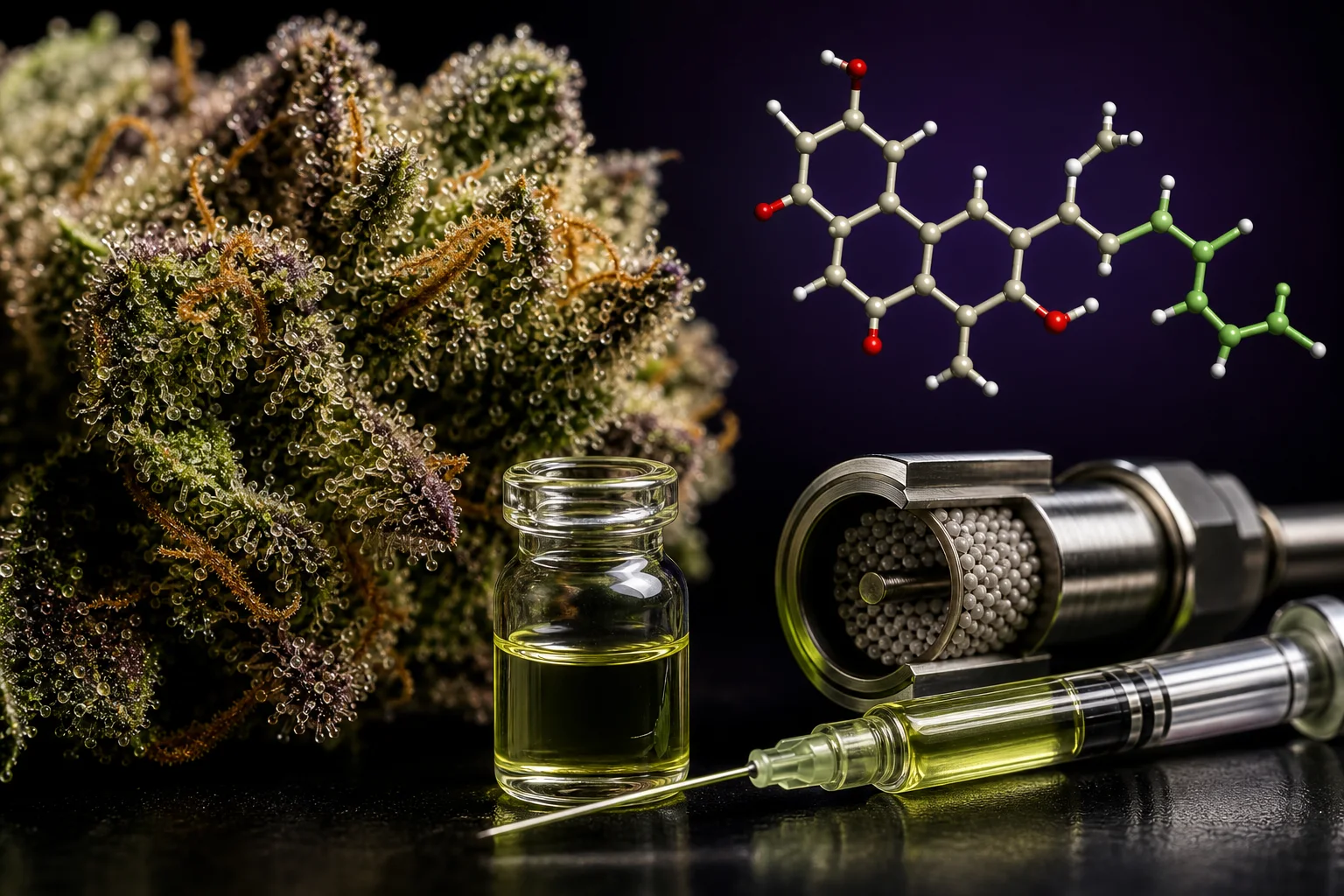
Combining botanical sampling and analytical chemistry: extraction, chromatographic separation, and molecular identification are the steps that make flavonoid measurements interpretable and reproducible.
Mainezilla original editorial visual · AI-assisted art directionWhy measure cannabis flavonoids? What we mean by 'flavonoid' here
Flavonoids are a large class of plant polyphenols with subgroups—flavones, flavonols, flavanones, flavan-3-ols, and prenylated derivatives—often contributing color, UV protection, and signalling in plants. Cannabis accumulates several characteristic flavonoids, including the cannabis-specific prenylated apigenin derivatives commonly called cannflavins A, B and C, plus more common flavonols (quercetin derivatives) and flavan-3-ols (catechins). These compounds are chemically distinct from cannabinoids and terpenes; they are smaller, more polar, and often chromophoric (they absorb in the UV–visible range), which affects how we extract and detect them.
In practical laboratory terms, 'measuring flavonoids' means two linked tasks: first, pulling the flavonoid fraction into solution without destroying or selectively losing compounds; second, separating and detecting those compounds with enough sensitivity and specificity to report quantities with confidence. The literature now contains validated methods for cannflavins and broader polyphenolic profiling in hemp and cannabis inflorescences, which provide the methodological scaffolding labs need to move from research measurements to routine reporting. Evidence for these method developments comes from method validation studies and high-resolution profiling papers that applied UHPLC-HRMS and HPLC-PDA workflows to cannabis and hemp matrices. (evidence: 3, 5, 6)
bullets
evidence
Sampling and extraction: the first place measurements go wrong
Sampling—how much flower, which parts of the plant, and how material was dried or cured—matters for flavonoids because these compounds are unevenly distributed. Published work quantifying polyphenols shows inflorescences (buds) often contain the highest flavonoid loads compared with leaf or stem, and that harvest timing alters profiles. A Certificate of Analysis (COA) that does not state the matrix (flower vs. extract) or the sample date can’t be used to compare flavonoid numbers across batches reliably. (evidence: 6)
Extraction solvents and conditions are chosen to match polarity. Typical approaches use polar solvents (methanol, ethanol, aqueous methanol, or mixtures) to recover flavonoids, sometimes preceded by defatting with hexane to remove nonpolar cannabinoids and lipids. For cannflavins—prenylated flavones that are less polar than many glycosylated flavonoids—mixed-polarity extraction with methanol or methanol:water followed by cleanup (solid-phase extraction or flash chromatography) is common. Recent validated methods for cannflavins explicitly describe solvent selection, sonication or agitation, and filtration/centrifugation steps needed to deliver reproducible extracts. (evidence: 3, 4)
Matrix effects are a perennial issue: cannabinoids, chlorophyll, sugars, resins and added excipients in infused products can suppress or enhance detector response. Accordingly, many labs use matrix-matched calibrators or recovery experiments (spike-and-recover) as part of method validation. When labs skip matrix matching and rely on solvent-only standards, reported concentrations can be biased—sometimes by substantial factors—especially in concentrates and edibles. (evidence: 4, 7)
Chromatography: separating similar flavonoids and isomers
Chromatography is the workhorse that separates flavonoids for detection. High-performance liquid chromatography (HPLC) with photodiode-array (PDA/UV-Vis) detection remains useful for flavonoids because their conjugated rings give characteristic UV spectra. HPLC–PDA methods have been validated specifically for cannflavins; those methods report retention times, UV spectra and quantitation limits for cannflavin A, B, and C across cultivars. UHPLC (ultra-high-performance liquid chromatography) using smaller particle columns and higher pressures improves resolution and speed and is widely applied in recent profiling studies. (evidence: 3, 5)
Column chemistry choice (C18 reverse-phase is common) and mobile-phase modifiers (formic acid or ammonium acetate in water and acetonitrile or methanol) tailor retention and ionization for mass spectrometry. Baseline separation of structurally similar flavonoids and isomeric glycosides is often necessary because MS/MS fragments can be similar; good chromatography reduces reliance on fragmentation alone to identify compounds. Reports using UHPLC-Q-Orbitrap HRMS demonstrate how high-resolution separations coupled to accurate mass can resolve coeluting plant metabolites in cannabis extracts. (evidence: 5)
Practical implications: if a lab’s COA lists a flavonoid without specifying the chromatographic method, column and run conditions, or retention time vs. a reference standard, treat the number as provisional. Validated chromatographic methods include system suitability criteria (retention time windows, resolution, peak shape) and often report backpressure, column lot, and mobile phase composition—details that signal a lab followed good practice rather than relying on a generic 'flavonoid panel.' (evidence: 3, 5)
Mass spectrometry: sensitivity, selectivity, and identification
Mass spectrometry (MS) greatly increases specificity compared with UV detection. Two common approaches appear in the cannabis flavonoid literature: high-resolution mass spectrometry (HRMS, e.g., Q-Orbitrap or qTOF) for comprehensive profiling and structural confirmation, and triple-quadrupole (QQQ) tandem MS for targeted, highly sensitive quantitation. HRMS can assign accurate masses and support MS/MS fragmentation-based structural elucidation. QQQ instruments using multiple reaction monitoring (MRM) offer lower limits of detection for predefined analytes and are ideal when labs intend to quantify a small set of known flavonoids like cannflavins. (evidence: 5, 4, 7)
Method papers show that MS parameters—ionization mode, collision energy, source temperature and gas flows—must be optimized for each flavonoid class. Prenylated flavones ionize well in negative electrospray (ESI–) for certain instruments but labs should evaluate both positive and negative modes during method development. MS/MS fragmentation patterns are also instrument-dependent; curated MS/MS libraries or in-house spectra of authentic standards are invaluable for reliable identification. Broad LC-HRMS profiling studies combine accurate mass, isotopic patterns, and MS/MS matching to tentatively annotate dozens of polyphenols in hemp and cannabis. (evidence: 5, 3, 6)
Limitations: HRMS gives excellent structural data but is higher-cost and requires expertise in interpretation; triple-quads quantify well but need carefully chosen transitions and verification that interferences are not present at the chosen MRM pairs. This tradeoff explains why many research groups profile with HRMS and then transfer validated targets to QQQ platforms for routine quantitation. (evidence: 5, 4)
Standards, calibration, and detection limits
Quantitative claims require calibrated standards and validated performance metrics: linearity, limit of detection (LOD), limit of quantitation (LOQ), accuracy (recovery), and precision (repeatability). For flavonoids, authentic standards are available for some common compounds (quercetin, apigenin, catechin) but for cannabis-specific prenylated flavones (cannflavins) the availability of high-purity reference materials has been a bottleneck. Recent method development studies have used isolated cannflavins or synthesized standards to produce reliable calibration curves, which is a necessary step toward inter-lab comparability. (evidence: 4, 3, 8)
NIST and interlaboratory programs (e.g., the Cannabis Quality Assurance Program) have worked to provide reference materials and proficiency frameworks for cannabinoids and other analytes; the same infrastructure is starting to support polyphenolic measures. Where a lab calibrates flavonoid assays to solvent standards but does not demonstrate matrix-matched recoveries or report LOD/LOQ in the submitted COA, reported numbers should be interpreted cautiously. (evidence: 8, 7)
Typical LOD/LOQ values reported for targeted cannflavin assays are in the low microgram-per-kilogram (ppb) to low milligram-per-kilogram (ppm) range depending on instrument and matrix; however, the numbers are method-specific and influenced by matrix suppression. Proper method validation documents these limits and shows spike-recovery and inter-day precision—documentation you should look for when evaluating a lab report. (evidence: 4, 3)
Matrices and reporting: why retail panels usually omit flavonoids
Regulatory testing programs focus on analytes tied to safety and consumer labeling: potency (THC/CBD and related cannabinoids), pesticides, solvents, metals, microbiology and water activity. In Maine’s adult use program the Office of Cannabis Policy lists mandatory analyte categories that do not include flavonoids; the rules and public testing data emphasize contaminants and cannabinoid potency. Because flavonoids are not regulatory pass/fail analytes, most routine COAs produced for product release will not list them unless an operator specifically requests research or R&D testing. (evidence: 1, 2)
Operational reasons amplify the regulatory omission. Flavonoid analysis requires an extra validated workflow—dedicated extraction, separate chromatographic run and often a different instrument or method calibration set. For a lab that is already set up to run high-throughput cannabinoid potency and contaminant screens, adding flavonoids represents time, equipment and validation overhead. Additionally, until recently there were few widely available certified reference materials for cannflavins; without such materials, cross-lab comparisons are challenging. (evidence: 3, 4, 8)
Consequently, when you do see flavonoid numbers on a COA, check the method details: which flavonoids were measured, whether they used authentic standards, the LOD/LOQ for each analyte, recoveries, and whether the report represents mandatory testing or an optional R&D panel. Maine’s OCP makes testing data and program rules public, but flavonoid reporting still lives mostly in research outputs and special-request analyses. (evidence: 1, 2, 3)
Practical guidance: reading flavonoid claims and COAs
When you encounter a flavonoid claim—on packaging, a vendor sheet, or a COA—ask for the method. Useful COA details include the analyte list (by compound name), the instrument type (HPLC–PDA, UHPLC-HRMS, LC–MS/MS), method validation metrics (LOD, LOQ, recovery), and whether the lab used matrix-matched standards. If these are missing, the number is informational at best. Research labs publishing on cannflavins usually include such detail; routine retail COAs often do not. (evidence: 3, 4, 5)
Be especially cautious when numbers are reported without units or sample context. Flavonoid concentrations can be reported per gram of dried flower, per milliliter of extract, or as a percentage of an extract fraction—these are not interchangeable. If a COA lists 'total flavonoids' without explaining the assay (spectrophotometric total phenolics vs. targeted LC quantitation), the figure reflects a different chemistry and cannot be compared to targeted cannflavin measures. (evidence: 6, 3)
If you are a cultivator or product developer planning to measure flavonoids, budget for validated method development: authentic standards, matrix-matched calibration, spike-recovery studies, inter-day precision and participation in proficiency testing or use of certified reference material where available. NIST activities and interlaboratory programs are making this easier over time, but good analytical practice remains the bedrock of reliable reporting. (evidence: 8, 7)
What remains uncertain and where the field is headed
Several technical gaps remain. Universal, widely available certified reference materials for cannabis flavonoids—especially cannflavins—are only now becoming realistic thanks to academic isolation or synthesis efforts and NIST-style initiatives. Until reference materials and broad inter-lab exercises become common, between-lab comparability will lag. The NIST Cannabis Quality Assurance Program and new hemp reference materials for cannabinoids illustrate the infrastructure path; equivalent flavonoid reference sets would do the same for polyphenols. (evidence: 8, 7)
Biological uncertainty also exists. The natural variation of flavonoid content across cultivars, growth stages and post-harvest handling is documented in profiling studies, but large-scale, multi-site agronomic datasets are sparse relative to cannabinoids. That means agronomic recommendations focused on flavonoid optimization are still provisional and cultivar-specific. Translating agronomic variation into validated product claims will require coordinated analytical and cultivation studies. (evidence: 6, 5)
Practically, expect more routine flavonoid measurement in the next few years as methods transfer from HRMS profiling into targeted LC–MS/MS assays, reference materials appear, and regulatory tolerance for expanded panels grows. For now, flavonoid data is most reliable when it comes from a peer-reviewed method paper or from a laboratory that provides full validation metrics and uses validated standards. (evidence: 4, 3, 8)
Questions this guide answers
Why don’t most COAs list flavonoids?
Two reasons: regulatory scope and practical cost. State-mandated testing (including Maine’s adult-use rules) concentrates on safety analytes (pesticides, solvents, metals, microbes) and cannabinoid potency. Flavonoids are not a required pass/fail category, so routine retail COAs usually omit them. Technically, flavonoid assays require separate validated methods, standards and sometimes different instrumentation, which adds time and expense for both labs and licensees. (evidence: 1, 2, 4)
If a lab reports 'total flavonoids' by spectrophotometry, is that the same as LC–MS numbers?
No. Spectrophotometric total-phenolic or total-flavonoid assays measure broad reactivity and are useful for screening, but they do not provide compound-specific quantitation. LC–MS or HPLC–PDA methods quantify individual flavonoids (for example, cannflavin A) and include method validation parameters. Treat 'total' spectrophotometric numbers as different in meaning and not directly comparable to targeted LC results. (evidence: 3, 6)
How can I tell whether a flavonoid measurement is reliable?
Look for method details: the analyte list; instrument type; reported LOD/LOQ, recovery (spike-in), and precision; whether authentic standards were used; and whether the lab used matrix-matched calibration. Peer-reviewed method papers or labs that provide full validation documentation are more trustworthy than terse COAs without method metadata. (evidence: 3, 4, 8)
Are there reference materials for cannabis flavonoids?
Reference materials for cannabinoids now exist and NIST has advanced interlaboratory programs and hemp reference materials; flavonoid-specific certified reference materials are less mature but method development studies and interlaboratory programs are beginning to close that gap. Use of any available reference or participation in proficiency testing strengthens a lab’s quantitative claims. (evidence: 8, 7)
Can a lab retrofit a cannabinoid potency method to measure flavonoids?
Not reliably. Flavonoids differ in polarity and UV/ionization properties from cannabinoids. While the same LC–MS instrument can often be used, extraction, chromatographic conditions, calibration standards and validation must be developed and documented specifically for flavonoids. Adapting cannabinoid methods without revalidation risks biased results. (evidence: 3, 4)
Educational information only. This guide is not medical or legal advice and does not recommend a product, dose, treatment, or outcome.