
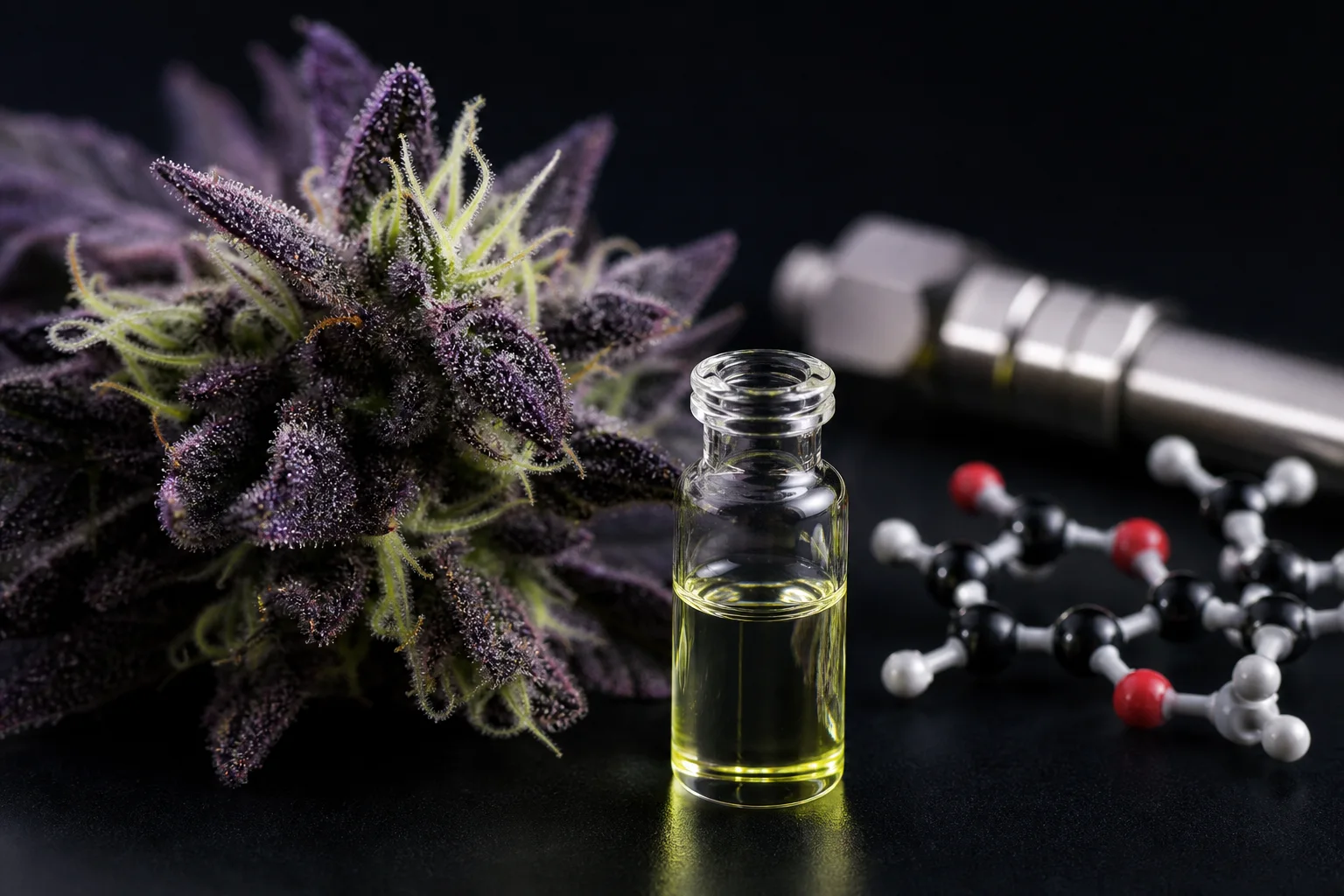
Plants meet measurement: looking for named flavonoids requires both botanical context and validated analytical methods.
Mainezilla original editorial visual · AI-assisted art directionWhy flavonoid claims show up (and why reading them matters)
Flavonoids are a diverse family of plant phenolics that contribute color, UV protection, and secondary metabolism in Cannabis sativa; within cannabis there are both common flavones/flavonols (quercetin, luteolin glycosides) and a distinctive group called cannflavins (A, B, C, and isocannflavin B). These molecules attract interest because they are chemically identifiable and, in lab experiments, have shown bioactivities that researchers study in isolation from cannabinoids and terpenes.
That scientific interest makes flavonoids attractive in product copy. Producers may highlight a named compound (e.g., “high cannflavin A”) or use vaguer language (e.g., “flavonoid-rich”), and editors or consumers seeing those claims need tools to judge whether the claim is about plant chemistry, lab measurement, or implied health benefit.
Reading claims carefully matters because the strength of evidence varies by domain: plant biochemistry and validated analytics are concrete and verifiable, preclinical models are hypothesis-generating, and controlled human evidence is scarce. Treat the claim type as a ladder — the higher the inference (from plant presence to human effect), the stronger the evidence required to justify it.
- Flavonoid identity is chemical (exact structures exist); claims should be specific.
- Measurement is empirical — look for method and batch traceability.
- Biological activity in cells/animals is not equivalent to human clinical proof.
Common claim types and what they actually mean
You will see at least three practical claim types: (1) compositional claims — straightforward statements about which flavonoids were detected or their measured concentration; (2) enrichment or extraction claims — that a process concentrates specific flavonoids; and (3) functional or health‑adjacent language implying benefits. Each class requires a different level of verification.
Compositional claims are the easiest to verify: they should point to an analytical report showing the compound name, concentration units (mg/kg or % w/w), method, and sample/batch identifiers. Enrichment claims should be matched by before‑and‑after measurements or validated extraction protocols; otherwise they are marketing words. Functional claims — anything implying an effect in people — demand human evidence and carry legal/ethical limits in many jurisdictions.
Editors and consumers should expect precision for compositional claims (exact molecule names and units) and skepticism for any language that converts presence into promise. Vague 'synergy' or 'entourage' statements are scientific hypotheses that may be framed correctly in editorial copy — but they should not be presented as proven outcomes.
- Compositional = verifiable (needs lab report and batch ID).
- Enrichment = needs comparative or process validation data.
- Functional = requires controlled human evidence; otherwise label as preclinical or speculative.
Source quality and batch evidence: provenance you can and should demand
Good claims tie to provenance. That means cultivar/chemovar name, part of plant tested (flower, leaf, trim), harvest date, and a clear batch or sample ID that matches a testing record. Flavonoid content varies considerably between varieties and between plant parts — a single lab value for an undefined sample tells you little about the whole production run.
Look for certificates of analysis (COAs) that include a sample or batch identifier that matches the product lot, a testing date, and, ideally, the sample's weight and extraction details. Some recent studies report wide variation in cannflavin content even within a single variety, which underlines the need for batch‑level testing rather than relying on a single representative number.
If a vendor references historical or aggregated data, ask whether those data are pooled across cultivars or represent the actual retail lot. Without a matching batch ID and a verifiable testing date, a flavonoid number is a claim without an anchor.
- Demand cultivar/plant part, harvest date, and batch/sample ID on COAs.
- Prefer batch-level COAs over aggregated or 'typical' tables.
- Variation within the plant and among plants is documented — batch testing reduces uncertainty.
Analytical measurement: what methods tell you and what to look for on a lab record
Analytical methods for flavonoids commonly include HPLC with photodiode array or UV detection (HPLC-PDA/UV) and LC‑MS or LC‑MS/MS. Methods can be developed and validated specifically for cannflavins or for broader phenolic profiles; validation (linearity, limit of detection, precision, recovery) is what separates a lab’s internal number from robust, repeatable science.
A trustworthy COA will show the method used (for example, 'HPLC-PDA, detector wavelength, column type, and a reference to a validation'), units (mg/kg or % w/w), and, preferably, reference standard information. Recent peer‑reviewed methods have validated HPLC-PDA protocols for cannflavins and multi‑dimensional LC‑HRMS workflows for detailed phenolic characterization — both approaches are appropriate if the reporting is transparent.
Beware of COAs that list a flavonoid number without method details or that use unspecified 'total flavonoids' assays (colorimetric or spectrophotometric totals are non‑specific and can be misleading). When a seller states an absolute number for a named flavonoid (e.g., cannflavin A = X mg/kg), there should be a method name and a lab accreditation or report available to verify it.
- Preferred methods: validated HPLC-PDA for named cannflavins, or LC‑HRMS for broader profiling.
- Watch for method details, units, and reference standards on COAs.
- Generic 'total flavonoids' without method or units is weak evidence.
How to read clinical language and scientific citations in copy
Cannflavin and other flavonoid studies in cannabis largely sit in preclinical literature (cell culture, biochemical assays, and animal models) with a smaller and emerging body of pharmacology around mechanism questions. Scoping and review articles map these preclinical findings and note that controlled human evidence specific to cannflavins is limited or absent.
When product copy cites 'studies' or 'research,' check whether the referenced work is in vitro (cells), in vivo (animals), or human. Each step has different implications: in vitro mechanistic signals are valuable for research but do not translate directly into predictable effects in people; animal studies can suggest pharmacokinetics or safety signals but are not human efficacy proof.
Editors should insist that copy distinguish preclinical evidence from clinical trials. Phrases such as 'has been shown to' should be restricted to measured chemical facts (e.g., 'contains X mg/kg of cannflavin A by HPLC'); any language about health or effect that references preclinical work must be qualified and not presented as medical evidence.
- Check the type of study (in vitro, animal, human).
- Preclinical ≠ clinical — label language must reflect that.
- Demand specific citations and check the original paper before repeating an implied claim.
Maine program context: packaging, testing expectations, and advertising boundaries
Maine’s Office of Cannabis Policy (OCP) requires testing and sets packaging, labeling, and advertising rules for the Adult Use Cannabis Program. OCP offers voluntary packaging, labeling, and advertising review and guidance documents; products in Maine are subject to mandatory contaminant and potency testing and must follow labeling rules including universal symbol requirements when applicable.
OCP guidance includes expectations around potency verification and notes that labeling tied to testing should be supported by accredited laboratory results. While Maine does not regulate plant molecules differently from other states in terms of intrinsic plant chemistry, the program does set administrative requirements about the accuracy and presentation of lab‑based claims on packaging and in advertisements.
For editorial and consumer purposes this means: (1) claims should be traceable to an OCP‑acceptable lab report or COA that matches the product lot, and (2) any language implying therapeutic benefit may cross advertising rules or consumer protection statutes and is subject to review. If in doubt, OCP’s voluntary review process lets producers and publishers confirm whether a label or ad meets state expectations.
- Maine requires lab testing and offers voluntary PLA (packaging/label/advertising) review.
- Labels tied to testing should be supported by accredited lab results and batch IDs.
- Avoid unqualified therapeutic language — OCP guidance and rules limit misleading claims.
A practical checklist for consumers and editors
Use this short checklist when you encounter a flavonoid claim: (A) Is the flavonoid named precisely (e.g., cannflavin A) or is the phrase generic ('total flavonoids')? (B) Is there a batch/sample ID and testing date that matches the retail lot? (C) Does the COA or lab report state the method (HPLC‑PDA, LC‑MS) and units (mg/kg or % w/w) and include validation info or lab accreditation?
If the answer to any of A–C is 'no,' flag the claim for verification. Additional good signs: the COA shows reference standard usage or method validation, the testing lab is ISO/IEC 17025 accredited, and if the seller cites studies they link to the original papers and describe the study type (in vitro/animal/human). Poor signs include: a single undated number on a product page, 'typical' values without batch traceability, or citations to review articles presented as clinical proof.
For editors: require that copy either (1) present only the verifiable compositional fact (with a link to the batch COA), (2) clearly qualify preclinical findings as such, or (3) remove health‑adjacent language unless there is controlled human evidence and legal clearance. For consumers: treat any claim without a verifiable COA and sample ID as unverified.
- Essential checklist items: named flavonoid, batch/sample ID, method + units, lab accreditation.
- Red flags: undated or aggregated numbers, non‑specific 'total flavonoids', missing method.
- Editors should require links to COAs and study types before publishing claims that imply effect.
What remains uncertain and where the evidence is headed
Open questions remain about the natural range and stability of specific cannflavins across commercial cultivars, the influence of drying/curing/extraction on quantitation, and the pharmacokinetics of cannabis flavonoids in humans. Several analytical and plant‑chemistry studies document intra‑varietal variability and point to the need for more standardized reference materials and multi‑lab comparisons.
Analytical capacity is improving: laboratories and metrology organizations are producing hemp/cannabis reference materials and cross‑lab quality programs to improve measurement consistency. But reference materials covering a broad flavonoid profile remain limited compared with cannabinoid reference materials, and method harmonization for flavonoids is still an active area of research.
Finally, clinical evidence specifically testing cannabis flavonoids in controlled human trials is sparse. Preclinical data justify further study, but until randomized human trials exist, claims that imply human benefit should be presented only as hypotheses or removed from marketing copy. Editors can help by being explicit about the evidence level and by avoiding translations from molecular mechanism into health claims.
- Needs: more reference materials and multi‑lab comparisons for flavonoids.
- Uncertainty: cultivar variability, processing effects, and human pharmacokinetics.
- Practical implication: treat functional claims as hypotheses until human trials are available.
Questions this guide answers
If a product lists a cannflavin concentration, is that proof of effect?
No. A measured concentration (for example, 'cannflavin A = X mg/kg') is a chemical fact about that sample if it’s tied to a verifiable laboratory report. It is not evidence of a health effect in people. Evidence for effects requires well‑designed human studies; preclinical cell or animal work indicates possible mechanisms but does not prove benefit in humans.
What is a COA and what should I look for on it?
A Certificate of Analysis (COA) is the lab report tied to a tested sample. On a COA look for: sample or batch ID that matches the product lot, testing date, method name (HPLC‑PDA, LC‑MS), units (mg/kg or % w/w), analyte names, and preferably lab accreditation or method validation details. If any of these are missing, the number is harder to verify.
Are 'total flavonoids' measurements useful?
Total flavonoid assays (often colorimetric) can indicate general phenolic content but are non‑specific and do not identify individual flavonoids like cannflavin A. When a claim concerns a named flavonoid, demand a method that identifies and quantifies that molecule specifically (HPLC‑PDA with a reference standard or LC‑MS).
Does Maine require flavonoid testing or regulate flavonoid claims?
Maine’s OCP requires testing for potency and contaminants and regulates labeling and advertising practices; OCP also offers voluntary packaging, labeling, and advertising review. While Maine does not single out flavonoids as a separate regulatory class, any label claim tied to lab testing should be supported by accredited lab results and follow OCP guidance on accuracy and advertising.
If a lab is ISO/IEC 17025 accredited, does that guarantee accurate flavonoid results?
ISO/IEC 17025 accreditation indicates that a lab meets international competency standards for testing and calibration, which improves trust in results. Accreditation does not eliminate all sources of variability (sample heterogeneity, extraction method, reference material availability), but it is an important quality marker to prefer when validating flavonoid claims.
Educational information only. This guide is not medical or legal advice and does not recommend a product, dose, treatment, or outcome.