
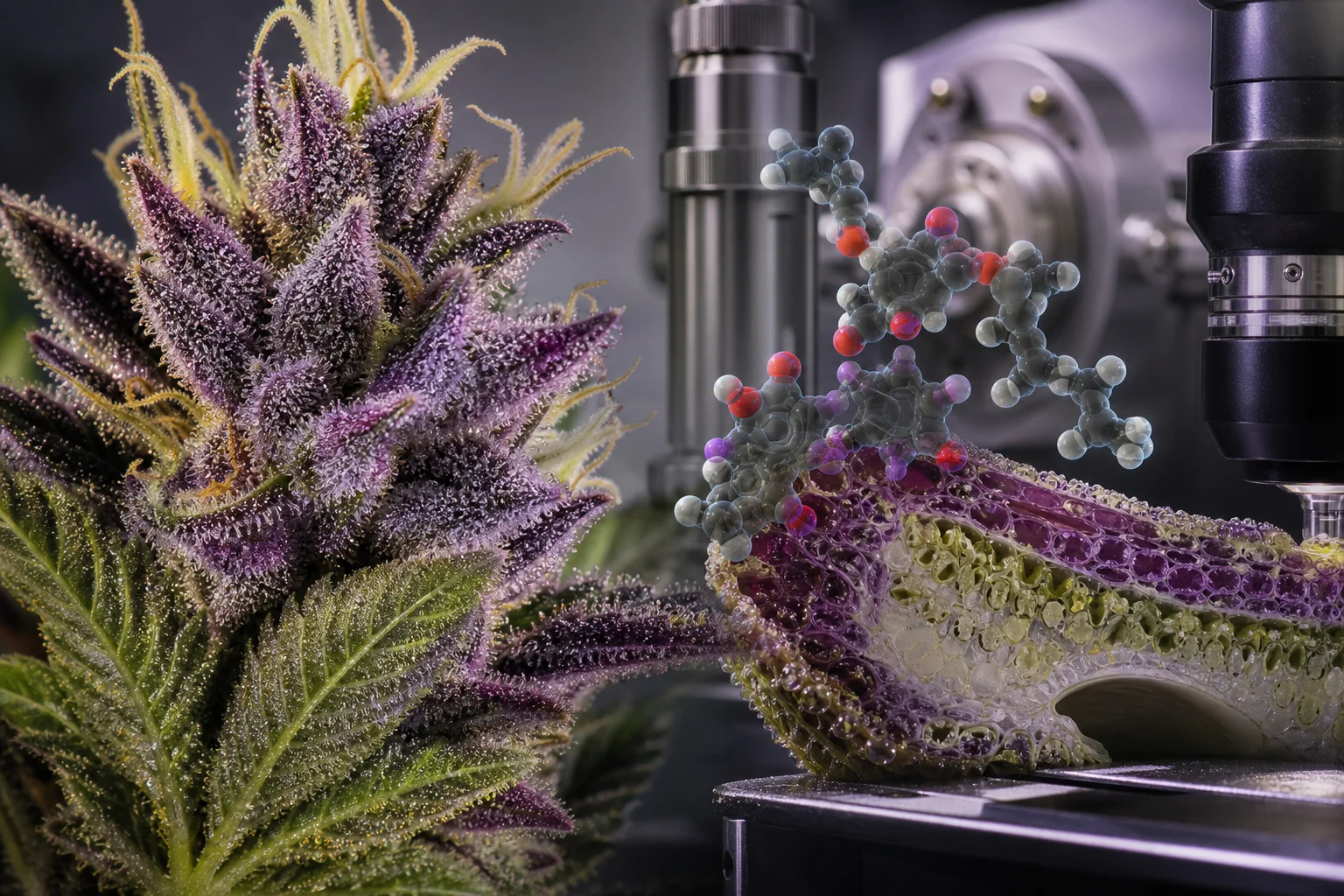
Cannabis flavonoids sit at the intersection of plant biology and analytical chemistry: macro tissue, microstructure, and molecular identity traced together in modern phytochemistry.
Mainezilla original editorial visual · AI-assisted art directionA map, not a manifesto: what we mean by "flavonoids" in cannabis
In plant chemistry, 'flavonoids' refers to a broad family of polyphenolic compounds built from a 15-carbon skeleton that can be modified (glycosylated, methylated, prenylated). In Cannabis sativa those core scaffolds appear as flavones, flavonols, flavanones, O-glycosides (like orientin and vitexin), and anthocyanins; cannabis also produces prenylated/methylated flavones that are often called cannflavins. ([pmc.ncbi.nlm.nih.gov](https://pmc.ncbi.nlm.nih.gov/articles/PMC7931196/))
Because flavonoids are a chemically diverse set, statements like 'cannabis contains flavonoids' are accurate but not decisive: different subfamilies have different chemistry and biological properties, and many cannabis flavonoids are structurally identical to compounds found across plants. The term is a taxonomic map, not a single active ingredient. ([pmc.ncbi.nlm.nih.gov](https://pmc.ncbi.nlm.nih.gov/articles/PMC7931196/))
Researchers commonly group cannabis flavonoids into two practical categories for study: (1) common plant flavonoids (apigenin, luteolin, quercetin derivatives and their glycosides), and (2) relatively under‑studied cannabis-associated prenyl/methyl flavones (cannflavins A, B, C and isocannflavin B). Treating these as separate analytical and biological questions keeps discussion precise. ([pmc.ncbi.nlm.nih.gov](https://pmc.ncbi.nlm.nih.gov/articles/PMC10714118/))
Families reported in cannabis — who’s been found where
The published chemical surveys that have profiled Cannabis sativa report more than 30 distinct flavonoids across roughly seven core scaffolds, many present as glycosides or prenylated derivatives. Frequent hits in analytical studies include orientin, vitexin, isovitexin, apigenin, luteolin, kaempferol, and quercetin derivatives, alongside the cannflavins. ([pmc.ncbi.nlm.nih.gov](https://pmc.ncbi.nlm.nih.gov/articles/PMC10714118/))
Cannflavins (A, B, C and isocannflavin B) are prenylated/methylated luteolin derivatives that have attracted special attention because early studies isolated them from flowers and leaves and because their substituents are less common among garden plants. Nonetheless, cannflavin A has also been found outside cannabis, underscoring that 'unique' is sometimes a matter of rarity, not absolute exclusivity. ([pmc.ncbi.nlm.nih.gov](https://pmc.ncbi.nlm.nih.gov/articles/PMC10714118/))
Comparative extraction and profiling work shows that the relative abundance of individual flavonoids varies by tissue and variety: leaves often have higher total flavonoid content than inflorescences on a percent‑dry‑weight basis in some surveys, while pollen and stalks contain different signatures. Analytical method and maturity at harvest strongly influence which compounds are detected. ([pmc.ncbi.nlm.nih.gov](https://pmc.ncbi.nlm.nih.gov/articles/PMC8230455/))
Where flavonoids sit in the plant: tissues and microenvironments
Flavonoids are not evenly distributed through the cannabis plant. Analytical surveys detect them in leaves, flowers (especially floral tissues and bracts), twigs, and pollen, with near‑absence in seeds and variable reports for roots. Within flowers, flavonoids are typically more concentrated in non‑glandular tissues than the cannabinoid-rich secretory structures, though co‑occurrence can still happen. ([pmc.ncbi.nlm.nih.gov](https://pmc.ncbi.nlm.nih.gov/articles/PMC8230455/))
At a microscopic level, many flavonoids are localized in epidermal cells, vacuoles, or cell walls where they influence light interception and redox chemistry; anthocyanins accumulate in vacuoles of petal and bract cells to produce color. These micro‑compartments explain both the protective roles flavonoids perform and why extraction yields depend on tissue disruption and solvent choice. ([pmc.ncbi.nlm.nih.gov](https://pmc.ncbi.nlm.nih.gov/articles/PMC7931196/))
For growers and analysts this heterogeneity matters: sampling that targets trichome‑rich resin heads will emphasize cannabinoids and terpenes, whereas bulk leaf or whole‑flower samples may register higher flavonoid contributions. Because regulatory testing and product labels usually report single composite values, understanding the sampled tissue is essential to interpreting a flavonoid record. ([pmc.ncbi.nlm.nih.gov](https://pmc.ncbi.nlm.nih.gov/articles/PMC8230455/))
What flavonoids do for the plant — functions supported by plant biology
Flavonoids are classic 'plant stress' compounds: they absorb UV, scavenge reactive oxygen species, deter herbivores or pathogens, and contribute to pigmentation that mediates pollinator and pest interactions. These actions are well supported by botanical and biochemical literature across many species and are consistent with the tissue distributions found in cannabis. ([pmc.ncbi.nlm.nih.gov](https://pmc.ncbi.nlm.nih.gov/articles/PMC7931196/))
Anthocyanins produce purple, red, and blue hues by accumulating in vacuoles of epidermal cells; in cannabis, anthocyanin expression explains the seasonal or cultivar‑specific purple coloration that consumers often notice, while flavonols and flavones play stronger roles in UV screening and antioxidation. These are plant‑centric functions and do not by themselves predict human effects. ([pmc.ncbi.nlm.nih.gov](https://pmc.ncbi.nlm.nih.gov/articles/PMC7931196/))
Cannflavins, because of their prenylated substitution, likely contribute to defense chemistry in a way that differs from simple flavones: prenylation can change membrane affinity and biological potency against microbes or herbivores. Still, the ecological role of cannflavins in cannabis remains a subject for targeted ecological and biochemical experiments rather than settled fact. ([pmc.ncbi.nlm.nih.gov](https://pmc.ncbi.nlm.nih.gov/articles/PMC10714118/))
Analytical measurement, variability, and what a lab record actually shows
Detecting a flavonoid requires an analytical chain: a representative sample, extraction method that favors the targeted analytes, separation (commonly HPLC), and identification/quantification often via UV, DAD or mass spectrometry. Different laboratories use different reference standards and limits of detection, so reported values can vary even for the same cultivar and harvest. ([pmc.ncbi.nlm.nih.gov](https://pmc.ncbi.nlm.nih.gov/articles/PMC8230455/))
Pre‑analytical factors—harvest maturity, drying conditions, storage temperature, and solvent choice—affect which flavonoids survive to be measured. Researchers have shown that some flavonoid glycosides and prenyl‑substituted species can degrade or isomerize under heat or light, making the time between harvest and analysis relevant to interpreting a flavonoid certificate. ([pmc.ncbi.nlm.nih.gov](https://pmc.ncbi.nlm.nih.gov/articles/PMC8230455/))
Regulatory testing programs (including state programs that publish guidance and testing data) usually set protocols for which analytes are reported and what methods are acceptable; they do not—and cannot—translate raw chemical presence into clinical claims. For local program context see Maine’s Office of Cannabis Policy resources and program documents. ([www1.maine.gov](https://www1.maine.gov/dafs/ocp/resources/guidance-documents))
Biological activity: what preclinical work shows and where human evidence stops
Most experimental work on cannabis flavonoids is preclinical. In vitro assays and animal models report antioxidant, anti‑inflammatory, neuroprotective, antiparasitic, and even anti‑cancer signals for select flavonoids (and for cannflavins in some models), but these results depend heavily on concentration, exposure route, and biological model. Translating those findings to humans requires careful pharmacokinetics and controlled clinical trials—data that largely do not exist for cannabis flavonoids. ([pubmed.ncbi.nlm.nih.gov](https://pubmed.ncbi.nlm.nih.gov/32858172/))
A recent primary study showed cytotoxicity of cannflavin A against human bladder carcinoma cells in vitro and suggested potential synergy with certain chemotherapeutics in cell models; such findings are hypothesis‑generating but not evidence that consuming cannabis will produce the same effects in people. Cell culture concentrations and delivery routes are not directly comparable to exposure from inhaling or ingesting plant material. ([pubmed.ncbi.nlm.nih.gov](https://pubmed.ncbi.nlm.nih.gov/35869542/))
Systematic reviews and scoping work emphasize a recurring pattern: promising mechanistic signals in controlled lab settings, sparse animal data with mixed replication, and an almost complete absence of robust randomized human trials that test isolated flavonoids from cannabis. Therefore, claims that a detected flavonoid on a lab certificate will produce a specific human outcome are unsupported by the evidentiary hierarchy. ([pubmed.ncbi.nlm.nih.gov](https://pubmed.ncbi.nlm.nih.gov/32858172/))
Why presence does not equal a human outcome — reading claims and certificates critically
A laboratory result that lists a flavonoid (for example, 'apigenin 0.05%') is a statement about chemical composition at analysis, not a statement about effect. To move from composition to outcome a chain of evidence is required: (a) a plausible mechanism at human‑relevant concentrations, (b) proof that the compound reaches target tissues in humans at effective concentrations (pharmacokinetics), and (c) controlled trials demonstrating benefit or harm. For most cannabis flavonoids those links are incomplete. ([pmc.ncbi.nlm.nih.gov](https://pmc.ncbi.nlm.nih.gov/articles/PMC7931196/))
When you read product or vendor claims, ask three operational questions: what tissue was sampled and when; which analytical method and standards were used; and what direct human evidence supports the stated effect? Answers to these questions will often reveal that a claim rests on preclinical work or on chemical analogy rather than human outcomes. ([pmc.ncbi.nlm.nih.gov](https://pmc.ncbi.nlm.nih.gov/articles/PMC8230455/))
From a regulatory and consumer‑protection standpoint, state programs publish testing requirements and guidance to make these distinctions clearer; in Maine the Office of Cannabis Policy provides resources and program data that help contextualize what a certificate of analysis reports and what it does not prove. Use those materials to interpret lab records instead of extrapolating clinical meaning from a single number. ([maine.gov](https://www.maine.gov/dafs/ocp/sites/maine.gov.dafs.ocp/files/2023-08/Maine%20Cannabis%20101.pdf))
Open questions and priorities for future research
Key uncertainties remain: (1) the in planta regulation of cannflavin biosynthesis and how environmental factors modulate final concentrations; (2) human pharmacokinetics of major cannabis flavonoids after real‑world routes of exposure; and (3) whether combinations of flavonoids and cannabinoids produce reproducible, clinically meaningful effects beyond additive chemistry. Addressing these requires cross‑disciplinary work that connects plant biochemistry, analytical chemistry, and controlled human studies. ([pmc.ncbi.nlm.nih.gov](https://pmc.ncbi.nlm.nih.gov/articles/PMC7931196/))
Methodologically, the field needs standardized reference materials for cannflavins and other flavonoids to reduce inter‑lab variability, alongside harmonized sampling protocols that state programs could adopt. Better reporting of sample provenance, harvest timing, and storage would also increase the interpretability of published concentration ranges. ([pmc.ncbi.nlm.nih.gov](https://pmc.ncbi.nlm.nih.gov/articles/PMC8230455/))
Finally, high‑quality clinical pharmacology (single‑compound and well‑characterized extrait studies) should precede efficacy claims for human outcomes. Until then, flavonoid detection is scientifically interesting and agriculturally important, but it is not a reliable basis for health claims about cannabis products. ([pmc.ncbi.nlm.nih.gov](https://pmc.ncbi.nlm.nih.gov/articles/PMC11870048/))
Questions this guide answers
Are cannflavins unique to cannabis?
Cannflavins A, B, C and isocannflavin B were first characterized from Cannabis sativa and are commonly associated with the species, but some cannflavin-like structures have been found in other plants; uniqueness is therefore a question of relative rarity rather than absolute exclusivity. ([pmc.ncbi.nlm.nih.gov](https://pmc.ncbi.nlm.nih.gov/articles/PMC10714118/))
Do flavonoids make cannabis "more therapeutic"?
No direct clinical evidence establishes that the presence of specific flavonoids in cannabis products produces consistent therapeutic effects in humans. Most support comes from cell and animal studies; human pharmacokinetic and randomized efficacy trials are largely missing. ([pubmed.ncbi.nlm.nih.gov](https://pubmed.ncbi.nlm.nih.gov/32858172/))
Can lab certificates be used to compare strains for flavonoids?
Certificates can give a snapshot of what was measured in a sampled batch, but differences in sampling, extraction, and analytical standards mean that inter‑lab and inter‑batch comparisons should be made cautiously. Prefer laboratories that publish methods and reference standards. ([pmc.ncbi.nlm.nih.gov](https://pmc.ncbi.nlm.nih.gov/articles/PMC8230455/))
Do plant color changes signal specific flavonoids?
Purple or red coloration in cannabis is usually due to anthocyanins, a subgroup of flavonoids, but color alone is not a reliable indicator of concentration or bioactivity; analytical measurement is required for accurate assessment. ([pmc.ncbi.nlm.nih.gov](https://pmc.ncbi.nlm.nih.gov/articles/PMC7931196/))
Where can I find Maine’s testing guidance and program data?
Maine’s Office of Cannabis Policy publishes guidance documents, testing program information, and public resources that clarify what regulated testing covers and how to interpret laboratory records; see the OCP resources and Cannabis 101 materials. ([www1.maine.gov](https://www1.maine.gov/dafs/ocp/resources/guidance-documents))
Educational information only. This guide is not medical or legal advice and does not recommend a product, dose, treatment, or outcome.