
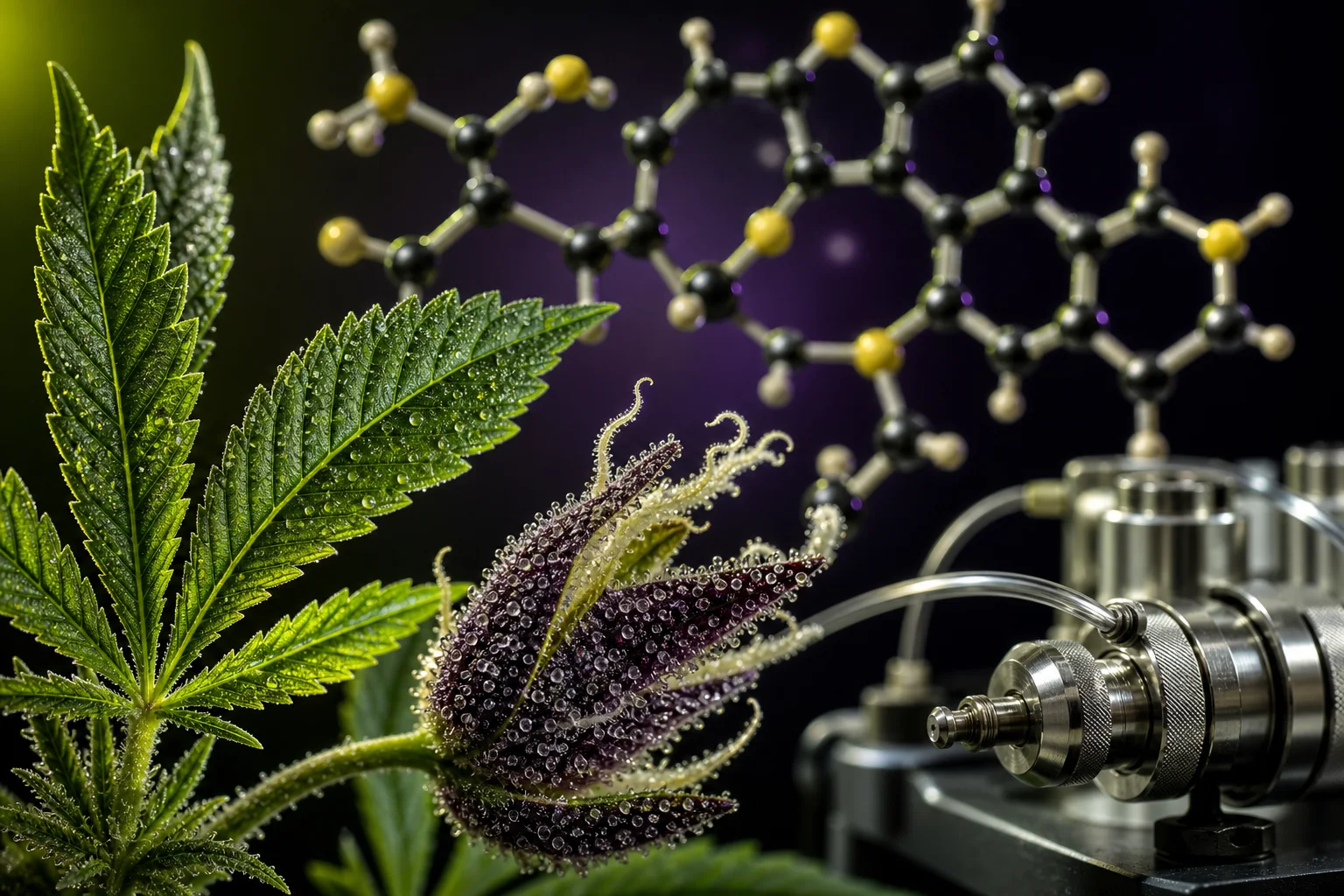
Cannflavin A: a cannabis‑specific prenylated flavone photographed beside lab equipment to emphasize the link between plant chemistry and analytical science.
Mainezilla original editorial visual · AI-assisted art directionWhy cannflavin A matters — and why to read skeptically
Cannflavin A is one of a small group of flavones (commonly called 'cannflavins') that are relatively characteristic of Cannabis sativa. They differ chemically from the cannabinoids that normally dominate popular conversations; cannflavin A is a methylated, prenylated/geranylated flavone rather than a meroterpenoid cannabinoid. Its uniqueness to Cannabis and repeated reports of anti‑inflammatory action in laboratory models have driven interest from chemists, botanists, and industry alike. Evidence: analytical chemistry identifying the molecule in plant tissue, and preclinical studies reporting biological activity. [See sources indexed in evidence.]
That interest can produce overreach. Laboratory mechanisms (for example, inhibition of specific inflammatory enzymes in cell culture) are commonly—but incorrectly—translated into claims about human benefit. By contrast, the peer‑reviewed literature on cannflavin A shows strong work on discovery, structure, biosynthesis, and measurement, and a solid set of cellular and animal studies; what is lacking is controlled clinical evidence in humans. Recognizing that distinction is the main reason this review focuses separately on chemical and analytic facts, preclinical mechanism data, and the gulf to clinical proof.
For readers who inspect product labels, media stories, or preprint claims: the important signals are (1) was cannflavin A identified by an appropriate analytical method (for example, validated HPLC with reference standard)? (2) are the cited results preclinical or clinical? (3) does the claim conflate mechanism with proof? Answering those questions requires looking at the underlying chemistry and the testing record rather than accepting headline language.
- Cannflavin A = methylated + prenylated/geranylated flavone unique to Cannabis. Evidence: structural and review literature.
- Strong analytical and mechanistic literature exists; controlled human data do not.
- Validate claims by checking methods (reference standards, validated HPLC/UV or LC‑MS).
Discovery and chemical structure: what the molecule is
Cannflavin A was recognized decades ago in chemical surveys of Cannabis secondary metabolites as a flavone bearing oxygenation and a terpenyl substituent attached to the flavone core. Modern structural analyses—NMR, mass spectrometry, and comparative chemistry—have confirmed its identification as a 6‑geranyl or 6‑prenyl substituted, 3′‑O‑methylated luteolin derivative (the exact substituent varies for the A versus B forms), which explains both its spectroscopic signature and its chemical reactivity. This structural assignment is central to interpreting analytical chromatograms and to enzymology studies that followed.
The 'cannflavin' label groups a handful of related flavones (A, B, C and isocannflavins) whose core is the flavone skeleton (derived biosynthetically from luteolin/apigenin family precursors). Geranyl (C10) versus dimethylallyl/prenyl (C5) groups account for differences between cannflavin A and B; methylation of the B‑ring phenol (to produce chrysoeriol from luteolin) is another defining chemical step. Those small changes influence solubility, chromatographic behavior, and biological interactions and are why authentic standards and careful structure confirmation are needed in laboratory reports.
Because cannflavin A is a flavone with a terpenyl substituent, it behaves like other prenylated flavonoids in extraction and analysis: it is moderately nonpolar compared with simple glycosylated flavonoids and shows characteristic UV and MS behavior that allows laboratories to separate and identify it when proper methods and standards are applied.
- Core skeleton: methylated luteolin (chrysoeriol) + geranyl group = cannflavin A.
- Geranyl (C10) vs prenyl (C5) distinguishes cannflavin A and B.
- Structure explains chromatographic and spectroscopic fingerprint; standards needed for robust ID.
Biosynthesis in Cannabis: enzymes, pathway, and tissue context
Recent molecular work has moved cannflavins from chemical curiosities to tractable metabolic products with identifiable enzymatic steps in Cannabis sativa. Genomic and biochemical studies identified an O‑methyltransferase that converts luteolin to chrysoeriol and a Cannabis aromatic prenyl/geranyl transferase (CsPT3) that transfers either a dimethylallyl (C5) or a geranyl (C10) group to produce cannflavins B and A, respectively. That enzyme pair establishes a plausible, evidence‑based route from ubiquitous flavone precursors to the cannflavins found in cannabis tissues.
Beyond the core enzymes, transcriptomics and metabolomics work show that cannflavins accumulate heterogeneously across plant organs and developmental stages; for example, biosynthesis genes and detectable cannflavin levels can be present in leaves and early plant tissues even before prolific cannabinoid accumulation in flowers, which has practical consequences for sampling and for interpreting laboratory test results across different chemovars and growing stages.
Because those biosynthetic enzymes have now been cloned and characterized biochemically, they also open routes for metabolic engineering (in microbes or heterologous plants) and provide a mechanistic foundation for rational strain selection. But genetic presence or expression of biosynthetic genes does not itself prove biological effect in humans; it only explains how and where the molecule is made in the plant.
- Key enzymes: O‑methyltransferase (luteolin → chrysoeriol) and CsPT3 (regiospecific prenyl/geranyl transfer).
- Cannflavin biosynthesis is a branch of the general flavonoid pathway in Cannabis.
- Biosynthesis explains tissue distribution and provides a route to engineered production.
Analytical identification: how laboratories find and quantify cannflavin A
Analytical identification of cannflavin A uses the same family of instrumental approaches used for other plant flavonoids: high‑performance liquid chromatography (HPLC) with UV/PDA detection or tandem mass spectrometry (LC‑MS/MS), often supported by NMR for structural confirmation when pure isolates are available. A recent validated HPLC‑UV/PDA method specifically targeted cannflavins A, B and C across chemovars and provided a template for reliable quantitation by describing extraction, chromatographic separation, and detector conditions plus validation parameters (linearity, precision, limits of detection). Accurate lab reporting therefore depends on validated methods and, ideally, comparison to certified reference standards.
Analytical pitfalls to watch for include coelution with structurally related flavonoids or isomers, matrix interferences from complex cannabis extracts, and reliance on unvalidated in‑house reference peaks. Because cannflavin A is relatively nonpolar (owing to its geranyl substituent), it often elutes later than simple flavone glycosides on reverse‑phase HPLC; mass spectral fragmentation patterns help confirm identity but require trained interpretation.
When reading a lab record or a public claim, check whether the lab used validated methods and reference standards, whether they reported limits of detection/quantitation, and whether the reported levels vary predictably across tissues and chemovars. Claims without methodological detail or with implausibly precise low‑level measurements warrant skepticism until the method is disclosed.
- Validated HPLC‑UV/PDA and LC‑MS methods exist for cannflavins; validation details are critical.
- Common pitfalls: coelution, matrix effects, and lack of reference standards.
- Ask for method validation, LOD/LOQ, and whether identity was confirmed by MS fragmentation or NMR.
Preclinical pharmacology: what the in‑vitro and animal models show
Across cell‑based assays and animal models, cannflavin A (and related cannflavins) have demonstrated anti‑inflammatory activity through several biochemical mechanisms. Reported effects include inhibition of prostaglandin E2 formation and reduction of specific inflammatory enzyme activities in vitro, as well as activity in standard animal inflammation models. Those results are reproducible across multiple laboratories and form the basis for interest in cannflavin A as a bioactive natural product.
Mechanistically, the prenyl/geranyl substituent and methylation pattern influence cell permeability and enzyme interaction, which partly explains why cannflavins can show higher potency in some enzyme assays than unmethylated luteolin. Nevertheless, potency in an isolated enzyme assay does not translate directly into efficacy in a whole organism (much less in a human clinical setting) because absorption, metabolism, tissue distribution, and biotransformation alter exposure to the unchanged parent molecule.
Fungal or microbial biotransformation studies further indicate that cannflavin A is metabolically mutable; microbes produce sulfated, glycosylated, and hydroxylated derivatives under fermentation. Those transformations are informative for metabolism research but underscore that the compound a human body sees after oral, topical, or inhalational exposure will likely differ from the isolated cannflavin A tested in vitro.
- Preclinical data: reproducible anti‑inflammatory signals in cell and animal models, not clinical outcomes.
- Mechanistic potency does not equal human effect because of ADME (absorption, distribution, metabolism, excretion).
- Microbial and metabolic studies show cannflavin A is readily transformed into different derivatives.
The evidentiary gap: why mechanism studies don't equal clinical proof
The pathway from a biochemical mechanism to a validated therapeutic effect in humans requires progressive evidence: reproducible in vitro activity, relevant animal models with appropriate pharmacokinetics, safety and toxicology, and controlled clinical trials that measure meaningful endpoints. For cannflavin A, the literature robustly covers the early stages (isolation, structure, enzymology, in vitro enzyme inhibition, some animal models) but stops short of well‑powered randomized controlled trials in humans. Reviews of cannabis flavonoids explicitly note the preclinical emphasis in the literature.
That absence is consequential. Without pharmacokinetic characterization and clinical safety data, extrapolating dosing, treatment windows, or efficacy from cell models risks error. Even when a molecule shows anti‑inflammatory action in animals, human biology can differ in target expression, metabolism, and off‑target effects. Responsible interpretation limits claims to what the data support: cannflavin A is a promising preclinical candidate for further study, not a clinically proven agent.
Regulatory and programmatic frameworks emphasize measured claims. For example, Maine's Office of Cannabis Policy (OCP) provides guidance and testing oversight for the state's licensed cannabis market; however, state regulatory oversight of testing and product claims is distinct from clinical evaluation of a molecule. In other words, a molecule being present in a regulated product does not change the evidentiary standard for clinical benefit.
- Evidence exists up to validated preclinical and analytical work; large, controlled human trials are absent.
- Clinical extrapolation requires PK/ADME and safety studies plus controlled efficacy trials.
- Regulatory testing (e.g., Maine OCP oversight) and clinical proof are separate domains.
How to read claims and laboratory records about cannflavin A
Start by separating three questions: (1) Is the molecule present? (analytical question); (2) What is known about mechanism? (preclinical question); and (3) Are there controlled human studies showing benefit? (clinical question). A laboratory report or product label can only answer (1) reliably if it cites validated methods, reference standards, and reasonable detection limits. Many overstated claims skip that first step and leap to therapeutic statements.
Practical checks: look for the laboratory method (HPLC‑UV/PDA or LC‑MS/MS) and validation details (linearity, LOD/LOQ, recovery), request a certificate of analysis that lists method and reference standards, and be wary of single‑digit 'parts per million' claims without method context. Where possible, prefer labs that participate in interlaboratory comparisons or publish their methods. Maine's OCP provides programmatic resources and guidance documents for testing and oversight; those documents are a useful place to understand what the state requires of licensed labs and what test reports should include.
When you encounter a product or article that claims 'cannflavin A reduces inflammation' without referencing human clinical work, treat it as a mechanistic claim rather than proof. Mechanistic claims are useful conversations starters for researchers and growers, but they are not a substitute for randomized controlled human data.
- Ask for method validation and a CoA that specifies method, LOD/LOQ, and use of reference standards.
- Use Maine OCP guidance to understand regulated testing and what to expect from licensed labs.
- Treat preclinical mechanism as hypothesis generation—not clinical proof.
Open questions and research priorities
Several important gaps deserve focused research: pharmacokinetics and metabolism of cannflavin A in mammalian systems; dose‑response and safety in controlled animal toxicology studies; and properly powered human pharmacokinetic and early safety studies that would inform any future efficacy trials. Because the biosynthetic enzymes have been identified, supply (either plant extraction with validated analytical tracking or heterologous biosynthesis) is increasingly tractable, which removes a practical barrier to experimental work.
Comparative work on activity between cannflavin A and structurally related flavones (for example, unmethylated luteolin or cannflavin B) is also important because small chemical changes markedly alter potency and metabolism. In addition, rigorous studies that connect exposure (measured plasma or tissue levels) to biochemical effects in vivo are necessary to assess whether concentrations that show activity in vitro are achievable safely in humans.
Finally, well‑designed clinical research—starting with human pharmacokinetic and tolerability studies and advancing to randomized trials if justified—would convert preclinical promise into clinical knowledge. Until such work is performed and published, any human‑health claims remain speculative.
- Priority studies: PK/ADME in mammals, toxicology, human PK/safety trials, then controlled efficacy trials if justified.
- Compare cannflavin A to close structural analogs to define structure–activity relationships.
- Ensure supply chain: validated analytical tracking and standards for reproducible study materials.
Questions this guide answers
Is cannflavin A the same as THC or CBD?
No. Cannflavin A is a flavone (a class of polyphenolic plant compound) that is chemically distinct from the cannabinoids THC and CBD. It has a flavone core and a terpenyl substituent, whereas THC and CBD are meroterpenoid cannabinoids built on a different chemical scaffold. Evidence: structural and review literature on cannabis flavonoids and cannflavins.
Are there human clinical trials proving cannflavin A works for inflammation?
As of the most recent reviews and primary literature, no robust, controlled human clinical trials demonstrate efficacy of cannflavin A for inflammation. The literature contains reproducible preclinical (cell and animal) results but lacks randomized controlled human studies. Translating preclinical findings to human benefit requires additional pharmacokinetic, safety, and clinical efficacy research.
How can I tell if a lab really measured cannflavin A in a sample?
Request the certificate of analysis (CoA) and check that the lab lists the analytical method (for example, validated HPLC‑UV/PDA or LC‑MS/MS), the use of reference standards for cannflavin A, and validation parameters such as limits of detection/quantitation and recovery. Unspecified 'flavonoids' claims without method details are insufficient to confirm identity and quantity.
Does Maine treat cannflavin A differently under its cannabis rules?
No. Maine's Office of Cannabis Policy regulates the licensed cannabis market (testing, product labeling, licensing, and related oversight) but does not treat single secondary metabolites as separately regulated drugs. Regulatory oversight focuses on product safety, testing standards, and labeling within the state's adult use and medical programs; it does not equate to clinical endorsement of a molecule's health effects.
Educational information only. This guide is not medical or legal advice and does not recommend a product, dose, treatment, or outcome.