
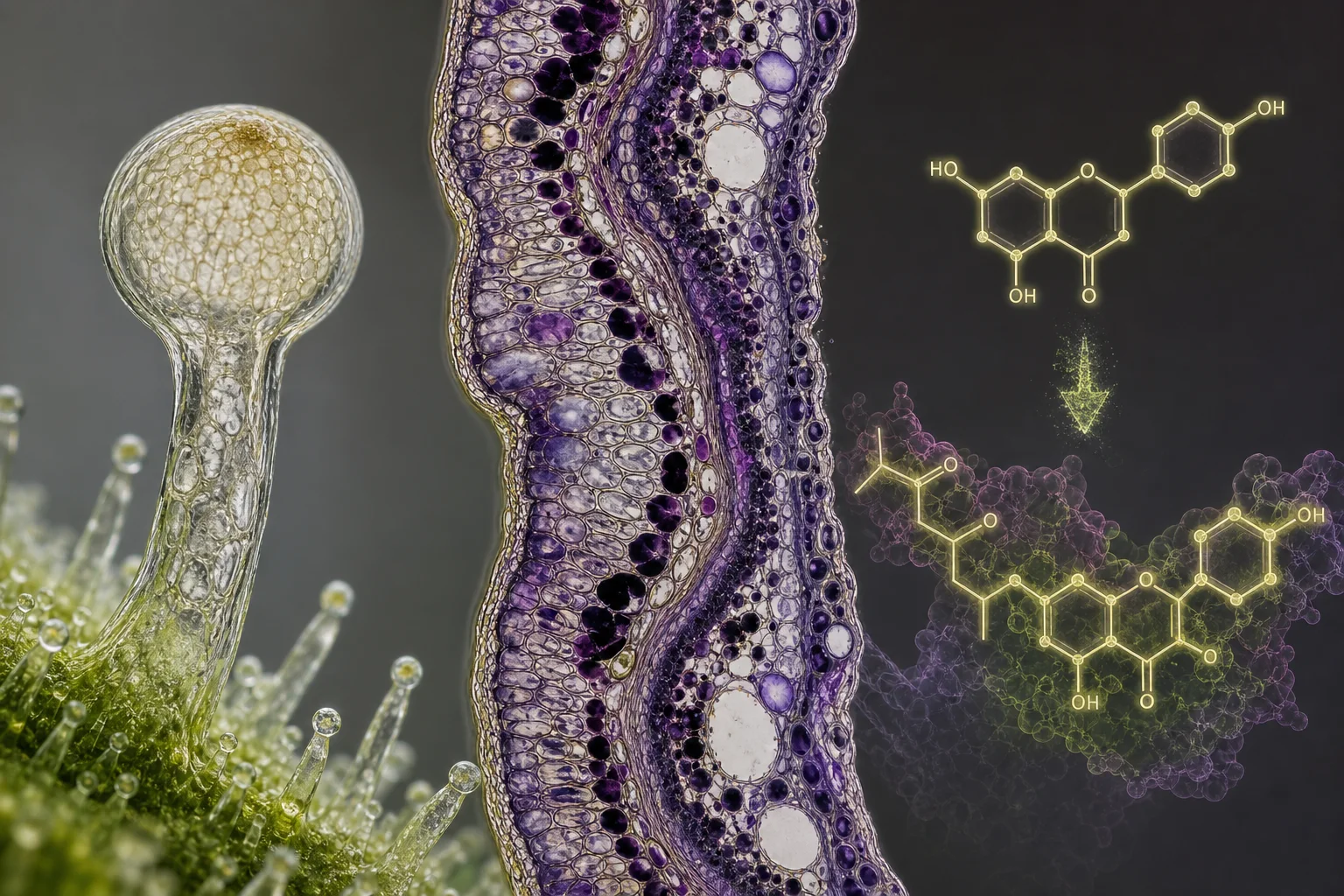
Composite image combining macro botanical detail, tissue microscopy, and a chemical schematic of luteolin → chrysoeriol → cannflavin transformations to illustrate where and how Cannabis builds flavonoids.
Mainezilla original editorial visual · AI-assisted art direction1. A simple starting point: phenylalanine and why it matters
If there’s one biochemical starting point you need for plant flavonoids, it’s the amino acid phenylalanine. Plants convert phenylalanine into a small set of cinnamic acids that feed many downstream pathways—lignin, coumarins, stilbenes, and the flavonoids we’re focused on here.
That conversion is catalyzed by phenylalanine ammonia-lyase, or PAL. PAL removes an amino group from phenylalanine to make cinnamic acid; subsequent enzymes—most importantly cinnamate 4‑hydroxylase (C4H) and 4‑coumarate‑CoA ligase (4CL)—produce p‑coumaroyl‑CoA, the activated phenylpropanoid substrate that chalcone synthase (CHS) uses to start flavonoid assembly. This multi-enzyme funneling from a common amino acid is why flavonoid production links closely to primary metabolism and to environmental signals that change amino-acid pools.
In Cannabis sativa, PAL, C4H and 4CL sequences and expression have been reported and are consistent with the canonical plant route from phenylalanine to p‑coumaroyl‑CoA, so nothing exotic is required for Cannabis to make flavonoids—the plant uses the familiar phenylpropanoid entry point. ([pmc.ncbi.nlm.nih.gov](https://pmc.ncbi.nlm.nih.gov/articles/PMC8657439/))
2. Building the flavonoid skeleton: CHS, CHI, and naringenin
Once p‑coumaroyl‑CoA is available, chalcone synthase (CHS) performs three condensations with malonyl‑CoA to build a chalcone backbone. Chalcone isomerase (CHI) then closes the ring to give a flavanone—naringenin—the common intermediate that the rest of the pathway branches from.
From naringenin, simple enzymatic choices produce different flavonoid families: flavone synthase (FNS) converts naringenin to flavones (apigenin → luteolin after further hydroxylation), flavanone 3‑hydroxylase (F3H) and flavonol synthase (FLS) produce flavonols (kaempferol, quercetin), and dihydroflavonol reductase (DFR) leads toward anthocyanins. Competition for intermediates and enzyme specificities determine the chemical profile of a tissue.
Cannabis carries the expected CHS/CHI/FNS/FLS gene families and produces the common aglycones—apigenin, luteolin, quercetin and kaempferol—alongside distinctive compounds. Genome and transcriptome analyses show that the core flavonoid enzymes are present and variably expressed across tissues and chemovars, which explains why some plants make more flavonols versus flavones or anthocyanins. ([pmc.ncbi.nlm.nih.gov](https://pmc.ncbi.nlm.nih.gov/articles/PMC8657439/))
3. The cannflavin branch: methylation then prenylation
Three flavones known as cannflavins A, B, and C are widely associated with Cannabis. They are prenylated (or geranylated) flavones derived chemically from luteolin. Two enzymatic steps distinguish cannflavin biosynthesis from the more common flavone routes: O‑methylation at the 3′‑hydroxyl (making chrysoeriol from luteolin) and an aromatic prenyltransferase reaction that installs a C5 (prenyl) or C10 (geranyl) side chain at a ring carbon.
Work combining biochemical purification, phylogenomics, and heterologous assays identified an O‑methyltransferase (CsOMT21) that methylates luteolin to produce chrysoeriol, and an aromatic prenyltransferase (CsPT3) that accepts chrysoeriol and transfers either dimethylallyl diphosphate (DMAPP) or geranyl diphosphate (GPP) to make cannflavin B and cannflavin A, respectively. Those two enzyme activities provide direct experimental evidence for the specific cannflavin branch in Cannabis and are a rare example of a fully mapped, Cannabis‑native flavonoid step. ([pubmed.ncbi.nlm.nih.gov](https://pubmed.ncbi.nlm.nih.gov/31151063/))
paragraphs_last_citation_note
4. Where flavonoids are made and stored in the plant
Flavonoid accumulation and the expression of biosynthetic genes vary by tissue. In Cannabis, transcriptomics and metabolite profiling show abundant flavonoid‑pathway expression in leaves and flowers, with particular enrichment of anthocyanins and related flavonols in purple varieties and of cannflavins and common flavones in floral and foliar tissues.
Trichomes (the glandular hairs that concentrate cannabinoids and many terpenes) have been investigated as sites of specialized metabolism, but flavonoid localization is not limited to trichomes. Genome‑wide expression studies that paired RNAseq with metabolomics indicate that many flavonoid biosynthetic genes are expressed in leaves and other aerial tissues; some early enzymes (PAL, CHS) are broadly expressed while later tailoring enzymes (OMTs, prenyltransferases) can be more tissue- or cell-specific. That pattern suggests that cannflavin production may be concentrated where the specialized tailoring enzymes are expressed, not necessarily only inside capitate trichomes. ([pmc.ncbi.nlm.nih.gov](https://pmc.ncbi.nlm.nih.gov/articles/PMC9571422/))
paragraphs_last_citation_note
5. How the flavonoid pathway is regulated (and why it’s messy)
Flavonoid biosynthesis is regulated at multiple levels: substrate supply (phenylalanine and malonyl‑CoA), enzyme abundance, enzyme isoform specificity, transcription factor control (notably MYB, bHLH and WD40 complexes in other plants), and post‑translational modification. Many of the classic transcriptional regulators discovered in model species are conserved in plants generally, and cannabis genomes also contain MYB and bHLH family members linked to secondary metabolism.
But the simple catalog of regulators doesn’t make predictions easy. Different tissues express different paralogs, environmental signals (light, temperature, nutrient stress) shift flux between branches, and competition between enzymes (for example FLS vs DFR at dihydroflavonol) changes whether a molecule becomes a flavonol or an anthocyanin. In Cannabis, early gene inventories and expression atlases provide candidate regulators, but functional evidence tying specific transcription factors to cannflavin or other flavonoid outputs remains limited.
That regulatory uncertainty is why two plants grown from the same genetics but in different environments can give strikingly different flavonoid profiles: genetics sets the potential, but environment and developmental stage lengthen or shorten the pathway’s reach. For researchers and technicians, that means gene expression and metabolite data are complementary—one shows capacity, the other shows the realized chemistry. ([pmc.ncbi.nlm.nih.gov](https://pmc.ncbi.nlm.nih.gov/articles/PMC8657439/))
6. Reading lab reports and claims: what the numbers mean (and don’t)
Analytical laboratories report flavonoid content using a variety of choices that affect comparability: some quantitate aglycones after hydrolysis, others report intact glycosides; methods can be targeted LC‑MS/MS for specific molecules or broader LC‑HRMS profiling. Prenylated flavones such as cannflavins are low‑abundance and chemically different from common flavonols, so method sensitivity and the availability of authentic standards affect whether a lab detects them at all.
In Maine’s regulated context, the Office of Cannabis Policy publishes testing guidance and related resources that shape how adult‑use products are sampled and tested. Those materials are an essential local reference for understanding which analytes are commonly reported, how samples are collected, and what program‑level reporting limitations exist—so auditors, buyers, and researchers should consult the OCP guidance relevant to the sample type and test in question rather than treating a single Certificate of Analysis as authoritative for all contexts.
Practically: when you read a flavonoid claim, check whether the lab used validated methods, which molecules are reported (aglycones, glycosides, prenylated flavones), the limits of detection, and whether sample handling (drying, storage) is described—those factors determine how much confidence to place in a numeric value. Numbers alone don’t show where a molecule was made, how stable it was, or whether post‑harvest loss occurred. ([pmc.ncbi.nlm.nih.gov](https://pmc.ncbi.nlm.nih.gov/articles/PMC7931196/))
- Ask: were measurements made by targeted LC‑MS/MS with verified standards or by non‑targeted profiling?
- Ask: does the report differentiate aglycones from glycosides, and list limits of detection?
- Ask: how were samples taken and stored before analysis?
7. What remains unsettled — and where new experiments will matter
We understand many of the enzyme classes and have experimentally identified the key methyltransferase and prenyltransferase in the cannflavin branch, but large gaps remain. Important unknowns include the precise cell-type localization of many tailoring enzymes (are they in stalk cells, trichome heads, surrounding epidermis?), the in planta flux under different developmental or stress conditions, and the transport and compartmentalization mechanisms that move flavonoids into vacuoles or cell walls.
Functional genetics in Cannabis—knockouts or cell‑type reporters—are technically and legally more difficult than in model plants, so much evidence still comes from expression correlations and heterologous enzyme assays. Those are strong leads, but correlation is not proof of in‑plant function: the identified CsPT3 and CsOMT21 activities are robust biochemical demonstrations, yet the full regulatory context that controls when and where they act in the living Cannabis plant needs more direct in‑plant testing.
Because of these uncertainties, honest interpretation of flavonoid data leans on converging evidence—genomics + transcriptomics + metabolomics + enzyme biochemistry—rather than on a single kind of dataset. That convergence is happening fast, and the steps already mapped are tractable entry points for metabolic engineering or for breeders who want to change profiles; but we should read those possibilities as plausible, not finished. ([pubmed.ncbi.nlm.nih.gov](https://pubmed.ncbi.nlm.nih.gov/31151063/))
Questions this guide answers
Are cannflavins unique to Cannabis?
Cannflavins A and B were first described in Cannabis and are characteristic prenylated/geranylated flavones in this plant, but related prenylated flavones exist in other species. Experimental work identified the Cannabis enzymes CsOMT21 and CsPT3 that convert luteolin → chrysoeriol → cannflavins, supporting a Cannabis‑native biosynthetic route, but similar chemistry is found elsewhere in the plant kingdom. ([pubmed.ncbi.nlm.nih.gov](https://pubmed.ncbi.nlm.nih.gov/31151063/))
Does the presence of a flavonoid in a COA guarantee a plant made it in a trichome?
No. A Certificate of Analysis shows that a molecule was present in the tested sample but not where it was synthesized. Flavonoid biosynthetic genes are expressed in multiple tissues in Cannabis; some tailoring enzymes are tissue‑specific, but the distribution is not limited to trichomes. To know localization you need tissue‑level expression or microscopy studies. ([pmc.ncbi.nlm.nih.gov](https://pmc.ncbi.nlm.nih.gov/articles/PMC9571422/))
Can post‑harvest handling affect flavonoid numbers?
Yes. Flavonoids can be glycosylated, degraded, or transformed during drying and storage, and analytical choices (reporting aglycones vs intact glycosides) change reported values. That’s why method descriptions and sample handling details are crucial for interpreting a flavonoid record. ([pmc.ncbi.nlm.nih.gov](https://pmc.ncbi.nlm.nih.gov/articles/PMC7931196/))
Does Maine require testing for flavonoids?
Maine’s Office of Cannabis Policy publishes testing guidance and required analyte lists for regulated testing; program guidance documents and FAQs explain what laboratories must report for regulated products. Consult the OCP resources for current program testing rules and guidance. ([www1.maine.gov](https://www1.maine.gov/dafs/ocp/resources/guidance-documents))
Educational information only. This guide is not medical or legal advice and does not recommend a product, dose, treatment, or outcome.