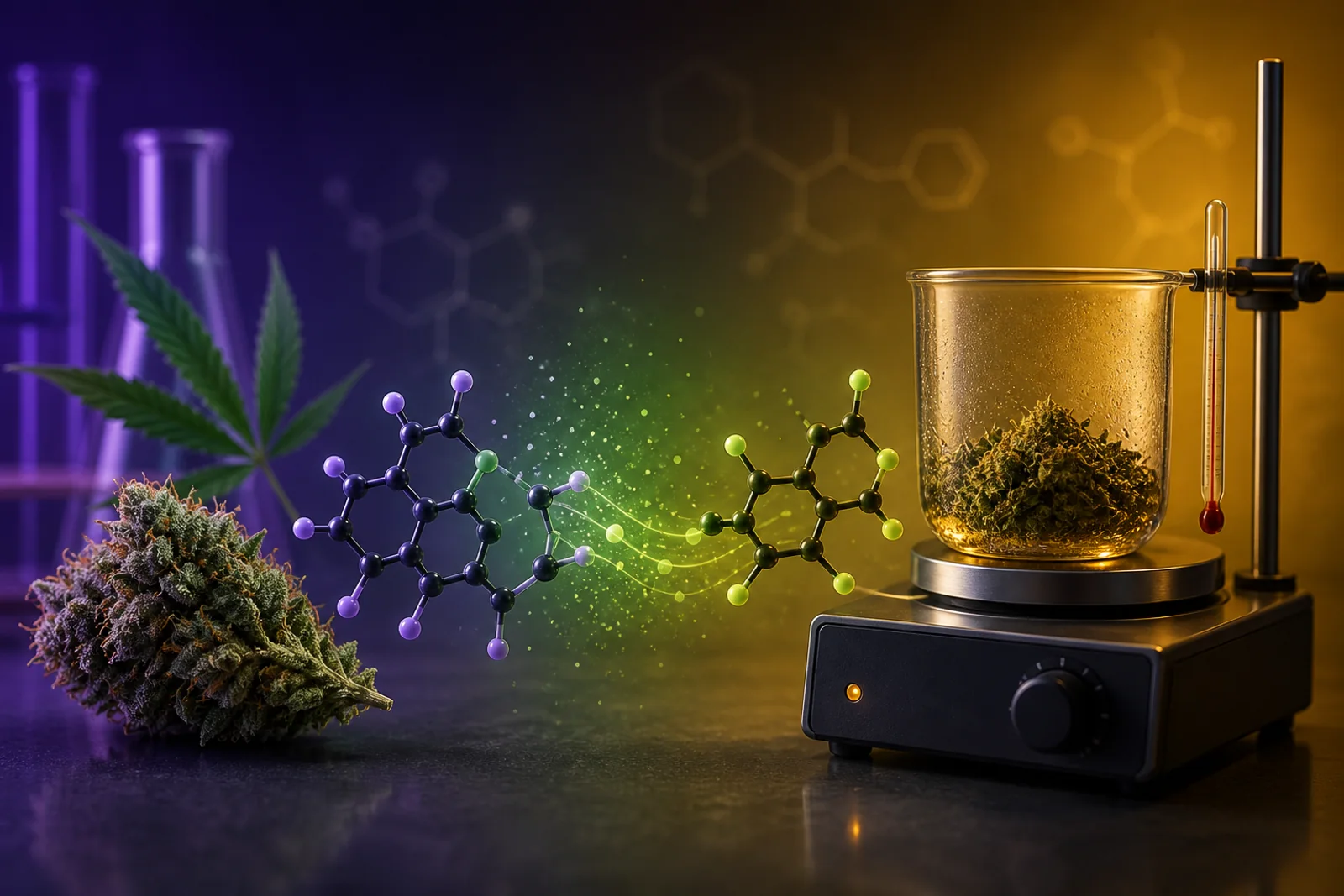
The transition from plant material through heat and molecular change directly supports the guide’s explanation of cannabinoid acids and decarboxylation.
Mainezilla original editorial visual · AI-assisted art directionWhy this field guide exists
If you spend any time around growers, testers, or labels you’ll hear two repeating refrains: "the plant makes the acid forms" and "look at the COA." This guide unpacks both statements without drowning you in equations. Think of it as the short, grounded tour that you can use in the trimming room, at the drying rack, or when you’re reading a lab report with a coffee in hand.
Our focus is practical and evidence‑first: what cannabinoid acids are, how and when they become the neutral molecules people often mean when they say “THC” or “CBD,” and why laboratory “total” numbers are a calculation, not a divine truth. We’ll lean on peer‑reviewed kinetics work and official testing guidance so that the advice you take back to the grow room is tied to real measurements, not lore.
We also keep it cautious. Chemistry doesn’t translate to a one‑size‑fits‑all effect in a human. Routes of use, product form, and individual differences matter. This is a field guide for the plant and for reading the record — not a dosing manual or medical advice.
What are cannabinoid acids (the 'A' in THCA and CBDA)?
Cannabis plants naturally produce cannabinoids in an acidic form: THCA, CBDA, CBGA and friends. These are the biosynthetic outputs of the plant’s enzymes — the molecules the plant actually makes and stores in trichomes on fresh and dried flowers. Recent work tracing the evolutionary origin and function of cannabinoid synthases lays out how enzymes channel precursors into these acidic products. The neutral forms (THC, CBD) are products that form when that acid group is removed, usually by heat or long‑term degradation.
Calling these molecules “inactive” is misleading. In the plant and in some lab assays the acid forms are bioactive in their own right; they simply differ chemically and pharmacologically from their decarboxylated siblings. From a grower’s perspective, the acid forms are the starting currency: how much THCA versus CBDA a cultivar makes determines the chemical trajectory of any finished product.
For analytical labs and reference programs, dried plant material is typically measured for both acidic and neutral forms because the ratio carries meaningful information about cultivar genetics, harvest timing, and processing. Reference materials and characterized hemp matrices exist to help labs measure those species consistently; these standards are important when you’re trying to compare one COA to another.
Decarboxylation — not an on/off switch
Decarboxylation is the chemical name for losing a carboxyl group (CO2 and a hydrogen) from the acidic cannabinoid to form the neutral molecule. It’s what happens when THCA becomes THC, CBDA becomes CBD, and so on. But it’s a kinetics problem — governed by temperature, time, oxygen, moisture, and the chemical matrix (whole flower vs. solvent extract vs. oil). Multiple peer‑reviewed studies show that the rate and completeness of conversion vary substantially across those variables.
Because decarboxylation follows temperature‑ and time‑dependent kinetics, it’s a continuum: partial conversion is common. At modest heat for short times you’ll see a partial shift toward neutral cannabinoids; at higher temperatures or longer times conversion is greater but so is the risk of secondary reactions (degradation to other, sometimes unidentified, products). Different cannabinoids decarboxylate at different rates — THCA often converts faster than CBDA under the same conditions in controlled experiments.
Practical takeaway: heating flower (smoking, vaping, baking) can increase the proportion of neutral cannabinoids available for absorption, but the exact change depends on how you apply heat. Likewise, long‑term storage, exposure to light, and oxygen can slowly convert acids to neutrals without deliberate heating, and that slow path can also yield degradation products.
This variability is why lab experiments measure decarboxylation under controlled conditions and why you shouldn’t assume a single temperature/time recipe will have identical effects in different matrices.
Reading 'total THC' (and why math matters more than wishful thinking)
Laboratories often report a calculated “total THC” intended to represent the maximum THC available after complete decarboxylation. The common approach is to measure THCA and THC separately and then apply a conversion factor that accounts for the change in molecular mass when CO2 is lost. In plain terms: THCA is heavier than THC because of that extra carboxyl group, so the math scales THCA down to the mass equivalent of THC before adding it to measured THC.
That conversion factor looks like chemistry homework — and it is chemistry. Different labs may use slightly different factors or rounding rules, and units matter: the COA should show the formula used and the units (mg/g, % weight, etc.). Don’t add numbers off the label without checking whether the lab already did the math for you. A reported “total” is an estimate tied to the tested sample and the method used, not a property of the cultivar that will be identical in everyone’s jar.
Regulatory programs — Maine’s included — require reporting of potency and cannabinoid profiles as part of mandatory testing, and they also set the expectations for COAs and electronic data deliverables. Because OCP requires THC potency and cannabinoid profiling as a mandatory analyte category, those calculation practices and the lab’s method become legally relevant for what gets sold and labeled.
In short: treat “total THC” as a useful educated estimate. Use the COA’s footnotes, the lab method, and the sample description to understand what that estimate actually represents for your batch.
Why route, preparation, and storage change what the plant delivers
A raw bud in a jar is chemically different from a baked brownie, a vape cartridge, or a pressed rosin. Smoking and vaping apply rapid heat that produces a quick bolus of neutral cannabinoids; edibles and tinctures involve extraction and digestion that change both availability and timing. The chemistry of decarboxylation sits at the center of those differences but doesn’t tell the whole story about onset, duration, or subjective effects.
Storage and post‑harvest handling also matter. Drying and curing protocols influence moisture, microbial risk, and slow chemical changes — including gradual decarboxylation or other degradation. NIST’s work on hemp reference materials and cannabis lab‑QA highlights how matrices and handling affect measured results, which is why certified reference materials and interlaboratory exercises are valuable for consistent testing.
From a safety perspective, exposure routes make a difference too. Inhalation produces effects within minutes; ingestion can be delayed hours. Poison Control resources and public health guidance emphasize that edibles can be unpredictable and that accidental pediatric exposures to infused products are a common and serious concern. As growers and label readers, you’re part of the safety chain: accurate COAs, child‑resistant packaging, and clear labeling reduce the real‑world risk of accidental exposure.
Finally, remember that the chemistry lesson does not equate to medical guidance. Individual tolerance, concurrent medication, and health status are all relevant when people make decisions about use — and those are conversations for clinicians, not field guides.
What testing variability means for growers and consumers
Different labs, different extraction and analytic methods, and different sample preparations can produce different numbers for the same batch. That’s one reason Maine’s Office of Cannabis Policy requires reporting of potency and cannabinoid profiles and maintains EDD reporting via the testing program: to create a consistent administrative record and to allow licensees to compare results over time and across labs.
Retesting is possible in limited circumstances (failed tests, remediation, suspected errors), but the tested sample is always the tested sample. If you changed how you processed the batch after sampling — a different cure, a new trim approach, or a post‑harvest heat treatment — the COA is no longer a perfect representation of the finished jar unless you re‑sample and re‑test.
Labs rely on reference materials and QA programs to keep methods aligned; NIST’s reference material for hemp and interlaboratory exercises help laboratories validate their measurements. As a grower, maintain tight sampling protocols and clear chain‑of‑custody so the COA corresponds to the product on the shelf. As a consumer, read the COA footnotes: they tell you the units, the conversion formula used for “total” values, and the sample context.
Remember — a COA gives you a snapshot for a specific sample and method. Use it together with good product stewardship and honest labeling practices to reduce surprises for everyone.
Field tips: practical steps that respect the chemistry
Handle samples like a scientist (or a fussy chef). When preparing a crop for sampling, standardize the portion you send: same buds, same trim stage, same drying/curing window. Inconsistent sampling is one of the most common reasons a COA and a jar disagree. Maine’s guidance for mandatory testing is the baseline for what must be tested and reported in the adult‑use system.
Control heat exposure pre‑package. If your process includes heat‑based remediation or extraction, document it. Heat speeds decarboxylation — sometimes deliberately (for edibles or extracts) and sometimes inadvertently (poorly ventilated drying rooms, sun‑exposed storage). Good records help you reconcile observed cannabinoid shifts with expected chemistry.
Store finished flower cold, dark, and dry when possible. Lower temperatures and minimal light slow chemical conversion and degradation. That won’t stop decarboxylation forever, but it buys you shelf stability. For labs and producers, using validated reference materials and participating in interlaboratory QA exercises improves confidence in measured numbers.
Finally, prepare to answer customer questions with humility. Explain that COAs are tied to a tested sample and a method, that ‘‘total THC’’ is a calculated estimate, and that route of use changes timing and experience. If someone needs clinical advice about interactions or health risks, point them toward clinicians or official public‑health resources rather than making medical claims yourself.
Questions this guide answers
If I heat flower, will all the THCA become THC?
Not always. Heating drives decarboxylation, but the amount converted depends on temperature, time, moisture, and matrix. Some conversion is likely; complete conversion requires sufficient heat and time and also risks secondary degradation.
Why do COAs list both THCA and THC separately?
Labs quantify acidic and neutral forms separately because they are distinct chemical species. Reporting both provides the data needed to calculate a ‘‘total’’ value and to understand the sample’s chemical profile.
Is 'total THC' guaranteed across products from the same cultivar?
No. 'Total THC' is a calculated estimate for a specific tested sample. Processing, storage, and testing methods make batch‑to‑batch differences likely.
Do acidic cannabinoids matter for safety or effects?
They can. Acidic cannabinoids are chemically different and may behave differently in lab assays and potentially in biology. However, translating that chemistry to specific human effects requires clinical evidence; the chemistry alone isn’t a dosing guide.
If a child eats an edible, what should I do?
Seek expert help immediately. Use webPOISONCONTROL or call your regional poison center (1‑800‑222‑1222 in the U.S.). Pediatric exposures to cannabis can require prompt evaluation.
Educational information only. This guide is not medical or legal advice and does not recommend a product, dose, treatment, or outcome.