
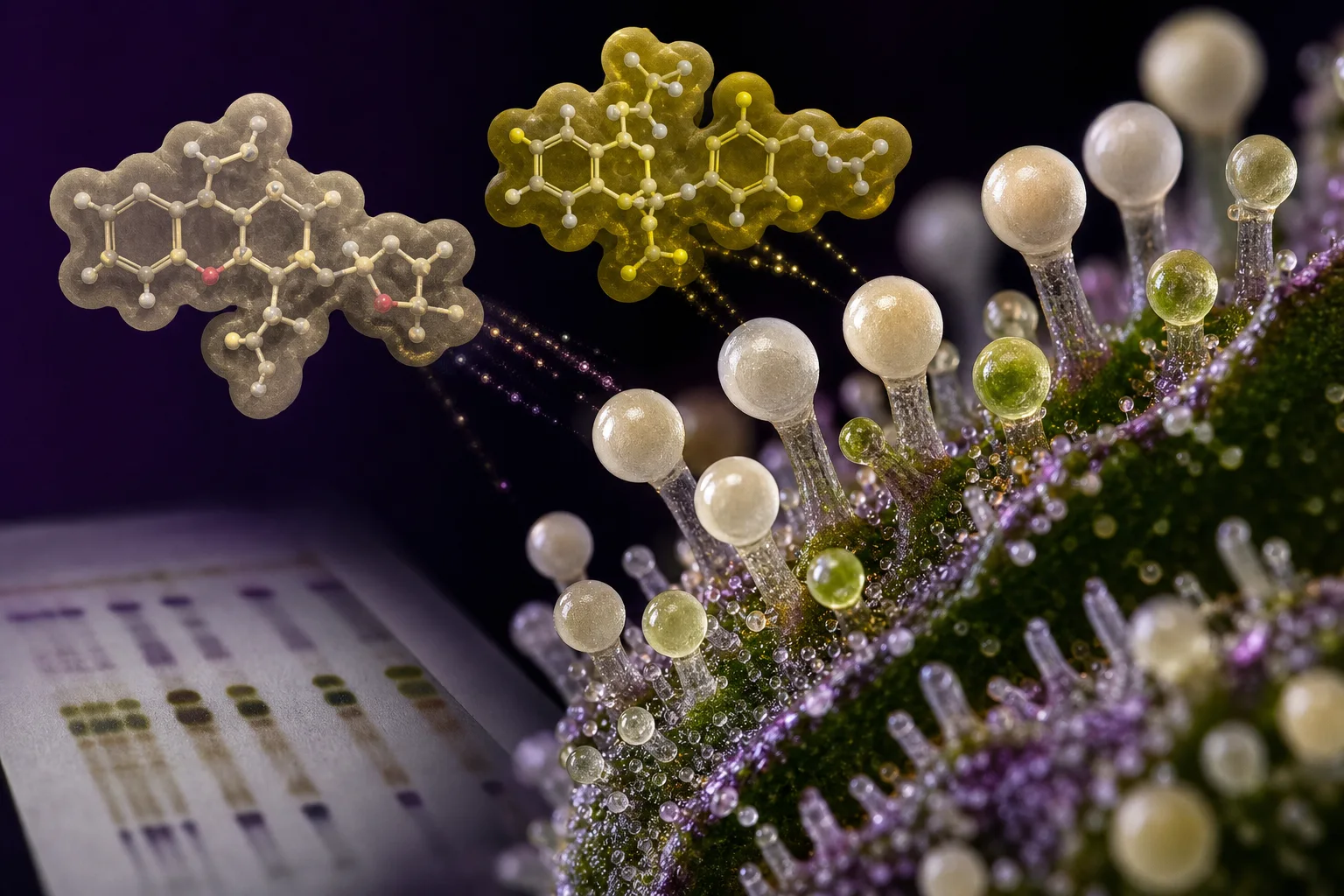
Glandular trichomes (source of cannflavins) shown with illustrative molecular models of cannflavin B and isocannflavin B; image emphasizes origin and analytical separation rather than consumption.
Mainezilla original editorial visual · AI-assisted art directionWhat are cannflavins B, C, and isocannflavin B?
Cannflavins are a small group of flavonoids that were first recognized as relatively Cannabis-specific prenylated flavones. The most commonly discussed are cannflavin A, B, and C; isocannflavin B is a structural isomer that shares much of the same core flavone skeleton but differs in how the prenyl group is attached. Modern reviews and chemical summaries treat these as prenylflavones (geranyl or dimethylallyl side chains on the flavone core) with subtle ring and substituent differences that influence physicochemical behavior. ([pmc.ncbi.nlm.nih.gov](https://pmc.ncbi.nlm.nih.gov/articles/PMC10714118/))
Chemically, what makes cannflavins ‘look’ different from common flavones (like luteolin) is the presence of an alkyl side chain — a dimethylallyl (C5) or geranyl (C10) substituent — attached to the A-ring, and in many cases a methoxy group on the B-ring. Those modifications raise lipophilicity and can change membrane permeability and metabolic stability in assays. Isocannflavin B retains the same atoms as cannflavin B but arranges the prenyl attachment so it’s a positional isomer; that small change can matter a lot for how a molecule behaves in chromatography, in enzyme assays, or in cell membranes. ([pmc.ncbi.nlm.nih.gov](https://pmc.ncbi.nlm.nih.gov/articles/PMC7931196/))
Because names like “cannflavin B” and “isocannflavin B” describe structural families rather than biological activities, it’s important to separate chemical identity (structure, stereochemistry, regiochemistry) from reported bioactivity. When you see a claim about 'cannflavin B' activity, check whether the study used a verified standard, an isolated natural extract, or a synthetic isomer — those distinctions change what the results mean. ([pubmed.ncbi.nlm.nih.gov](https://pubmed.ncbi.nlm.nih.gov/32858172/))
How cannflavins differ at the molecular level
At a glance the three cannflavins share a flavone backbone; the differences are in the pattern and size of alkylation and in B-ring substitution. Cannflavin A is typically described as the geranyl (C10) derivative, while cannflavin B bears a smaller dimethylallyl (C5/prenyl) group. Cannflavin C is also prenylated but differs in precise substitution pattern or oxidation state. Isocannflavin B is a regiochemical isomer of cannflavin B — the prenyl unit is attached at a different position on the ring system. These structural details are not trivia: they affect solubility, HPLC retention time, UV-visible spectra, and how enzymes in living systems recognize or metabolize the molecules. ([pmc.ncbi.nlm.nih.gov](https://pmc.ncbi.nlm.nih.gov/articles/PMC10714118/))
Because prenylation increases lipophilicity and may mask polar hydroxyls, prenylated flavones often partition into nonpolar solvent fractions during extraction and show distinct chromatographic behavior compared with non-prenylated flavones (for example, luteolin). That property helps analysts enrich for cannflavins during preparative chromatographic separations but also complicates quantitation in complex plant matrices unless methods are validated specifically for these compounds. ([pubmed.ncbi.nlm.nih.gov](https://pubmed.ncbi.nlm.nih.gov/40981218/))
Isomeric differences — such as those between cannflavin B and isocannflavin B — mean that mass alone is rarely decisive. Analysts rely on orthogonal data (retention time against authentic standards, UV spectra, MS/MS fragmentation, or NMR when quantities allow) to establish identity. In research reports, the most defensible statements tie a biological effect to a chemically verified structure, not merely to an extract labeled by the investigator. ([pubmed.ncbi.nlm.nih.gov](https://pubmed.ncbi.nlm.nih.gov/40981218/))
Where they live in the plant and how abundant they are
Cannflavins are typically present at low concentrations in Cannabis sativa compared with major cannabinoids. Recent targeted and untargeted phytochemical work, including single-trichome analyses, shows that cannflavins concentrate in glandular trichomes — the same micro-organs that harbor cannabinoids and many terpenes — but absolute levels can vary tenfold or more between plants and cultivars. That variation matters: two samples labeled the same variety can yield dramatically different cannflavin content. ([pubmed.ncbi.nlm.nih.gov](https://pubmed.ncbi.nlm.nih.gov/40139041/))
A growing analytical literature has reported cannflavin concentrations in units like milligrams per kilogram of dried flower, but numbers differ because of extraction method, plant material (whole flower vs. isolated trichomes), harvest timing, and post-harvest handling. The low native abundance is one practical reason researchers push toward synthesis or heterologous biosynthesis when gram-scale quantities are needed for pharmacology. ([pmc.ncbi.nlm.nih.gov](https://pmc.ncbi.nlm.nih.gov/articles/PMC10714118/))
For anyone reading a product label, lab certificate, or a research table: low abundance increases the chance of analytical false negatives or of quantitation at the limits of detection. That’s why method validation for extraction efficiency, matrix effects, and limit of quantitation is not optional if you want trustworthy numbers. ([pubmed.ncbi.nlm.nih.gov](https://pubmed.ncbi.nlm.nih.gov/40981218/))
How researchers isolate and measure cannflavins
Because cannflavins are low-abundance and chemically similar to other flavonoids, analytical approaches must be targeted and validated. A recent validated HPLC-UV/PDA method demonstrates development and application of chromatographic separation and detection specifically for cannflavin A, B, and C across several chemovars, including calibration against standards and attention to sample preparation. That kind of targeted chromatography remains the backbone of accurate quantitation in plant samples and commercial testing. ([pubmed.ncbi.nlm.nih.gov](https://pubmed.ncbi.nlm.nih.gov/40981218/))
Typical workflows start with solvent extraction (often methanol or methanol-containing mixtures), cleanup (solid-phase extraction or liquid–liquid partitioning to remove chlorophyll and bulk lipids), and chromatographic separation using reversed-phase columns. Because cannflavins are more lipophilic than parent flavones, gradients and column chemistries sometimes need optimization to avoid co-elution with cannabinoids or late-eluting matrix components. Detection is often by photodiode array and mass spectrometry to add specificity. ([pubmed.ncbi.nlm.nih.gov](https://pubmed.ncbi.nlm.nih.gov/40981218/))
Analytically, the presence of isomers (such as isocannflavin B) underlines the importance of authentic reference standards. Without standards, labs may report a combined peak or misassign a signal. Synthetic chemistry and biosynthetic production of authenticated materials therefore directly support reliable measurement because they provide the reference compounds needed for retention-time and spectral confirmation. ([pubmed.ncbi.nlm.nih.gov](https://pubmed.ncbi.nlm.nih.gov/40981218/))
Routes to supply: isolation versus synthesis and biosynthesis
Because natural yields are low and plant-to-plant variability is high, researchers have pursued two complementary strategies to obtain cannflavins at scale: classical chemical synthesis and biosynthetic (metabolic engineering) approaches. A regiodivergent chemical synthesis developed in the organic chemistry literature shows how medicinal chemists can access both cannflavin B and its isomer, isocannflavin B, from common synthetic intermediates by controlling protecting groups and reaction conditions. Chemical synthesis gives unambiguous material for structural confirmation and biological testing. ([pubmed.ncbi.nlm.nih.gov](https://pubmed.ncbi.nlm.nih.gov/18454537/))
On the biosynthetic side, work in Cannabis has identified enzymes that convert upstream flavones (like luteolin and chrysoeriol) into cannflavins A and B. The discovery of candidate methyltransferases and prenyltransferases that act on flavone substrates creates a route to heterologous production — for example, using microbes or engineered plant hosts — which could yield larger quantities without the complexity of Cannabis biomass. That approach also offers a cleaner supply chain for pharmacology because the product can be produced in a controlled fermentation or expression system. ([pubmed.ncbi.nlm.nih.gov](https://pubmed.ncbi.nlm.nih.gov/31151063/))
Both strategies have trade-offs. Synthesis can be step-heavy and require chromatographic purifications, but it yields unambiguous standards. Biosynthesis can be scalable and stereospecific but needs enzyme characterization and pathway balancing, and the end product still requires purification. For the researcher or product developer, the sensible path depends on the quantity required, required purity, and whether the goal is discovery research or potential downstream development. ([pubmed.ncbi.nlm.nih.gov](https://pubmed.ncbi.nlm.nih.gov/18454537/))
What the preclinical evidence actually shows — and what it doesn’t
Preclinical literature on cannflavins centers on cell-based assays and animal models that examine anti-inflammatory, antioxidant, antiparasitic, antiviral, and some antiproliferative endpoints. Cannflavin A historically attracted attention for its inhibition of prostaglandin synthesis; downstream work looking across the cannflavins family has suggested overlapping but distinct bioactivities. Reviews and scoping analyses catalog these findings but consistently flag that most work is in vitro or in small-animal models. ([pubmed.ncbi.nlm.nih.gov](https://pubmed.ncbi.nlm.nih.gov/32858172/))
The scoping review of cannflavins summarized the available activity studies and highlighted heterogeneity in methods, compound source (isolated vs. synthetic), and outcome measures. That heterogeneity matters: an inhibitory concentration determined in a purified enzyme assay is not directly comparable to an effect seen in a whole-animal model where absorption, metabolism, and distribution come into play. The reviews emphasize promising signals but stop short of clinical claims because of the lack of controlled human data. ([pubmed.ncbi.nlm.nih.gov](https://pubmed.ncbi.nlm.nih.gov/32858172/))
Two common sources of over-interpretation in the public sphere are (1) extrapolating an in vitro EC50 directly to expected human dosing and (2) assuming that an effect seen with a crude extract equates to the activity of a single constituent. Both errors can be reduced by demanding chemical verification (authentic standard, MS/MS, or NMR), clear description of assay context, and, ultimately, replication in models that incorporate pharmacokinetics. Until controlled human studies appear, statements about 'effects in people' remain speculative. ([pubmed.ncbi.nlm.nih.gov](https://pubmed.ncbi.nlm.nih.gov/32858172/))
Reading claims and records: practical guidance
If you’re parsing a laboratory certificate, product claim, or research report, start by asking five straightforward questions: (1) What exact compound was tested (cannflavin B, isocannflavin B, or a combined signal)? (2) Was an authentic standard used for identification? (3) What were the limits of detection and quantitation? (4) Was the matrix whole flower, isolated trichomes, or extract? (5) Is the result replicated or published in a peer-reviewed report? Answers to those questions distinguish robust data from anecdote. ([pubmed.ncbi.nlm.nih.gov](https://pubmed.ncbi.nlm.nih.gov/40981218/))
Be especially cautious with claims that rely on crude extracts or on 'proprietary blends' without analytical disclosure. Low-abundance molecules are easy to mis-assign; co-eluting phenolics or lab-specific method quirks can create false positives. Request chromatograms and method validation parameters or look for independent third-party testing that separates and quantifies cannflavins by validated HPLC or LC–MS methods. ([pubmed.ncbi.nlm.nih.gov](https://pubmed.ncbi.nlm.nih.gov/40981218/))
For Maine readers navigating the state program context: the Maine Office of Cannabis Policy provides resources on testing, packaging, and public education, but state program materials do not imply a separate regulatory determination about individual plant molecules. Use OCP resources for operational context (where to find recalls, guidance documents, and lab-related resources) and treat molecular claims as scientific evidence that stands or falls on analytical and experimental quality. ([maine.gov](https://www.maine.gov/dafs/ocp/resources))
- Ask whether an authentic standard was used for identification and quantitation.
- Request method validation parameters: LOD/LOQ, recovery, matrix effects.
- Prefer reports that show orthogonal confirmation (UV spectrum, MS/MS, or NMR).
Where uncertainty remains and sensible next steps for researchers
Despite steady progress, several uncertainties are prominent. First, we lack controlled human pharmacokinetic or pharmacodynamic studies for the cannflavins; preclinical promise has not been translated into human evidence. Second, analytical standardization across laboratories remains incomplete: different extraction and chromatographic methods produce a patchwork of reported concentrations. Third, biosynthetic pathways and enzyme specificities, while recently elucidated in part, need fuller characterization if heterologous production is to be reliable at scale. ([pubmed.ncbi.nlm.nih.gov](https://pubmed.ncbi.nlm.nih.gov/32858172/))
These gaps point to clear, achievable next steps: validated multi-lab analytical round-robins to harmonize quantitative reporting; production of certified reference materials (either by synthesis or biosynthesis) to support identification; rigorously designed translational pharmacology studies that begin with human pharmacokinetics; and mechanistic studies that place observed in vitro targets in a physiologically relevant concentration range. None of that requires hype — only careful chemistry and careful study design. ([pubmed.ncbi.nlm.nih.gov](https://pubmed.ncbi.nlm.nih.gov/40981218/))
For growers, lab managers, and readers trying to separate signal from noise, the sensible posture is humility: acknowledge interesting preclinical results while insisting on chemical verification, reproducibility across methods, and controlled human data before elevating an anecdotal claim to an assertion about effects in people. That approach respects both plant complexity and the limits of the evidence. ([pmc.ncbi.nlm.nih.gov](https://pmc.ncbi.nlm.nih.gov/articles/PMC10714118/))
Questions this guide answers
Are cannflavins B, C, or isocannflavin B unique to Cannabis?
Cannflavins are often associated with Cannabis because early identification came from the plant, and related prenylflavones are characteristic of the species' specialized metabolism. However, structurally similar prenylated flavonoids occur in other plants; for example, some taxa produce related geranylated or prenylated flavones. Chemical uniqueness should be evaluated case-by-case by structural analysis, not by the common name alone. ([pmc.ncbi.nlm.nih.gov](https://pmc.ncbi.nlm.nih.gov/articles/PMC7931196/))
Can laboratory testing reliably tell cannflavin B from isocannflavin B?
Yes — if the laboratory uses orthogonal identification criteria (authentic standards, retention time matching, UV–Vis spectra, MS/MS fragmentation, and ideally NMR when scale permits). Without reference standards, isomeric peaks can be misassigned or reported as combined signals, so ask for method details and confirmation. ([pubmed.ncbi.nlm.nih.gov](https://pubmed.ncbi.nlm.nih.gov/40981218/))
Do we have human clinical trials showing cannflavins work for inflammation or other conditions?
No controlled human clinical trials for cannflavins B, C, or isocannflavin B were identified in the recent literature reviews. Existing evidence comes from in vitro and animal models, which are hypothesis-generating but not proof of clinical efficacy. ([pubmed.ncbi.nlm.nih.gov](https://pubmed.ncbi.nlm.nih.gov/32858172/))
Why might a producer choose synthesis or biosynthesis instead of extracting from Cannabis flower?
Natural yields are low and variable; extraction requires large amounts of biomass and extensive purification. Chemical synthesis supplies unambiguous standards and is useful for small-scale studies, while biosynthetic (heterologous) production offers a potential scalable and cleaner route if enzymology and pathway engineering are optimized. Each route has cost and technical trade-offs. ([pubmed.ncbi.nlm.nih.gov](https://pubmed.ncbi.nlm.nih.gov/18454537/))
Where can I look for reliable program-level information about testing and recalls in Maine?
The Maine Office of Cannabis Policy maintains a Resources section that links to guidance documents, testing and recall information, and consumer education campaigns. That page is a practical starting point for state-specific operational context but does not represent a safety endorsement of individual molecules. ([maine.gov](https://www.maine.gov/dafs/ocp/resources))
Educational information only. This guide is not medical or legal advice and does not recommend a product, dose, treatment, or outcome.