
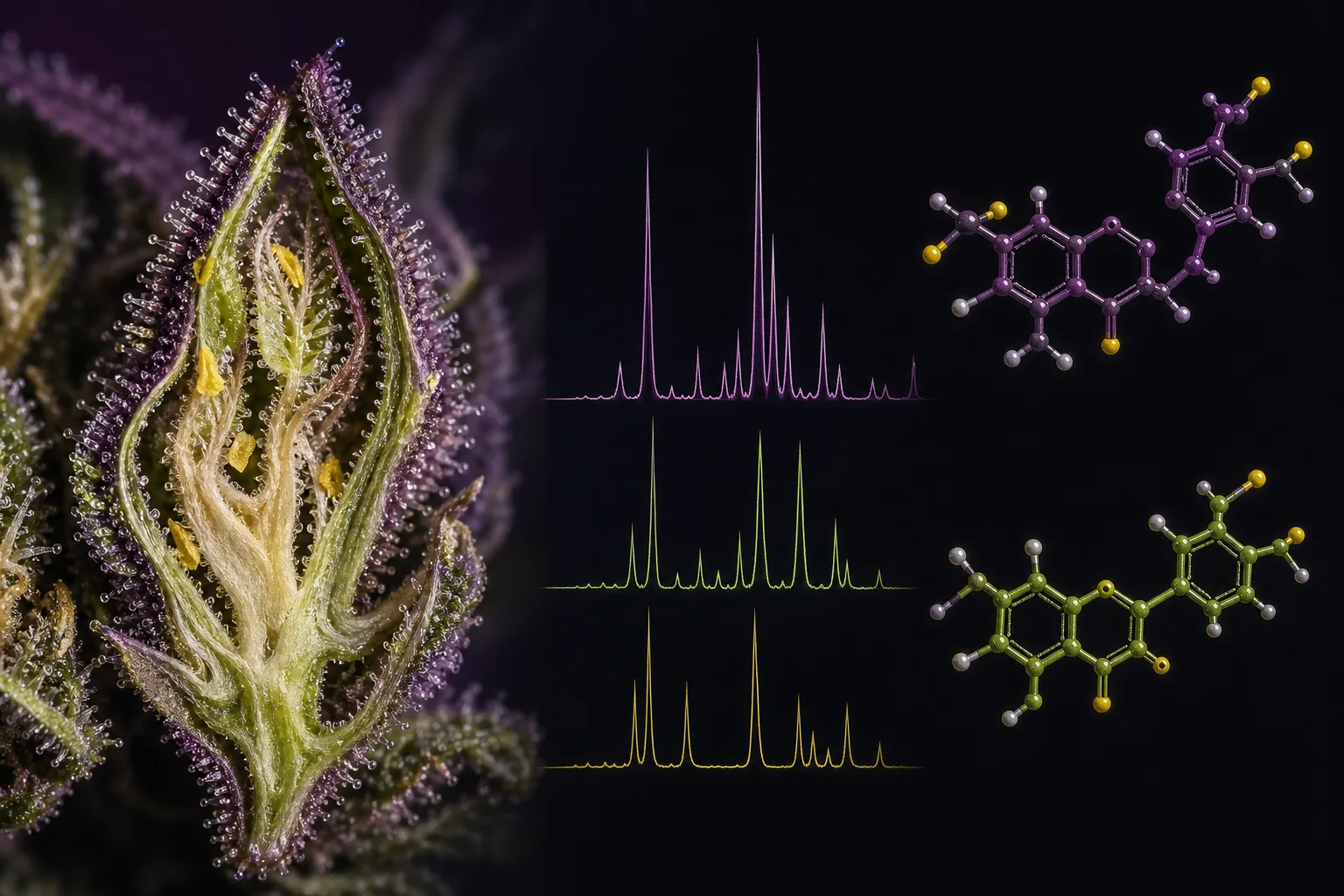
Flavonoids in cannabis are both a biosynthetic record and a post‑harvest chemistry story — drying, light, oxygen, and processing change what laboratories measure.
Mainezilla original editorial visual · AI-assisted art directionWhy this matters: flavonoids are a fragile biochemical record
Flavonoids are a large family of plant polyphenols that include classical flavonols, flavones, anthocyanins, and a small set of cannabis‑enriched molecules (the cannflavins). In the living plant these molecules are localized, conjugated, and maintained by cellular compartmentation and enzymatic systems that buffer them from rapid chemical change. Once a flower is cut, that buffering stops: water relations change, enzymes contact substrates differently, and exposure to oxygen and light becomes consequential for the chemistry researchers and regulators read later. ([pubmed.ncbi.nlm.nih.gov](https://pubmed.ncbi.nlm.nih.gov/36064291/))
For regulators, labs, and growers, the practical consequence is that a flavonoid profile measured in a dried, packaged sample is not a neutral ‘snapshot’ of what the living plant contained. It is the product of the plant’s original biosynthesis plus all modifications introduced by harvest timing, drying strategy, cure, storage time, temperature, oxygen, light exposure, and any downstream extraction or analytical prep. Flavonoids carry both biological signal and post‑harvest noise. ([pmc.ncbi.nlm.nih.gov](https://pmc.ncbi.nlm.nih.gov/articles/PMC9404914/))
That duality — biosynthetic reality versus post‑harvest alteration — is why we need cautious, plant‑specific experiments rather than borrowing stability conclusions from other crops or from cannabinoid data alone. The food‑science literature provides mechanistic expectations (light and oxygen drive polyphenol oxidation; heat accelerates degradation), but cannabis contains some unique structures and matrices that alter reaction pathways. ([pubmed.ncbi.nlm.nih.gov](https://pubmed.ncbi.nlm.nih.gov/36064291/))
What the analyses measure: molecule versus matrix
Analytical labs report flavonoids in many ways: raw peak areas from LC or UV chromatograms, concentrations of aglycones or glycosides, or semi‑quantified values relative to standards. Those numbers are sensitive to extraction solvent, temperature, filtration, and whether the analysis targets free aglycones or conjugated forms. A method that cleaves conjugates will report higher apparent aglycone amounts than a non‑hydrolyzing method; both can be ‘correct’ for that method but are not directly comparable. ([pmc.ncbi.nlm.nih.gov](https://pmc.ncbi.nlm.nih.gov/articles/PMC9404914/))
This method sensitivity interacts with post‑harvest chemistry. For example, oxidative cleavage, enzymatic hydrolysis, or photochemical transformation during drying or storage will change the chemical form available to extraction, and therefore the lab record. In short: measurement is a joint function of the molecule’s chemical state and the analytical procedure. Comparing flavonoid numbers without matching sample history and method is a common source of error. ([pmc.ncbi.nlm.nih.gov](https://pmc.ncbi.nlm.nih.gov/articles/PMC8911901/))
Regulatory test menus (including forms and chain‑of‑custody data used in state programs) typically capture which tests were requested and some aspects of sampling and storage, but they rarely capture the nuanced pre‑analytical history (hang time, relative humidity during cure, light exposure during storage) that most influences flavonoid fate. That omission makes it harder to interpret discrepant lab records across batches or facilities. Maine’s Office of Cannabis Policy (OCP) provides sample‑chain templates and guidance on requested tests, which support traceability but are not a substitute for flavonoid‑specific handling parameters in the record. ([maine.gov](https://www.maine.gov/dafs/ocp/sites/maine.gov.dafs.ocp/files/inline-files/OCP_SCF_1.pdf))
Drying and curing: pathways to change, not just moisture removal
Drying is the first major post‑harvest inflection point. Traditional air or hang drying, forced‑air ovens, freeze‑drying, and newer approaches like controlled microwave or desiccant systems produce very different thermal and oxygen exposure histories. Those differences matter because flavonoid stability depends on both temperature and the presence of oxygen and light. Low‑temperature, oxygen‑limited drying tends to preserve more native flavonoid structure; high‑temperature or long drying under oxygen accelerates oxidative loss and enzymatic transformations. ([pmc.ncbi.nlm.nih.gov](https://pmc.ncbi.nlm.nih.gov/articles/PMC8911901/))
Recent controlled studies in cannabis and other botanicals show that drying can change not only concentration but chemical form: glucosides may hydrolyze, flavonoid aglycones can oxidize, and small local shifts in pH or metal ion availability (released as tissues break down) can catalyze degradative pathways. A cannabis study that profiled volatiles and cannabinoids under different drying regimes also noted that non‑volatile, polar metabolites vary with drying and handling — an expected but under‑quantified result for flavonoids. ([pmc.ncbi.nlm.nih.gov](https://pmc.ncbi.nlm.nih.gov/articles/PMC11180634/))
Curing (equilibration after drying) is often promoted in cannabis culture to round aromas and ‘age’ material. From a flavonoid perspective, curing can either stabilize the profile (if moisture and oxygen are controlled) or promote slow oxidative change if humidity and oxygen permit residual enzymatic or microbial activity. There are few cannabis studies that systematically compare curing atmospheres for flavonoid retention; the broader medicinal‑plant literature suggests careful humidity control and oxygen limitation preserve polyphenols best. ([pmc.ncbi.nlm.nih.gov](https://pmc.ncbi.nlm.nih.gov/articles/PMC9404914/))
Storage: oxygen, light, temperature, and packaging matter
Storage is not passive: oxygen diffusion, light exposure, and temperature cycles continue to reshape flavonoid chemistry. Light, particularly in the UV‑visible range, drives photo‑oxidation of conjugated flavonoids; oxygen enables classical oxidative cleavage and polymerization, and elevated temperatures accelerate these reactions. In practice, cold, dark, low‑oxygen storage slows flavonoid decay across many plant systems. ([pubmed.ncbi.nlm.nih.gov](https://pubmed.ncbi.nlm.nih.gov/36064291/))
Packaging choices change the microenvironment. Vacuum‑sealed, inert‑gas flushed containers reduce oxygen‑driven loss; opaque or UV‑blocking materials reduce photochemical reactions. Conversely, permeable plastics, frequent container opening, or storage under bright retail lighting are predictable accelerants of change. Controlled studies in cannabis and related botanicals show measurable shifts in marker compounds over months under different packaging regimens, underscoring that what a lab measures after weeks or months of storage is largely a storage artefact. ([pmc.ncbi.nlm.nih.gov](https://pmc.ncbi.nlm.nih.gov/articles/PMC13032246/))
Temperature is a particularly strong driver. Even modest warming (for example, storage at 25–30 °C versus refrigerated conditions) shortens flavonoid half‑lives. This is consistent with general kinetics of polyphenol degradation and with experimental cannabis postharvest literature that flags temperature as a leading variable for phytochemical stability. If a record lacks an explicit storage temperature and duration, the flavonoid numbers are significantly less informative. ([pubmed.ncbi.nlm.nih.gov](https://pubmed.ncbi.nlm.nih.gov/36064291/))
Processing and extraction: solvents, heat, and selective recovery
Processing — whether lab extraction for analysis or commercial extraction for products — is a second critical filter on the flavonoid record. Solvent polarity strongly determines which flavonoids are solubilized: methanol, acetonitrile, or aqueous mixtures extract different glycosides and aglycones. Heat‑assisted extractions can improve yield but also promote thermal degradation or hydrolysis of conjugates. Therefore, extraction conditions must be considered when comparing flavonoid numbers from a plant sample versus a finished product or an extract. ([pmc.ncbi.nlm.nih.gov](https://pmc.ncbi.nlm.nih.gov/articles/PMC9404914/))
People often conflate ‘loss’ with disappearance from a particular analytical window. Many flavonoid degradation pathways create oxidized products, dimers, or polymeric material that may not be quantified by a targeted assay but still exist in the matrix. Those transformation products can have different solubilities and spectral properties, which makes them invisible to the original assay but chemically real. Comprehensive non‑targeted profiling (HR‑MS, untargeted LC–MS/MS) reveals this shifting landscape but is not yet routine in the cannabis testing network. ([pmc.ncbi.nlm.nih.gov](https://pmc.ncbi.nlm.nih.gov/articles/PMC13032246/))
This is why regulatory and research labs must report methods tightly (extraction solvent, temperatures, standards used) and why comparisons across labs require method harmonization or method‑conversion factors. Without that context, statements like “X% of flavonoids lost during processing” are at best an incomplete observation and at worst misleading. ([pmc.ncbi.nlm.nih.gov](https://pmc.ncbi.nlm.nih.gov/articles/PMC9404914/))
Evidence trail: [6]
The danger of borrowing conclusions across plant matrices or from cannabinoids
Cannabinoids and flavonoids have different chemistries. Cannabinoids are terpenophenolic and often lipophilic; many flavonoids are polar and exist as glycosides. Their stability drivers differ: cannabinoids undergo decarboxylation and oxidation in predictable ways, whereas flavonoids are often subject to enzymatic hydrolysis, metal‑catalyzed oxidation, photochemical rearrangement, and pH‑sensitive reactions. Treating evidence from cannabinoid stability studies as direct proof for flavonoids is therefore a mistake. ([pmc.ncbi.nlm.nih.gov](https://pmc.ncbi.nlm.nih.gov/articles/PMC9404914/))
Likewise, extrapolating flavonoid stability from unrelated crops (tea leaves, citrus peels, or berry tissues) can mislead because matrix interactions — binding to cell wall materials, co‑extracted metal ions, or endogenous enzyme repertoires — alter reaction kinetics. Cannabis has unique cannabinoids and specialized metabolism that can affect redox balance, meaning flavonoid fate may be different in cannabis than in another plant under the same temperature and oxygen conditions. Dedicated cannabis experiments are required. ([pmc.ncbi.nlm.nih.gov](https://pmc.ncbi.nlm.nih.gov/articles/PMC13032246/))
The literature is improving: recent cannabis‑focused post‑harvest work explicitly profiles volatiles, cannabinoids, and polar metabolites across drying and storage regimes and points to matrix‑specific outcomes. But flavonoid‑targeted time‑series studies (controlled oxygen, light, and temperature with validated flavonoid standards) remain comparatively rare. Until those data exist, readers should treat cross‑matrix claims and cannabinoid‑based analogies skeptically. ([pmc.ncbi.nlm.nih.gov](https://pmc.ncbi.nlm.nih.gov/articles/PMC11180634/))
Practical guidance: how to read flavonoid records without overclaiming
When you see a flavonoid profile or a product claim, first look for the pre‑analytical metadata: harvest date, drying method, cure conditions, storage time and temperature, and packaging description. If that meta‑data is absent, treat single‑time‑point numbers as highly provisional because storage and handling usually dominate measured differences. Maine’s OCP documents and sample forms help with chain‑of‑custody and test requests, but they do not replace flavonoid‑specific handling notes. ([maine.gov](https://www.maine.gov/dafs/ocp/sites/maine.gov.dafs.ocp/files/inline-files/OCP_SCF_1.pdf))
Second, inspect the analytical method: what extraction solvent and temperature were used? Was the assay targeted to specific aglycones or to glycosides? Were certified standards used, and were method validation data (linearity, LOD/LOQ, recovery) reported? Without method transparency you cannot know whether differences between samples reflect real plant chemistry or simply differences in extraction and detection. ([pmc.ncbi.nlm.nih.gov](https://pmc.ncbi.nlm.nih.gov/articles/PMC9404914/))
Third, beware of single‑number ‘retention’ claims (for example, “90% of flavonoids retained”) without time, temp, and O2 context. Retention is a kinetic statement — it depends on how long and under what conditions. Finally, prefer datasets that include non‑targeted profiling or that report likely transformation products, not only the parent compounds, because transformed flavonoids can be chemically significant even if they are not the original analyte. ([pubmed.ncbi.nlm.nih.gov](https://pubmed.ncbi.nlm.nih.gov/36064291/))
- Always request or look for sample history (drying method, curing conditions, storage time/temperature).
- Compare only results generated with the same extraction method and analytical platform.
- Prefer reports that include method validation, or non‑targeted profiling that detects transformation products.
Evidence trail: [6]
What remains uncertain and where research should go next
We can summarize current knowledge: polyphenols are sensitive to light, oxygen, heat, and enzymes; cannabis flavonoids are likely governed by these same drivers; and available cannabis post‑harvest studies show matrix‑dependent changes. But the evidence gaps are concrete. There are relatively few controlled, time‑series studies that isolate oxygen, light, and temperature for flavonoids in multiple cannabis chemotypes with standardized analytical endpoints and validated standards. This makes cross‑study synthesis tentative. ([pmc.ncbi.nlm.nih.gov](https://pmc.ncbi.nlm.nih.gov/articles/PMC11180634/))
Specific experimental needs include: (1) controlled oxygen partial‑pressure studies to quantify oxidative rate constants for key cannflavins and common flavonols; (2) standardized drying trials (hang, low‑temp forced air, freeze‑drying, microwave drying) that include flavonoid speciation and transformation products; (3) storage experiments crossing temperature, light spectra, and packaging oxygen transmission rates with frequent sampling; and (4) cross‑laboratory method harmonization with shared reference materials to make results comparable. These are feasible studies that would substantially reduce the current interpretive uncertainty. ([pmc.ncbi.nlm.nih.gov](https://pmc.ncbi.nlm.nih.gov/articles/PMC10874826/))
Finally, data sharing and reporting standards matter. Regulators (including state OCPs) and research labs can help by requiring or encouraging richer metadata submission: drying and curing logs, precise storage conditions, and full method SOPs alongside quantitative results. Those changes would not alter chemistry, but they would transform the flavonoid record from isolated numbers into interpretable science. ([maine.gov](https://www.maine.gov/dafs/ocp/home))
Questions this guide answers
Do flavonoids always decrease after harvest?
Not always. Some flavonoid forms can be relatively stable under low temperature, dark, oxygen‑limited conditions; others transform into oxidized or polymeric products that targeted assays may not detect. Net concentration in a particular assay depends on the compound, matrix, handling, and analytical method. ([pubmed.ncbi.nlm.nih.gov](https://pubmed.ncbi.nlm.nih.gov/36064291/))
Are cannflavins particularly fragile compared with other flavonoids?
Cannflavins are structurally related to flavones and may follow similar degradation pathways, but direct stability data are limited. We cannot assume cannflavins behave identically to common flavonols in all matrices; targeted stability studies are required. ([pmc.ncbi.nlm.nih.gov](https://pmc.ncbi.nlm.nih.gov/articles/PMC13032246/))
Can proper packaging stop all flavonoid change?
No packaging can freeze chemistry perfectly, but vacuum or inert‑gas packaging combined with opaque, low‑permeability materials and cool storage substantially slows the reactions that alter flavonoids. Frequency of opening and prior sample history remain critical factors. ([pmc.ncbi.nlm.nih.gov](https://pmc.ncbi.nlm.nih.gov/articles/PMC9404914/))
If two lab reports show different flavonoid numbers for the same strain, what should I check first?
Check the sample chain (when was it harvested, how was it dried/cured, how long and where was it stored), the extraction and analytical method, and whether the labs report the same chemical targets (aglycones vs glycosides) and use validated standards. Differences in any of those factors explain most discrepancies. ([maine.gov](https://www.maine.gov/dafs/ocp/sites/maine.gov.dafs.ocp/files/inline-files/OCP_SCF_1.pdf))
Does the Maine OCP regulate flavonoids differently than cannabinoids?
No. State regulatory focus is typically on safety and mandated tests (microbial, mycotoxin, metals, residual solvents) and on cannabinoid profiles for labeling consistency. OCP forms and guidance support sampling and test requests but do not impose molecule‑specific flavonoid rules. That does not change the scientific need to document flavonoid‑relevant preanalytic conditions. ([maine.gov](https://www.maine.gov/dafs/ocp/sites/maine.gov.dafs.ocp/files/inline-files/OCP_SCF_1.pdf))
Educational information only. This guide is not medical or legal advice and does not recommend a product, dose, treatment, or outcome.