
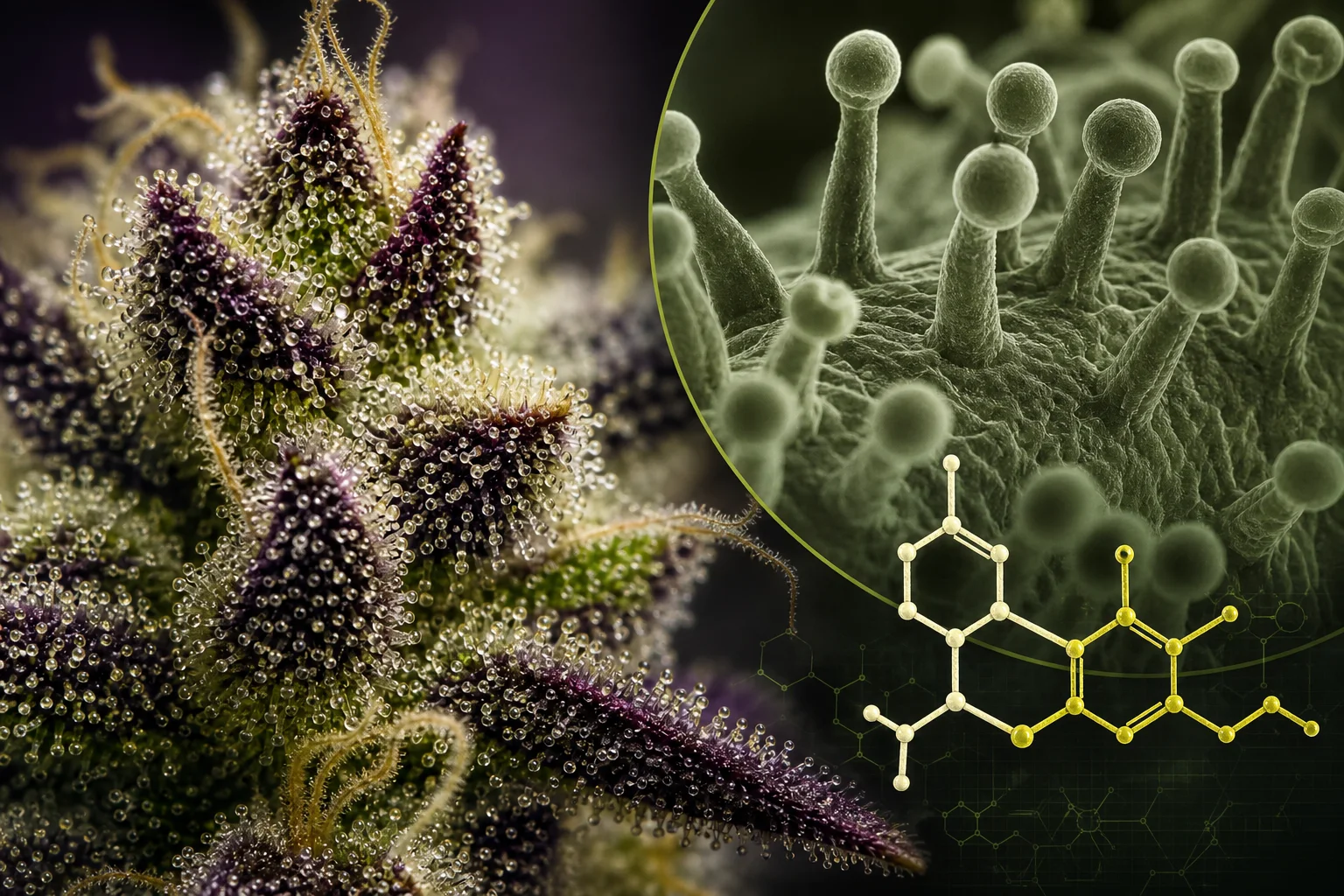
Macro-to-micro view: intact glandular trichomes on Cannabis inflorescence (macro) paired with cryo‑preserved microscopy to illustrate structure and fragility.
Mainezilla original editorial visual · AI-assisted art directionWhy trichome handling matters: scope and limits
Glandular trichomes—especially the capitate stalked glands that coat mature Cannabis inflorescences—are the biochemical factories that house cannabinoids, terpenes, and related metabolites. They are small, mechanically delicate, and chemically active; what happens to them immediately after harvest affects both the amount of material physically retained on the plant and the chemical composition that analytical labs will measure days or weeks later. Understanding the intersection of plant structure, physical stress, and chemistry is essential for growers, researchers, and regulators alike. ([maine.gov](https://www.maine.gov/dafs/ocp/sites/maine.gov.dafs.ocp/files/2023-08/Maine%20Cannabis%20101.pdf))
This article synthesizes primary studies on trichome ultrastructure, peer‑reviewed experiments on postharvest drying and storage, and standards work around measurement and reference materials, then translates those findings into practical handling guidance. It also explains why visual cues—specifically visible 'frost' or glitter on buds—are unreliable as proof of potency and why documented lab methods and controls matter. ([nist.gov](https://www.nist.gov/news-events/news/2024/07/nists-new-hemp-reference-material-will-help-ensure-accurate-cannabis))
A note about limits: the literature includes controlled lab studies on cannabinoid and terpene stability, microscopy papers that explore trichome architecture with different fixation methods, and interlaboratory work on reference materials and analytic precision. But controlled clinical outcomes about effects and subjective potency are outside this piece’s scope; here we focus on plant biology, postharvest chemistry, measurement science, and record interpretation. ([pubmed.ncbi.nlm.nih.gov](https://pubmed.ncbi.nlm.nih.gov/36542368/))
Anatomy and physical fragility of glandular trichomes
Glandular trichomes on Cannabis have a multicellular substructure (stalk, stipe/disc cells, and a secretory cavity or surface resin head) that is rich in lipids and volatile metabolites. Electron and advanced optical microscopy reveal that the resin sits in a small dome that is attached to the plant by a thin stalk; that geometry explains both the biological function (sequestration of secondary metabolites) and the mechanical vulnerability. ([pubmed.ncbi.nlm.nih.gov](https://pubmed.ncbi.nlm.nih.gov/36542368/))
Microscopic preparation techniques matter for what researchers observe: chemically fixed samples historically suggested certain intracellular distributions, but cryofixation and modern methods show different ultrastructural detail and preserve lipid‑rich secretions more faithfully. From a handling perspective, those findings are a reminder that trichome structures can be altered by heat, solvents, or physical compression, and that observation method influences interpretation. ([pubmed.ncbi.nlm.nih.gov](https://pubmed.ncbi.nlm.nih.gov/36542368/))
Mechanically, trichomes can shear off when plant material rubs together, when vibrational energy is high, or during rough trimming and transport. Because the physical head that contains resin is small and often tenuously attached, even modest agitation transfers resin to other surfaces (trichomes, container walls, sieves) or losses as fine particulate. These transfers are physical loss events—not chemical transformations—though transferred resin may later oxidize or volatilize depending on storage. ([pubmed.ncbi.nlm.nih.gov](https://pubmed.ncbi.nlm.nih.gov/36542368/))
Evidence trail: [2]
Temperature, drying, and chemical fate of cannabinoids and terpenes
Temperature is one of the strongest drivers of chemical change after harvest. Multiple controlled studies show that higher storage and drying temperatures accelerate cannabinoid degradation (for example, conversion of Δ9‑THC to other species and loss through volatilization) and greater terpene loss, while lower temperatures generally slow those processes. Optimal conditions reported across experiments favor cool, dark, and moderately dry conditions to maximize chemical retention. ([pubmed.ncbi.nlm.nih.gov](https://pubmed.ncbi.nlm.nih.gov/33420535/))
Drying and curing are not merely steps to remove moisture; they’re active chemical regimes. Recent experimental comparisons of hot‑air drying, ambient curing, and jar curing show differences in final cannabinoid profiles and microbial counts: rapid hot‑air drying can lower microbial load but may change terpene profiles and cannabinoid concentrations differently than slow ambient drying and jar curing. The balance between microbial safety and chemical preservation is therefore a management decision informed by both microbiology and chemistry. ([pubmed.ncbi.nlm.nih.gov](https://pubmed.ncbi.nlm.nih.gov/39942976/))
Storage temperature after drying is also decisive. Longitudinal metabolic profiling of whole inflorescences and extracts demonstrates that room temperature storage (e.g., ~25 °C) produces the largest changes in phytocannabinoid composition over time compared with refrigerated or frozen conditions. For many growers and labs, refrigeration (and, when feasible for long‑term storage, freezing) reduces the rate of loss for volatile terpenes and labile cannabinoids. ([pubmed.ncbi.nlm.nih.gov](https://pubmed.ncbi.nlm.nih.gov/33178249/))
Agitation, processing, and mechanical separations: what is lost and what is collected
Agitation—movement of plant material against itself, across trimming blades, into collection bins, or through sieves—causes two distinct outcomes: (1) whole trichome detachment (physical loss of the glandular head) and (2) breakup of heads into sub‑micron or micron fragments (particulate resin). Both outcomes change what remains on the flower and what becomes collectable as kief, hash, or homogenized extract. The same physical processes that create collectable resin also increase surface area and thus subsequent exposure to oxygen and heat. ([pubmed.ncbi.nlm.nih.gov](https://pubmed.ncbi.nlm.nih.gov/39942976/))
Mechanical separation techniques—dry sieving, ice-water separation, tumbling, and solvent extraction—are optimized to trade off yield, particle size, and contamination. Dry sifting tends to collect intact heads plus broken fragments; sieves and mesh size selection determine how much intact gland material passes vs. how much is retained. That matters because whole heads retain some of the internal architecture, while fragmented resin presents greater surface area and is more prone to chemical change. Experimental work on postharvest processing underscores that method selection should match the intent: preserving intact structures for microscopy or slow‑release formulations, or producing fine particulate feedstock for extraction. ([pubmed.ncbi.nlm.nih.gov](https://pubmed.ncbi.nlm.nih.gov/33178249/))
From a practical margin‑of‑error standpoint, any transfer process that increases agitation will increase short‑term yield of collectable resin but also tends to accelerate downstream loss of volatile terpenes and oxidation of cannabinoids unless immediately cooled, shielded from oxygen, or stored under controlled conditions. Recognize agitation as both an opportunity to recover material and a risk to chemical fidelity. ([pubmed.ncbi.nlm.nih.gov](https://pubmed.ncbi.nlm.nih.gov/33178249/))
Microscopy and documenting trichome condition: methods that preserve meaning
Imaging trichomes is not neutral: how you fix and prepare samples changes what you see. Recent microscopy work shows that chemical fixation can produce artefacts in lipid‑rich secretory tissues, whereas cryofixation preserves the resin and subcellular relationships more faithfully. If your goal is to document the presence, intactness, or ultrastructure of glandular trichomes, choose preservation and imaging methods that reflect that goal and note method‑dependent limitations in your records. ([pubmed.ncbi.nlm.nih.gov](https://pubmed.ncbi.nlm.nih.gov/36542368/))
For practical documentation, pair macro photography with a small set of calibrated microscopic images (stereo or compound at 20–100× for overall gland density; SEM or cryo‑SEM for surface detail when available). Record magnification, lighting, any fixation or dehydration steps, and time elapsed since harvest—those metadata are essential for comparing images over time or between batches. The literature supporting cryo‑methods argues strongly for noting whether images were chemically fixed or cryopreserved because interpretive differences are meaningful. ([pubmed.ncbi.nlm.nih.gov](https://pubmed.ncbi.nlm.nih.gov/36542368/))
Finally, keep a reproducible image log: file names with timestamps, sample IDs, and basic environmental records (temperature, humidity). When microscopy is used to support claims (for example, about intactness at harvest vs. after processing), include the method in any report so a reader can weigh what the images actually demonstrate. Microscopy can show form and damage—but alone it does not quantify total chemical content. ([pubmed.ncbi.nlm.nih.gov](https://pubmed.ncbi.nlm.nih.gov/36542368/))
Evidence trail: [2]
Resin collection approaches and their analytical implications
Whether you collect dry sift, bubble hash, or solvent extracts, the physical state of collected resin affects analytical outcomes. Whole heads will present a different extractability profile than finely pulverized material because glandular architecture and attached plant matrix change solvent access and matrix effects in chromatography. Studies that compare whole inflorescence chemistry to extracts or ground material emphasize that sample preparation is a major source of measurement variance. ([pubmed.ncbi.nlm.nih.gov](https://pubmed.ncbi.nlm.nih.gov/33178249/))
NIST’s work creating a homogenized hemp plant reference material (ground and sieved to consistent particle size) underlines why standardization matters: laboratories analyzing different sample types—whole heads, ground flower, or mixed extracts—can legitimately get different results unless methods and reference materials are harmonized. Reference materials help labs calibrate methods and quantify uncertainty, but they do not change the underlying biological variability in trichome number or head integrity. ([nist.gov](https://www.nist.gov/news-events/news/2024/07/nists-new-hemp-reference-material-will-help-ensure-accurate-cannabis))
For handlers: if your goal is to maximize preserved profile (e.g., retain volatile terpenes and labile cannabinoids), favor gentler separation and immediate low‑temperature storage. If your goal is reproducible analytical input for high‑throughput labs, standardize particle size and document homogenization steps so analytical uncertainty can be understood relative to reference materials. ([nist.gov](https://www.nist.gov/news-events/news/2024/07/nists-new-hemp-reference-material-will-help-ensure-accurate-cannabis))
Analytical measurement, records, and why visible 'frost' isn’t a certificate
A visual surface of crystalline or resinous 'frost' can indicate abundant trichomes or redistributed resin—but it does not quantify cannabinoids, terpenes, or safety. The only way to know concentrations and to compare batches meaningfully is through laboratory measurement using validated methods, reference materials, and quality assurance. NIST’s hemp reference material and lab QA programs exist precisely because visual appearance cannot substitute for analytic rigor. ([nist.gov](https://www.nist.gov/news-events/news/2024/07/nists-new-hemp-reference-material-will-help-ensure-accurate-cannabis))
Read lab certificates critically: ask which matrix was tested (whole flower, ground flower, extract), which methods were used (GC, LC, detector type), whether the lab participated in proficiency testing, and whether the lab used reference materials or reported measurement uncertainty. Without those method details and QA context, a percentage or concentration on a sheet is incomplete information. Maine’s Office of Cannabis Policy publishes program rules and resources for regulated testing that provide useful baseline expectations for how certificates should be documented and retained. ([nist.gov](https://www.nist.gov/programs-projects/nist-tools-cannabis-laboratory-quality-assurance))
In short: visual cues can guide immediate handling decisions (e.g., take extra care with a bud that appears heavily glandular), but they are not evidence of potency, safety, or precise composition. For that, rely on documented analytical methods, traceable reference materials, and transparent reporting of uncertainty. ([nist.gov](https://www.nist.gov/news-events/news/2024/07/nists-new-hemp-reference-material-will-help-ensure-accurate-cannabis))
- Visible resin ≠ quantitative measurement.
- Ask for method details, reference materials, and uncertainty on lab reports.
- Regulatory program resources (such as Maine OCP) help set expectations for testing transparency.
Practical post‑harvest workflow: gentle, cool, documented
A practical workflow minimizes mechanical loss and chemical change while producing material suitable for the intended downstream use (storage, analytical testing, processing). Key controls are: limit agitation between harvest and drying; keep temperatures low during any transfer; and choose a drying regime that balances microbial control with chemical preservation. Several experimental studies demonstrate the tradeoffs between rapid hot‑air drying (microbial reduction) and slower curing (better terpene retention), so adopt a protocol that records condition and outcome. ([pubmed.ncbi.nlm.nih.gov](https://pubmed.ncbi.nlm.nih.gov/39942976/))
Suggested handling steps grounded in published evidence: (1) harvest into low‑agitation containers, avoiding tumbling; (2) cool material as soon as reasonable (ambient to refrigerated, depending on logistics); (3) if hot‑air drying is used, document temperature and duration and recognize the likely shifts in terpene composition; (4) once dried to safe moisture, consider jar curing at controlled RH to stabilize profile; (5) when milling or sieving for lab samples, standardize particle size and document the process. Each step should be logged so that later analytical or quality questions can be traced to handling conditions. ([pubmed.ncbi.nlm.nih.gov](https://pubmed.ncbi.nlm.nih.gov/39942976/))
When transporting samples to a testing lab, use sealed, inert containers, minimize headspace where feasible, include a chain‑of‑custody form, and—if available—use chilled transport to slow volatile loss. These steps do not guarantee chemical fidelity, but they reduce known mechanisms of postharvest change and improve the interpretability of later lab results. ([nist.gov](https://www.nist.gov/news-events/news/2024/07/nists-new-hemp-reference-material-will-help-ensure-accurate-cannabis))
- Limit agitation and avoid tumbling after harvest.
- Cool quickly if possible; avoid prolonged exposure at ~25 °C.
- Standardize and document sample preparation for labs.
What remains uncertain and how to approach claims
The literature gives strong, reproducible signals about temperature, agitation, and method‑dependent imaging, but several areas remain uncertain. First, inter‑genotype differences in trichome attachment strength and resin chemistry mean that general rules (cool and gentle is better) do not perfectly predict outcomes for every cultivar. Controlled comparative studies across many commercial genotypes are still sparse. ([pmc.ncbi.nlm.nih.gov](https://pmc.ncbi.nlm.nih.gov/articles/PMC10071647/))
Second, there are open questions about the micro‑kinetics of terpene loss from intact heads versus fractured resin particles under realistic storage atmospheres; some kinetic modelling exists for dried cannabis, but connecting that to particulate state and real world supply‑chain fluctuations requires more work. That uncertainty is why the literature emphasizes reporting uncertainty and method detail rather than issuing single‑number claims without context. ([pubmed.ncbi.nlm.nih.gov](https://pubmed.ncbi.nlm.nih.gov/33420535/))
Finally, while reference materials and NIST interlaboratory efforts are rapidly improving analytic comparability, routine use of commutable reference standards for whole‑flower analyses is still an evolving practice. Expect improvements over time; in the meantime, treat single lab results as informative but incomplete unless accompanied by method details, uncertainty, and QA evidence. ([nist.gov](https://www.nist.gov/news-events/news/2024/07/nists-new-hemp-reference-material-will-help-ensure-accurate-cannabis))
Questions this guide answers
Is the visible 'frost' on buds a reliable indicator of potency?
No. Visible surface resin reflects gland density or redistributed resin but does not quantify cannabinoid or terpene concentrations. Only laboratory measurement using documented methods and appropriate reference materials can provide quantitative claims about chemical content; visual inspection is useful for handling decisions but not certification. ([nist.gov](https://www.nist.gov/news-events/news/2024/07/nists-new-hemp-reference-material-will-help-ensure-accurate-cannabis))
How does drying temperature affect terpenes and cannabinoids?
Higher drying and storage temperatures generally accelerate loss of volatile terpenes and can alter cannabinoid composition over time. Studies comparing hot‑air drying, ambient drying, and curing report different impacts on both chemical profiles and microbial loads; tradeoffs should be documented and chosen to match safety and quality goals. ([pubmed.ncbi.nlm.nih.gov](https://pubmed.ncbi.nlm.nih.gov/39942976/))
Why do different labs sometimes report different cannabinoid numbers for the same batch?
Differences arise from sample type (whole flower vs. ground sample vs. extract), preparation methods, analytical technique (LC vs. GC, detector choice), calibration, and whether the lab used reference materials or participated in proficiency testing. NIST reference materials and QA programs aim to reduce these differences by providing standards and interlaboratory comparisons. ([nist.gov](https://www.nist.gov/news-events/news/2024/07/nists-new-hemp-reference-material-will-help-ensure-accurate-cannabis))
Can microscopy be used as evidence of trichome loss after transport?
Yes—microscopy can document changes in trichome abundance and intactness—but image interpretation depends on fixation and imaging method. Cryopreservation preserves lipid‑rich secretions better than many chemical fixation methods, so include method metadata when using images as evidence. Microscopy does not replace chemical quantification. ([pubmed.ncbi.nlm.nih.gov](https://pubmed.ncbi.nlm.nih.gov/36542368/))
What should be included on a laboratory report to make it trustworthy?
A trustworthy report lists the tested matrix (whole flower, ground, extract), analytical method and instrument, calibration details or reference materials used, measurement uncertainty, and evidence of QA or proficiency testing. Regulatory program resources (for example, those published by Maine OCP) provide useful baselines for what programs expect labs to report. ([nist.gov](https://www.nist.gov/programs-projects/nist-tools-cannabis-laboratory-quality-assurance))
Educational information only. This guide is not medical or legal advice and does not recommend a product, dose, treatment, or outcome.