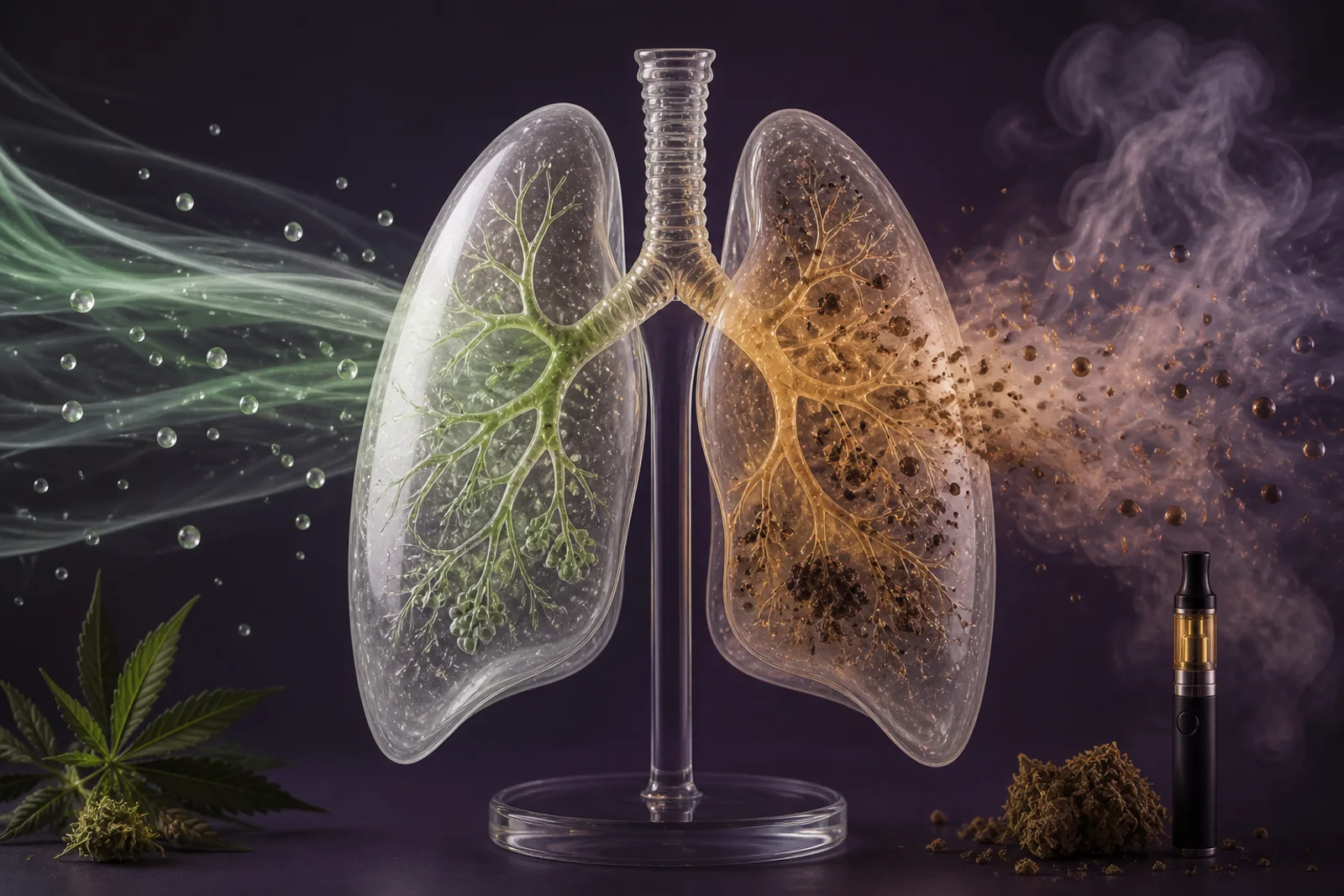
The lung model and separated exposure paths keep the focus on inhalation context, uncertainty, and respiratory risk—not lifestyle imagery.
Mainezilla original editorial visual · AI-assisted art directionWhy this field guide — a quick orientation
If you grow, medicate, or counsel people about cannabis in Maine, inhalation is a common question and a complex one. This guide strips back the jargon: it explains, in plain evidence-first language, how smoke and vapor differ, what inhalation actually exposes lungs to, and where we still don’t have clean answers.
We wrote this for people who want practical clarity without cheerleading. That means acknowledging two things the record supports: smoked cannabis exposes lung tissue to combustion byproducts, and ‘vaping’ or aerosolizing cannabis removes combustion but introduces a different set of chemical and device-related uncertainties. Both are worth respectful caution. (Key public health summaries and systematic reviews make these points clearly.)
This is not medical advice. It’s a field guide — organized so growers can explain risks to customers, clinicians can ask the right questions, and patients can bring accurate details into clinical conversations. Where the science is unsettled, we’ll say so and point to primary sources.
- Primary keyword: cannabis smoke
- Audience: growers, patients, clinicians in Maine
- Approach: evidence-first, practical, uncertainty-preserving
Combustion creates exposure — what burning a plant actually does
When you burn plant material, you produce smoke: a hot, complex mixture of gases, particles, and condensed chemicals. That mix includes irritants (like formaldehyde and acrolein), particulate matter, and other thermal breakdown products found in any combusted biomass. Public health reviews link smoked cannabis to lung-tissue irritation and bronchitic symptoms (cough, increased sputum, wheeze), independent of how the joint or pipe is built.
A water pipe, bong, or a different rolling method does not make combustion risk vanish. The water may cool and remove some particles, but it doesn’t selectively remove the full suite of chemical irritants or the ultrafine particles that reach deep into small airways. The Centers for Disease Control and Prevention (CDC) summarizes that smoked cannabis can harm lung tissue and is associated with bronchitis-like outcomes.
Epidemiology on long-term outcomes (for example, lung cancer) is more mixed and confounded by tobacco use and study design. Some systematic reviews find weak or inconsistent associations for certain long-term outcomes; others report clear links to chronic respiratory symptoms. That uncertainty should not be read as a clean bill of safety — it means the question of particular chronic outcomes is complex and influenced by dose, pattern, and co-exposures.
- Smoke contains combustion products (carbonyls, VOCs, particulates).
- Short-term effects: cough, mucus, bronchitic symptoms.
- Long-term disease links are incompletely settled and confounded.
Vapor and aerosols — different chemistry, different cautions
Devices that heat flower, distillates, or carrier liquids to make an aerosol do not combust the plant in the same way as an open flame. But ‘no flame’ is not ‘no chemistry.’ Heating solvents, carrier humectants, and additives produces aerosols that contain the original active compounds plus thermal degradation products and any impurities that were present in the material or device.
The usual solvent carriers—propylene glycol (PG) and vegetable glycerin (VG)—are generally recognized as safe for ingestion, but inhalation is a different exposure route. When heated they can generate carbonyl compounds (formaldehyde, acetaldehyde, acrolein) and reactive intermediates; particle-size distributions also differ from smoke and can reach deep lung regions. Lab and toxicology literature show aerosol chemistry is highly sensitive to formulation, coil temperature, device power, and even the PG:VG ratio.
In short: vapor changes the exposure profile; it reduces combustion products but introduces other possible toxicants. The clinical bottom line is honest: aerosolized cannabis is not the same as harmless air, and safety depends on what you started with (concentrate or flower), the formulation, and how the device is built and used.
- PG/VG can form reactive carbonyls under heat.
- Aerosol particle size and chemistry vary with device settings and formulations.
- Vapor reduces some combustion exposures but creates new, formulation-dependent ones.
Devices and cartridges — where engineering meets chemistry
Aerosol chemistry is partly a function of the device. Coil materials, solder, and wicking materials can shed metals (chromium, nickel, lead) or particulates when heated; atomizer design and power determine the temperature reached and therefore which thermal byproducts form. Laboratory studies of electronic delivery systems repeatedly show that device design and operating conditions change emissions dramatically.
Aftermarket or modified cartridges—those altered from the original device specifications—can increase power delivery and temperature and thus increase harmful thermal degradation byproducts. Similarly, counterfeit or tampered cartridges may contain nonstandard materials or thinning agents that were never intended for inhalation.
From a grower or retailer perspective, this is a product-integrity issue as much as a chemistry issue: knowing the manufacturing chain, claiming tested contents only when reliable certificates exist, and avoiding unknown informal sources are practical steps that materially change risk. State oversight and product testing (where present) reduce—but do not eliminate—uncertainty.
- Device materials can add metals and particulates to aerosols.
- Aftermarket modification raises temperature and toxicant formation.
- Supply-chain testing and intact device design lower, but don’t erase, risk.
Adulterants, EVALI, and lessons from the outbreak
The 2019–2020 EVALI (e-cigarette or vaping product use–associated lung injury) outbreak showed how adulterants and informal supply chains create acute, severe risk. Investigations implicated lipid-like diluents—most prominently vitamin E acetate—found in bronchoalveolar lavage samples from many affected people. Public health agencies (FDA, CDC) concluded that some THC-containing products from informal sources were associated with hospitalizations and deaths.
That outbreak is a clear, real-world example of three general points: first, inhaled additives that are safe by other routes (topical or oral) are not automatically safe to heat and inhale; second, informal or unregulated supply chains greatly increase the chance of harmful contaminants or inappropriate diluents; third, surveillance and careful product testing can identify problem batches and trigger recalls.
In Maine, the Office of Cannabis Policy has used targeted recalls and guidance to remove suspect products from the regulated market. Still, a recall does not change the underlying toxicology: inhalation safety is contingent on formulation chemistry and device compatibility, and when either is altered or unknown, risk rises.
- EVALI was linked to inhaled lipid additives (e.g., vitamin E acetate) in some THC products.
- Informal markets and untested cartridges are higher-risk.
- Regulatory recalls help but do not eliminate all inhalation hazards.
Bringing route into the clinical conversation
If you or someone you care for uses inhaled cannabis and has respiratory symptoms, heart disease, pregnancy, or other risk factors, the route matters for clinical discussion. Clinicians should ask specifically about route (smoke, vape, dab), frequency, product source (regulated Maine dispensary vs informal source), and any recent changes (new device, new cartridge, or new concentrate). Specifics matter for risk assessment and for tracing potential product-related harms.
People should describe what they used as concretely as possible: ‘regulated Maine cartridge, brand X, batch number Y’ or ‘informal cartridge bought from a friend’ are materially different pieces of information. Clinicians and public health responders rely on these details when investigating clusters of respiratory illness or identifying contaminated batches.
We are blunt about limits: absence of immediate symptoms is not proof of long-term safety, and no route is risk-free. That said, being specific—about route, frequency, product labeling, and device type—gives clinicians and regulators the best chance to interpret symptoms, identify possible chemical exposures, and recommend appropriate next steps such as monitoring or referral.
- Clinicians should ask: route, frequency, product source, device details.
- Provide batch or label info when possible; it matters.
- No inhaled format should be described as universally 'safe.'
Practical takeaways for growers, retailers, and patients
For growers and retailers: test and document. ‘Trusted brand image’ is not a substitute for a recent certificate of analysis done by a reputable lab and for clear labeling of batch numbers. If you sell aerosolizable products, verify device compatibility and avoid recommending or supplying modified carts or unknown diluents.
For people who use cannabis: if you inhale, be precise in clinical conversations and avoid unregulated cartridges or unknown offline sources. If you notice new or persistent respiratory symptoms—cough, shortness of breath, chest pain—seek clinical evaluation and report product details to the state office or poison control, so public health authorities can act if needed.
For clinicians and counselors: ask the route and the details before making risk judgments. When the record is uncertain, favor conservative language (e.g., ‘inhalation carries possible respiratory harms dependent on formulation and device’) and document product details. Encourage safer supply chains and tested products in Maine’s regulated market when inhalation is chosen.
- Do not trust aesthetic branding over certificates and batch testing.
- Avoid informal cartridges and unknown diluents; they were implicated in EVALI.
- If symptoms occur after vaping, report and seek care; product details help public health.
Questions this guide answers
Is vaping cannabis safer than smoking it?
‘Safer’ depends on what you mean. Vaping removes many combustion products but can introduce thermal degradation products and device-related contaminants. The evidence shows different exposure profiles — fewer combustion chemicals but other aerosolized toxicants — so neither route is risk-free.
Should I trust a branded cartridge I bought online?
Branding alone is not proof of safety. Certificates of analysis from accredited labs, batch numbers, and legitimate supply chains are the meaningful signals. Avoid cartridges from informal or unregulated sources.
What should I tell my clinician about my inhalation habits?
Be specific: say whether you smoke, vape, or dab; how often; where you bought the product; brand and batch numbers if available; and whether you changed devices or cartridges recently.
Did vitamin E acetate cause EVALI?
Investigations found vitamin E acetate in lung samples from many EVALI patients and it’s strongly implicated as a cause in several cases, but EVALI illustrated that multiple adulterants and supply-chain issues can cause acute harm. The clear lesson is: avoid unregulated, informal THC cartridges and unknown diluents.
As a grower, what can I do to reduce inhalation risk for customers?
Support tested supply chains: keep accurate harvest and processing records, use reputable extraction and formulation partners, demand certificates of analysis, and avoid recommending or supplying products that require aftermarket modification of devices.
Educational information only. This guide is not medical or legal advice and does not recommend a product, dose, treatment, or outcome.